



Question: A protective collar involves buying an out-of-the-money put and writing an out-of-the-money call on an underlying asset that you own. Let's say you own
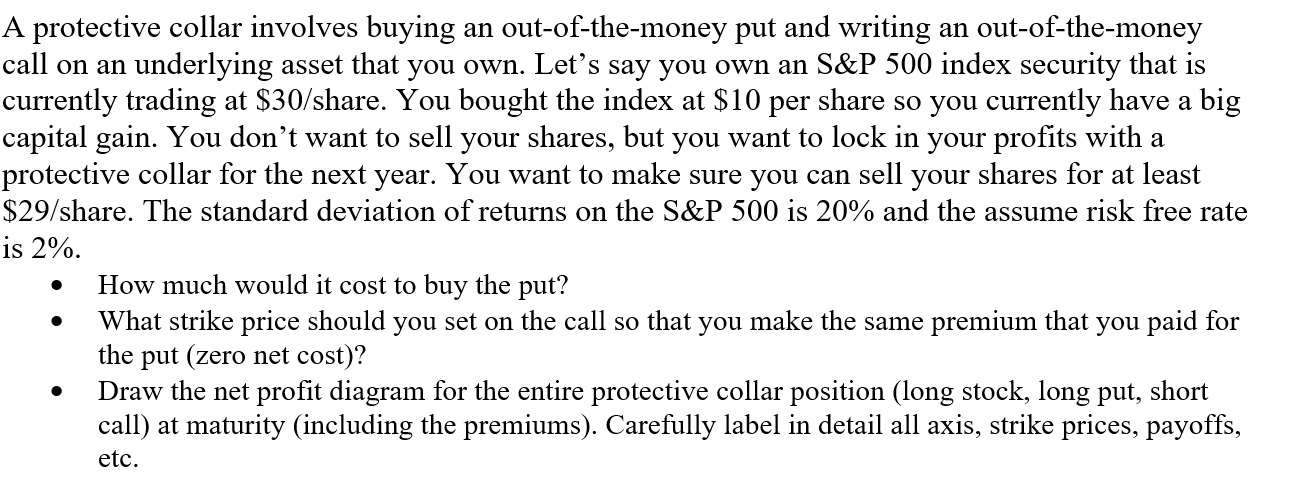
A protective collar involves buying an out-of-the-money put and writing an out-of-the-money call on an underlying asset that you own. Let's say you own an S&P 500 index security that is currently trading at $30/share. You bought the index at $10 per share so you currently have a big capital gain. You don't want to sell your shares, but you want to lock in your profits with a protective collar for the next year. You want to make sure you can sell your shares for at least $29/share. The standard deviation of returns on the S&P 500 is 20% and the assume risk free rate is 2%. How much would it cost to buy the put? What strike price should you set on the call so that you make the same premium that you paid for the put (zero net cost)? Draw the net profit diagram for the entire protective collar position (long stock, long put, short call) at maturity (including the premiums). Carefully label in detail all axis, strike prices, payoffs, etc.
Step by Step Solution
There are 3 Steps involved in it
To solve this problem we need to use the BlackScholes option pricing model to calculate the cost of the put option Given information Current price of ... View full answer

Get step-by-step solutions from verified subject matter experts