







Question: (a) Prove that E reaches its smallest possible value at thermal equilibrium when S and V are fixed. (b) Prove that W reaches its smallest
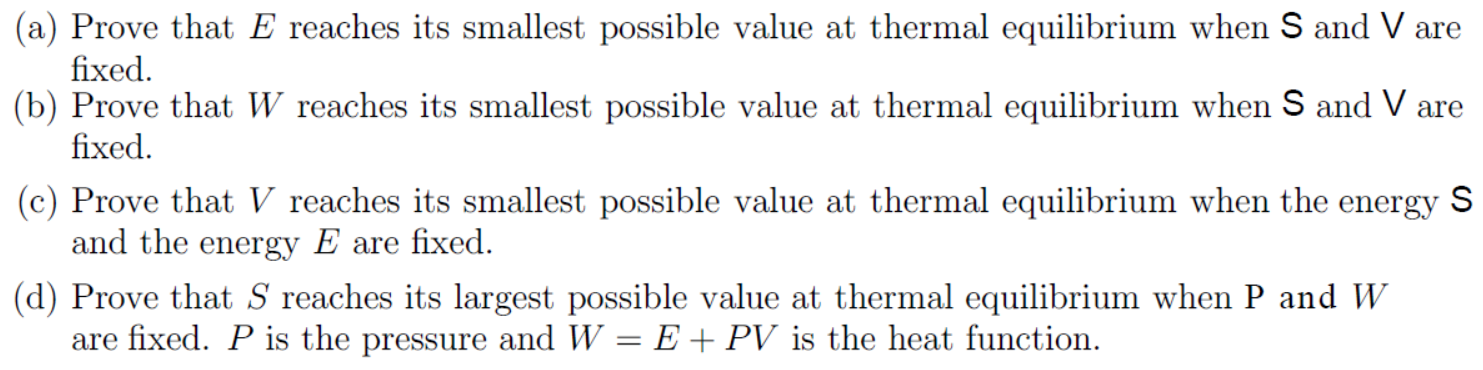
(a) Prove that E reaches its smallest possible value at thermal equilibrium when S and V are fixed. (b) Prove that W reaches its smallest possible value at thermal equilibrium when S and V are fixed. (c) Prove that V reaches its smallest possible value at thermal equilibrium when the energy S and the energy E are fixed. (d) Prove that S reaches its largest possible value at thermal equilibrium when P and W are fixed. P is the pressure and W = E + PV is the heat function
Step by Step Solution
There are 3 Steps involved in it
1 Expert Approved Answer
Step: 1 Unlock

Question Has Been Solved by an Expert!
Get step-by-step solutions from verified subject matter experts
Step: 2 Unlock
Step: 3 Unlock
 Study Help