







Question: (a) Prove, using the definition, that L{f(at)} = F() (a #0). (b) Prove, using the definition, that L{eat f(t)} = F(s-a). (c) Prove, using
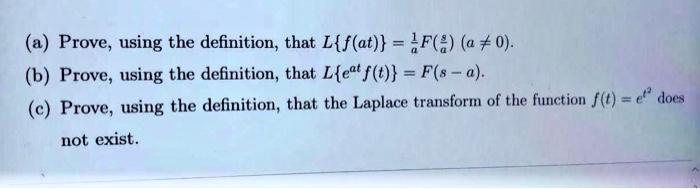
(a) Prove, using the definition, that L{f(at)} = F() (a #0). (b) Prove, using the definition, that L{eat f(t)} = F(s-a). (c) Prove, using the definition, that the Laplace transform of the function f(t)=e does not exist.
Step by Step Solution
There are 3 Steps involved in it
1 Expert Approved Answer
Step: 1 Unlock

To prove that fat F for a 0 we need to use the definition of the Laplace transform Lift Fs ft dt Let ... View full answer
Question Has Been Solved by an Expert!
Get step-by-step solutions from verified subject matter experts
Step: 2 Unlock
Step: 3 Unlock
 Study Help