


Question: a. Purchase Date Nov. 14..... Dec. 12..... Total available for sale at Dec. 31.. Quantity 8 20 28 Unit Cost $400 310 Total Cost $3,200
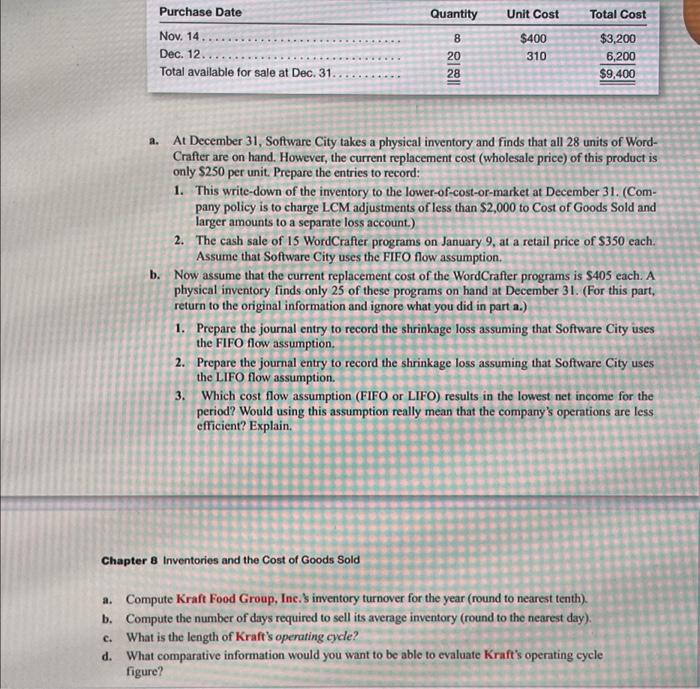
a. Purchase Date Nov. 14..... Dec. 12..... Total available for sale at Dec. 31.. Quantity 8 20 28 Unit Cost $400 310 Total Cost $3,200 6,200 $9,400 At December 31, Software City takes a physical inventory and finds that all 28 units of Word- Crafter are on hand. However, the current replacement cost (wholesale price) of this product is only $250 per unit. Prepare the entries to record: 1. This write-down of the inventory to the lower-of-cost-or-market at December 31. (Com- pany policy is to charge LCM adjustments of less than $2,000 to Cost of Goods Sold and larger amounts to a separate loss account.) 2. The cash sale of 15 WordCrafter programs on January 9, at a retail price of $350 each. Assume that Software City uses the FIFO flow assumption. Chapter 8 Inventories and the Cost of Goods Sold b. Now assume that the current replacement cost of the WordCrafter programs is $405 each. A physical inventory finds only 25 of these programs on hand at December 31. (For this part, return to the original information and ignore what you did in part a.) 1. Prepare the journal entry to record the shrinkage loss assuming that Software City uses the FIFO flow assumption. 2. Prepare the journal entry to record the shrinkage loss assuming that Software City uses the LIFO flow assumption. 3. Which cost flow assumption (FIFO or LIFO) results in the lowest net income for the period? Would using this assumption really mean that the company's operations are less efficient? Explain. b. a. Compute Kraft Food Group, Inc.'s inventory turnover for the year (round to nearest tenth). Compute the number of days required to sell its average inventory (round to the nearest day). What is the length of Kraft's operating cycle? C. d. What comparative information would you want to be able to evaluate Kraft's operating cycle figure?
 a. Purchase Date Nov. 14..... Dec. 12..... Total available for sale

a. At December 31 , Software City takes a physical inventory and finds that all 28 units of WordCrafter are on hand. However, the current replacement cost (wholesale price) of this product is only $250 per unit. Prepare the entries to record: 1. This write-down of the inventory to the lower-of-cost-or-market at December 31. (Company policy is to charge LCM adjustments of less than $2,000 to Cost of Goods Sold and larger amounts to a separate loss account.) 2. The cash sale of 15 WordCrafter programs on January 9, at a retail price of $350 each. Assume that Software City uses the FIFO flow assumption. b. Now assume that the current replacement cost of the WordCrafter programs is $405 each. A physical inventory finds only 25 of these programs on hand at December 31 . (For this part, return to the original information and ignore what you did in part a.) 1. Prepare the journal entry to record the shrinkage loss assuming that Software City uses the FIFO flow assumption. 2. Prepare the journal entry to record the shrinkage loss assuming that Software City uses the LIFO flow assumption. 3. Which cost flow assumption (FIFO or LIFO) results in the lowest net income for the period? Would using this assumption really mean that the company's operations are less efficient? Explain, Chapter 8 Inventories and the Cost of Goods Sold a. Compute Kraft Food Group, Inc.'s inventory turnover for the year (round to nearest tenth). b. Compute the number of days required to sell its average inventory (round to the nearest day). c. What is the length of Kraft's operating cycle? d. What comparative information would you want to be able to evaluate Kraft's operating cycle figure

Step by Step Solution

There are 3 Steps involved in it

1 Expert Approved Answer
Step: 1 Unlock blur-text-image
Question Has Been Solved by an Expert!

Get step-by-step solutions from verified subject matter experts

Step: 2 Unlock
Step: 3 Unlock

Students Have Also Explored These Related Accounting Questions!