



Question: (a) (Q1, , ,s,A1) is a DFA and N2(Q2, , 2,$2,A2) is an NFA. Formally Suppose M1 describe a DFA that accepts the language L
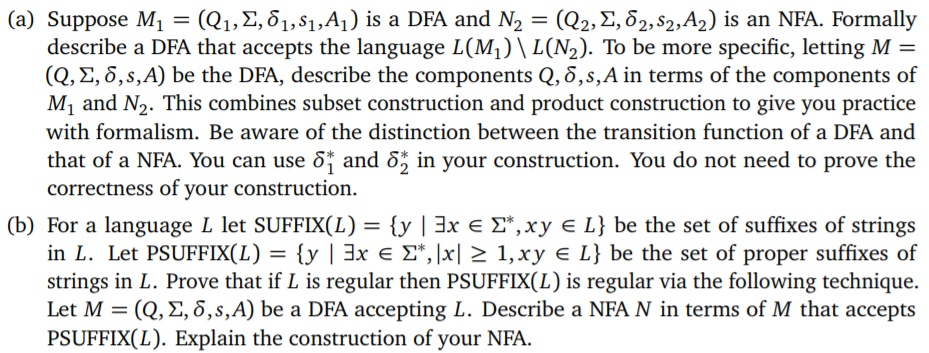
(a) (Q1, , ,s,A1) is a DFA and N2(Q2, , 2,$2,A2) is an NFA. Formally Suppose M1 describe a DFA that accepts the language L (M) \ L(N>). TO be more specific, letting M = (Q, ,5,s,A) be the DFA, describe the components Q,5,s,A in terms of the components of M1 and N2. This combines subset construction and product construction to give you practice with formalism. Be aware of the distinction between the transition function of a DFA and that of a NFA. You can use and in your construction. You do not need to prove the correctness of your construction (b) For a language L let SUFFIX(L) = {y | 3x E *, xy e L} be the set of suffixes of strings in L. Let PSUFFIX(L) = {y 3x E *,1x2 1, xy e L} be the set of proper suffixes of strings in L. Prove that if L is regular then PSUFFIX(L) is regular via the following technique. Let M (Q,2, 6,s,A) be a DFA accepting L. Describe a NFA N in terms of M that accepts PSUFFIX(L). Explain the construction of your NFA. (a) (Q1, , ,s,A1) is a DFA and N2(Q2, , 2,$2,A2) is an NFA. Formally Suppose M1 describe a DFA that accepts the language L (M) \ L(N>). TO be more specific, letting M = (Q, ,5,s,A) be the DFA, describe the components Q,5,s,A in terms of the components of M1 and N2. This combines subset construction and product construction to give you practice with formalism. Be aware of the distinction between the transition function of a DFA and that of a NFA. You can use and in your construction. You do not need to prove the correctness of your construction (b) For a language L let SUFFIX(L) = {y | 3x E *, xy e L} be the set of suffixes of strings in L. Let PSUFFIX(L) = {y 3x E *,1x2 1, xy e L} be the set of proper suffixes of strings in L. Prove that if L is regular then PSUFFIX(L) is regular via the following technique. Let M (Q,2, 6,s,A) be a DFA accepting L. Describe a NFA N in terms of M that accepts PSUFFIX(L). Explain the construction of your NFA
Step by Step Solution
There are 3 Steps involved in it

Get step-by-step solutions from verified subject matter experts