







Question: A Qnlu sonia - Search https://childmyths.blogspot.com/2012/07/attachment-and-day-care-part-1.html Sonia - Winter 2024 ECE 342: Cul X A Discussions List - ECE-342-0 B CHILDMYTHS: Attachment and D
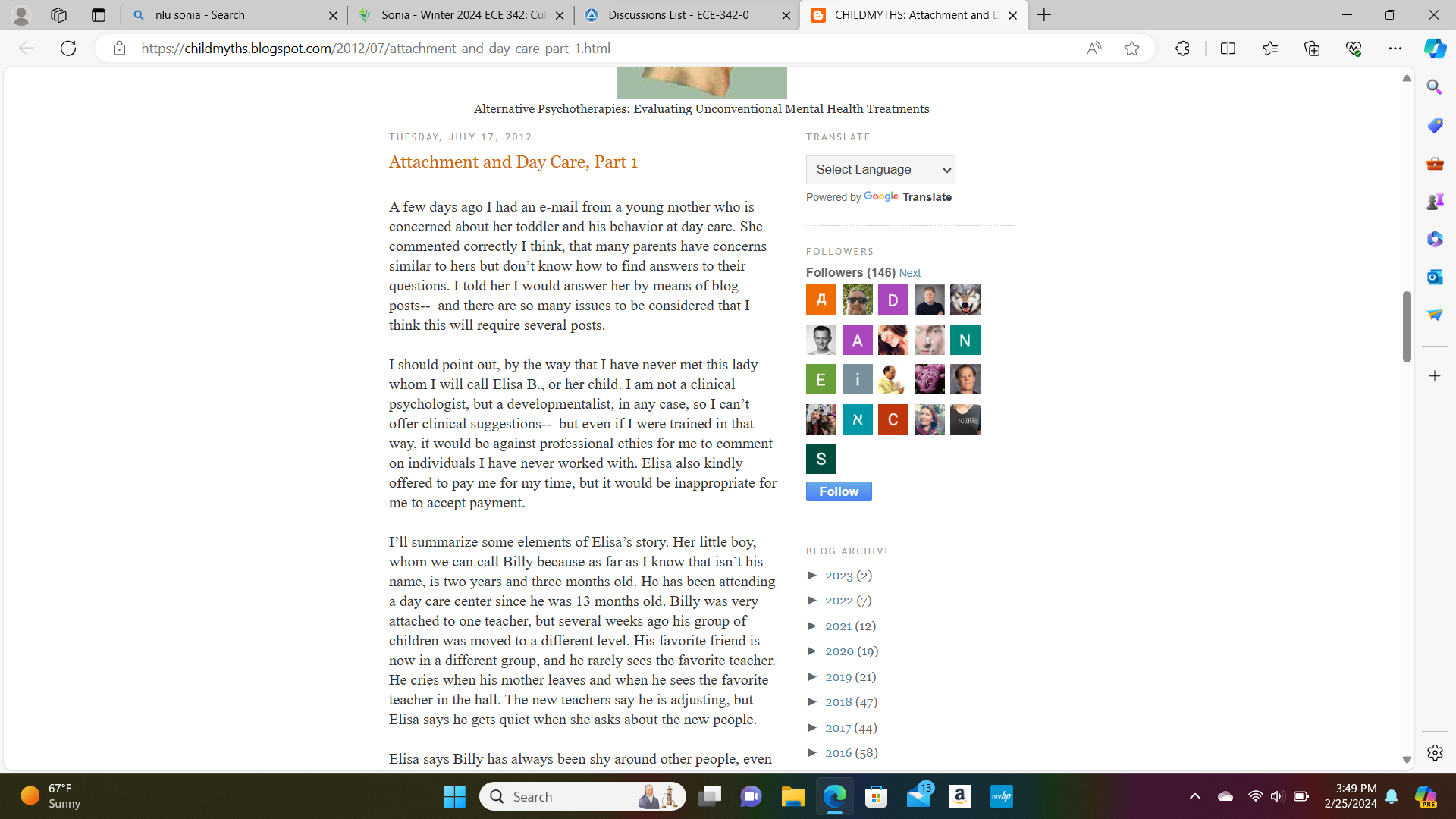
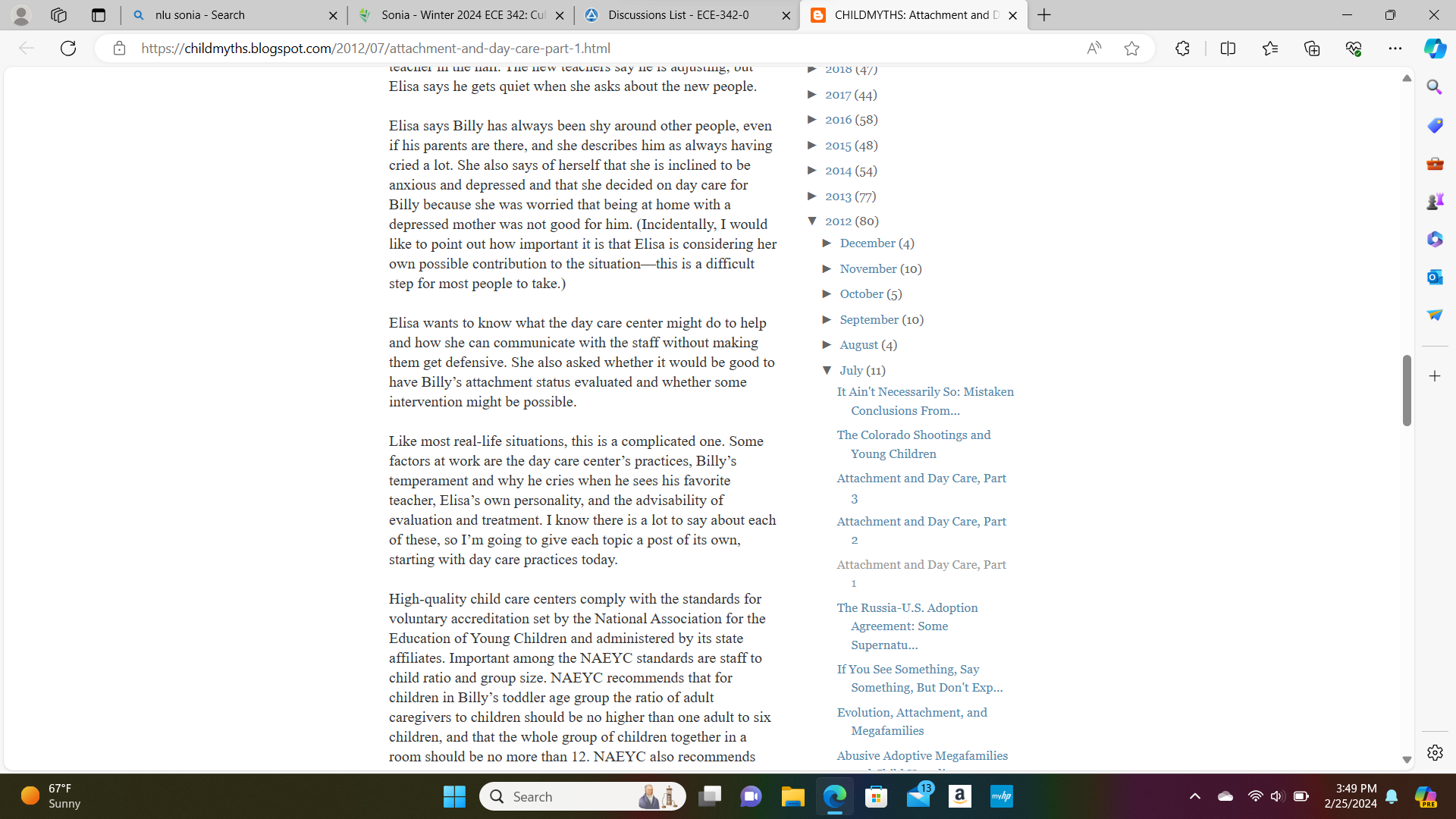
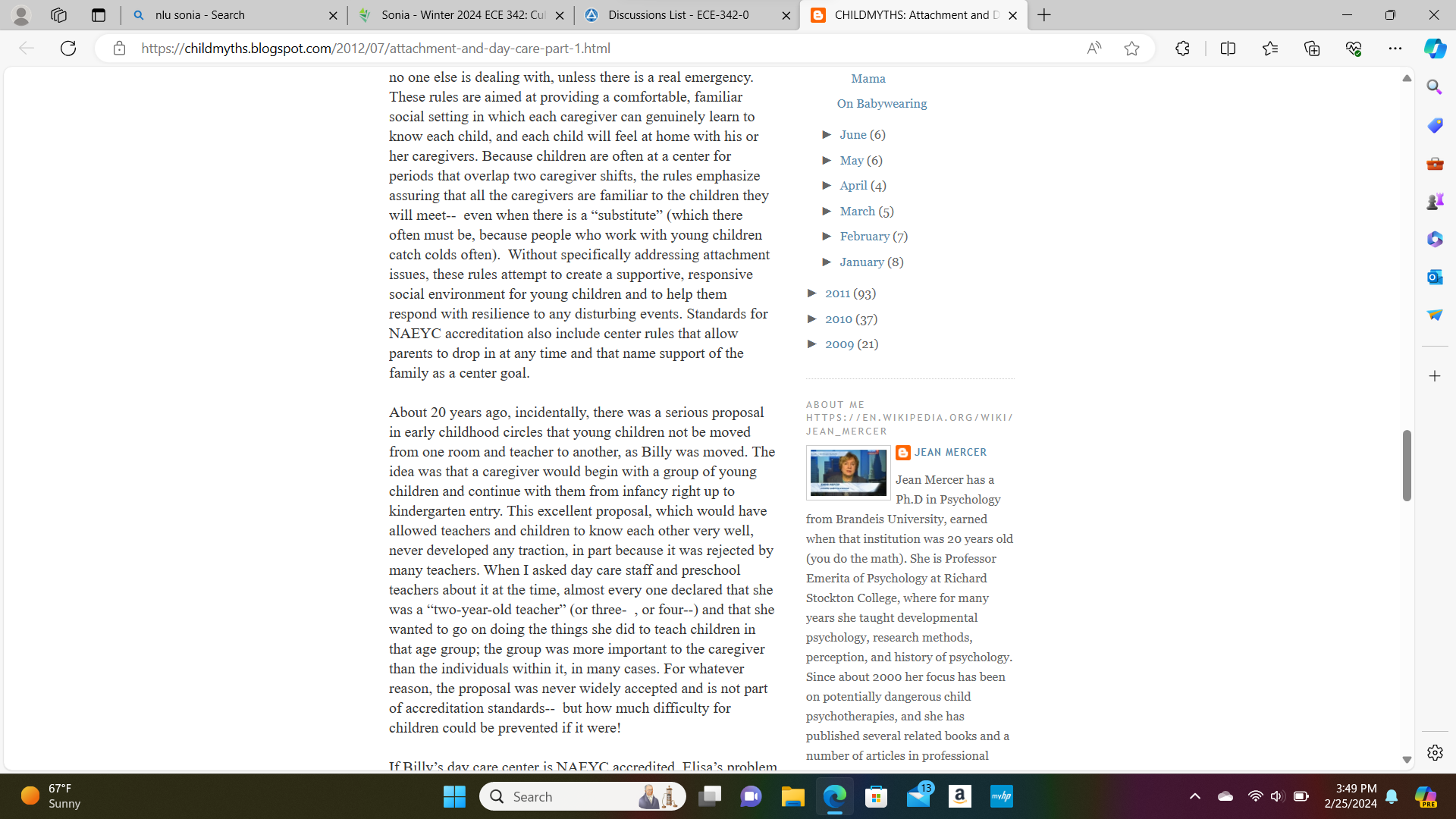
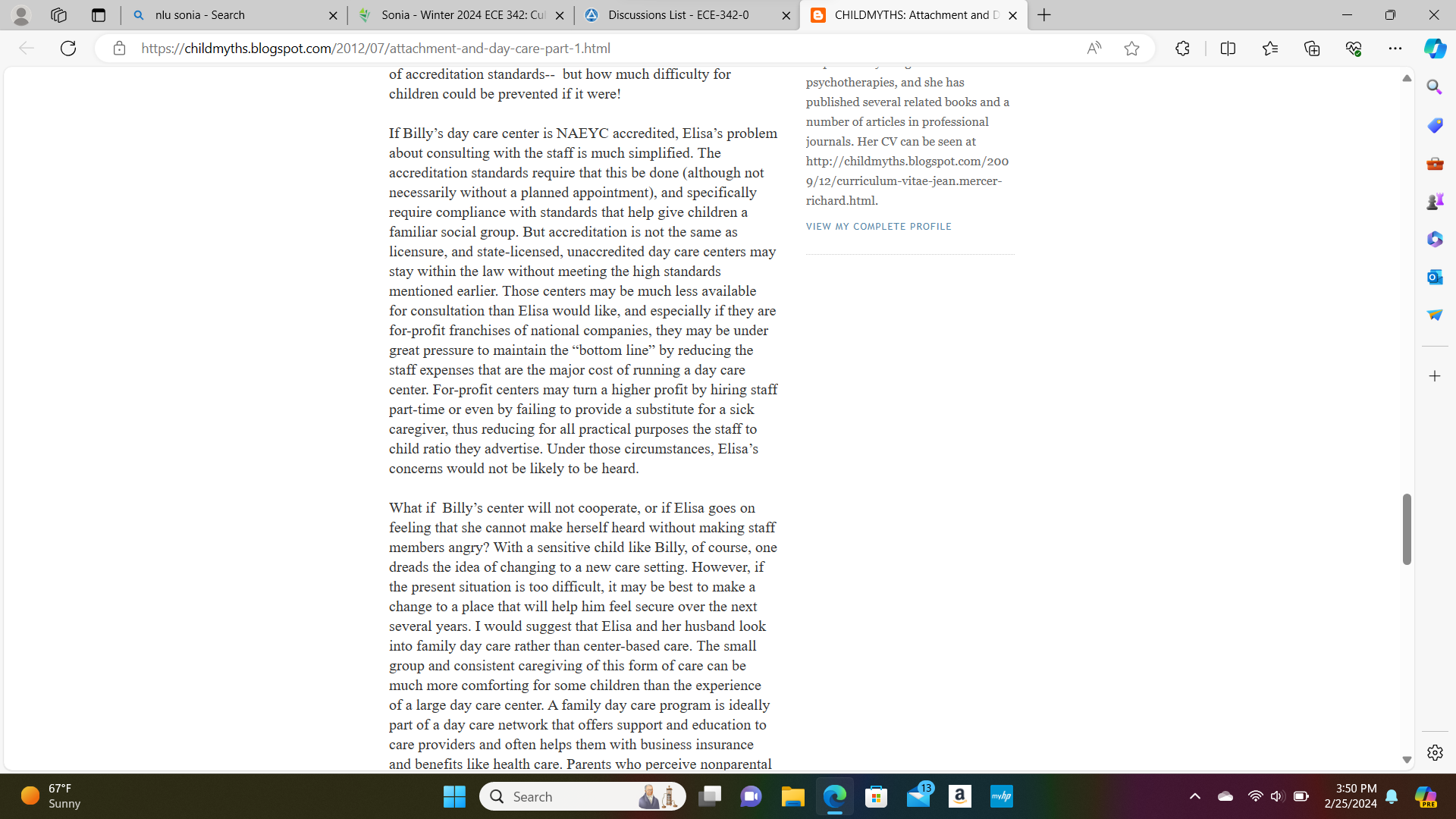
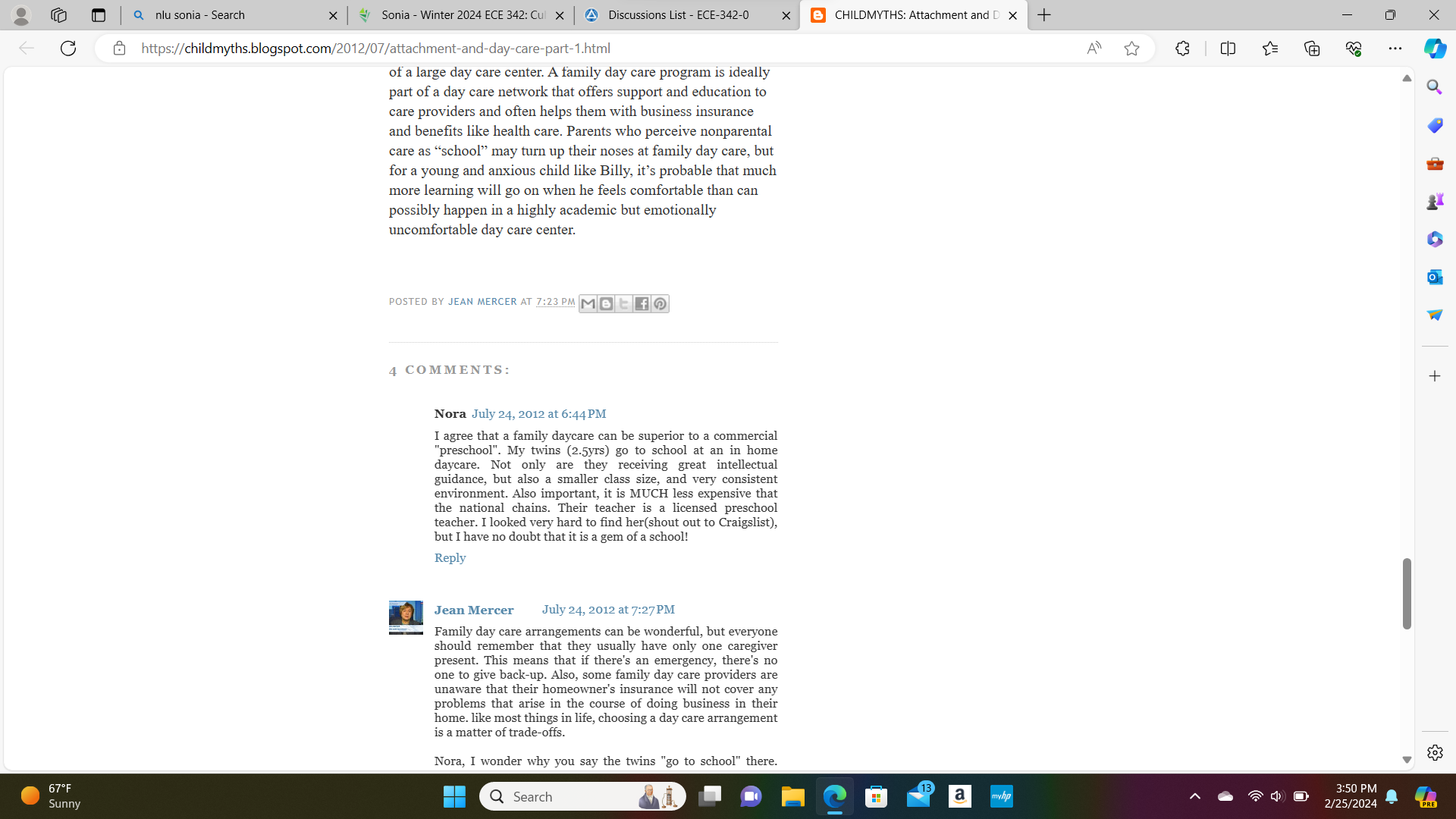
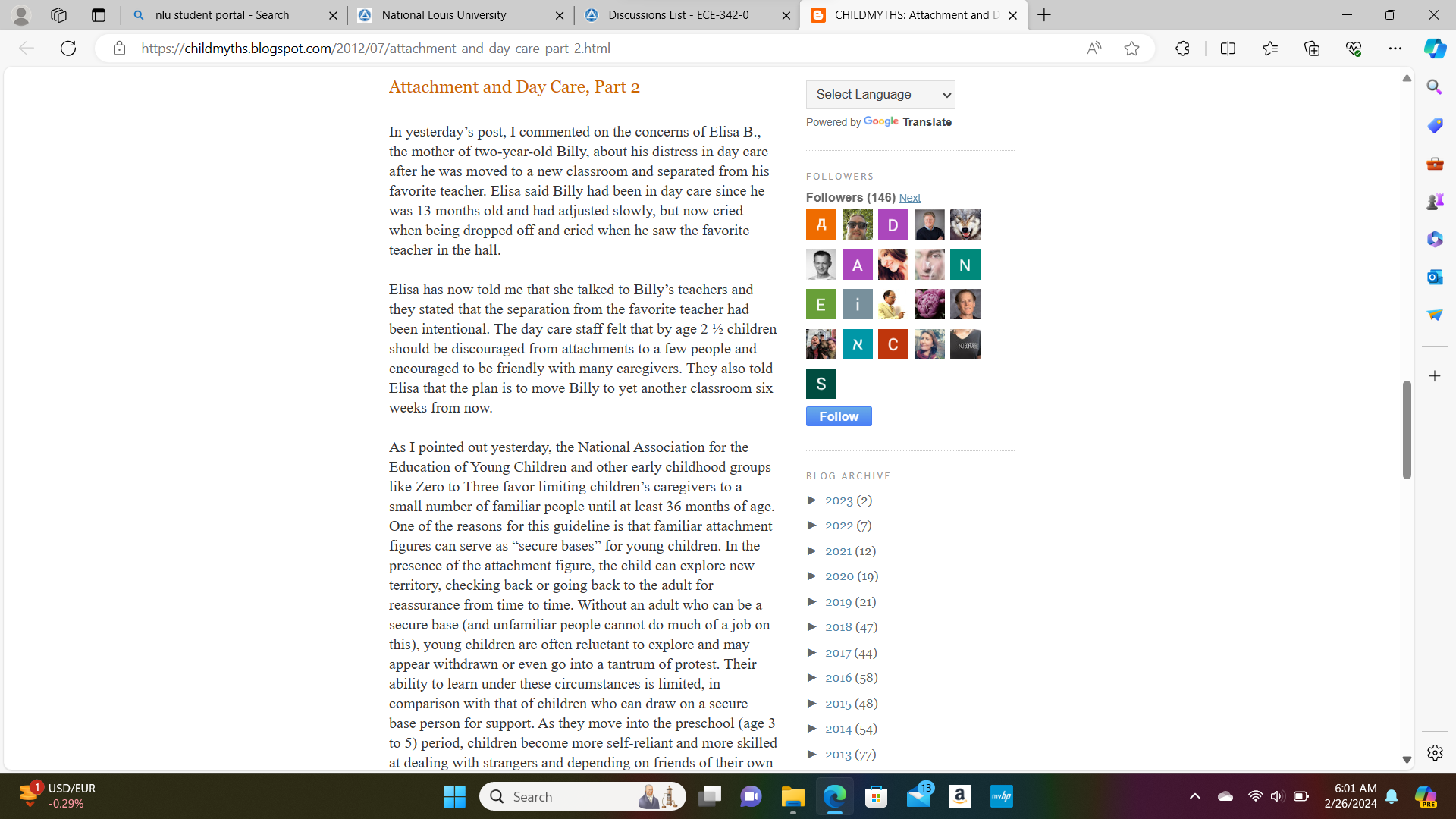
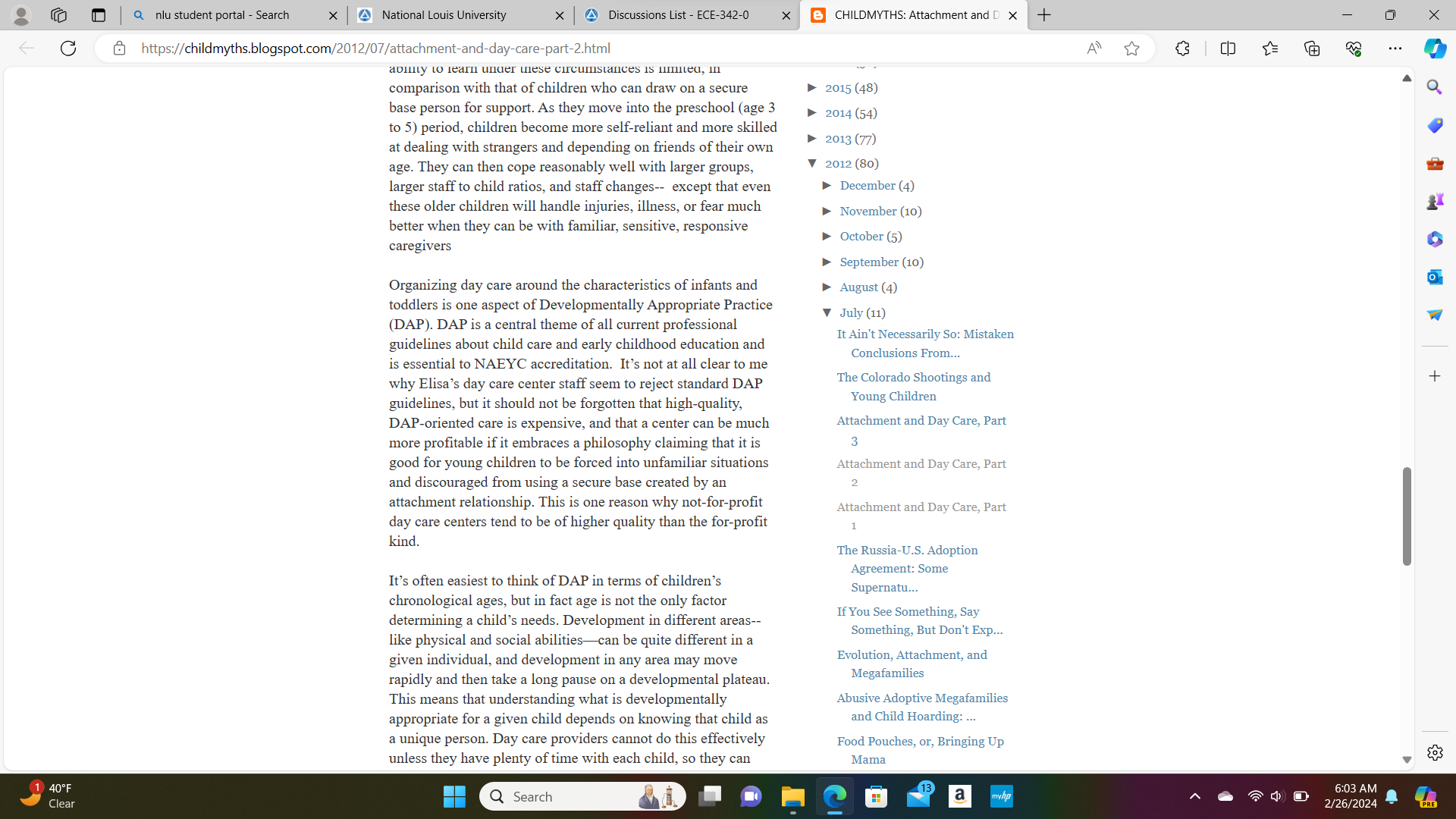
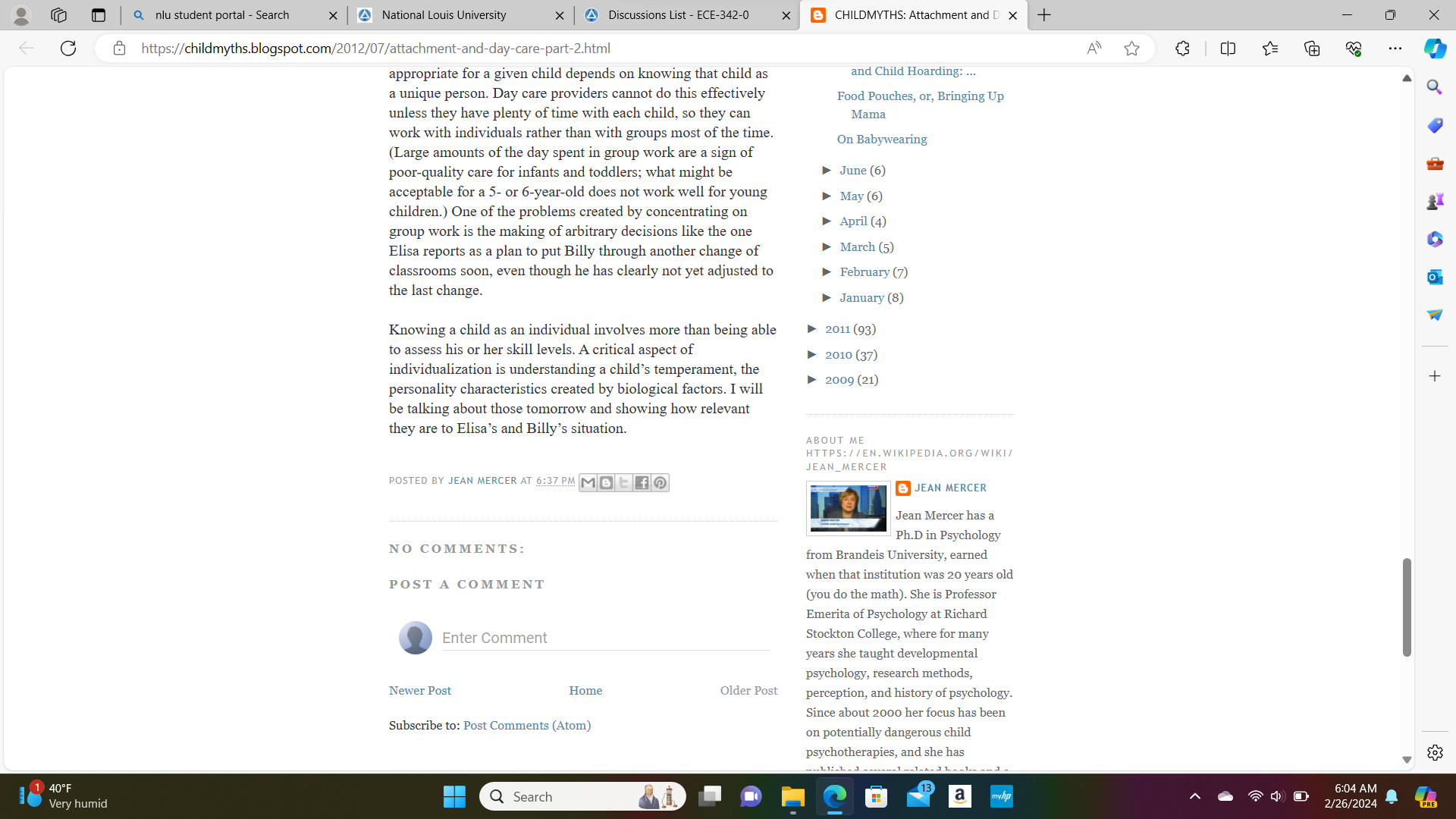
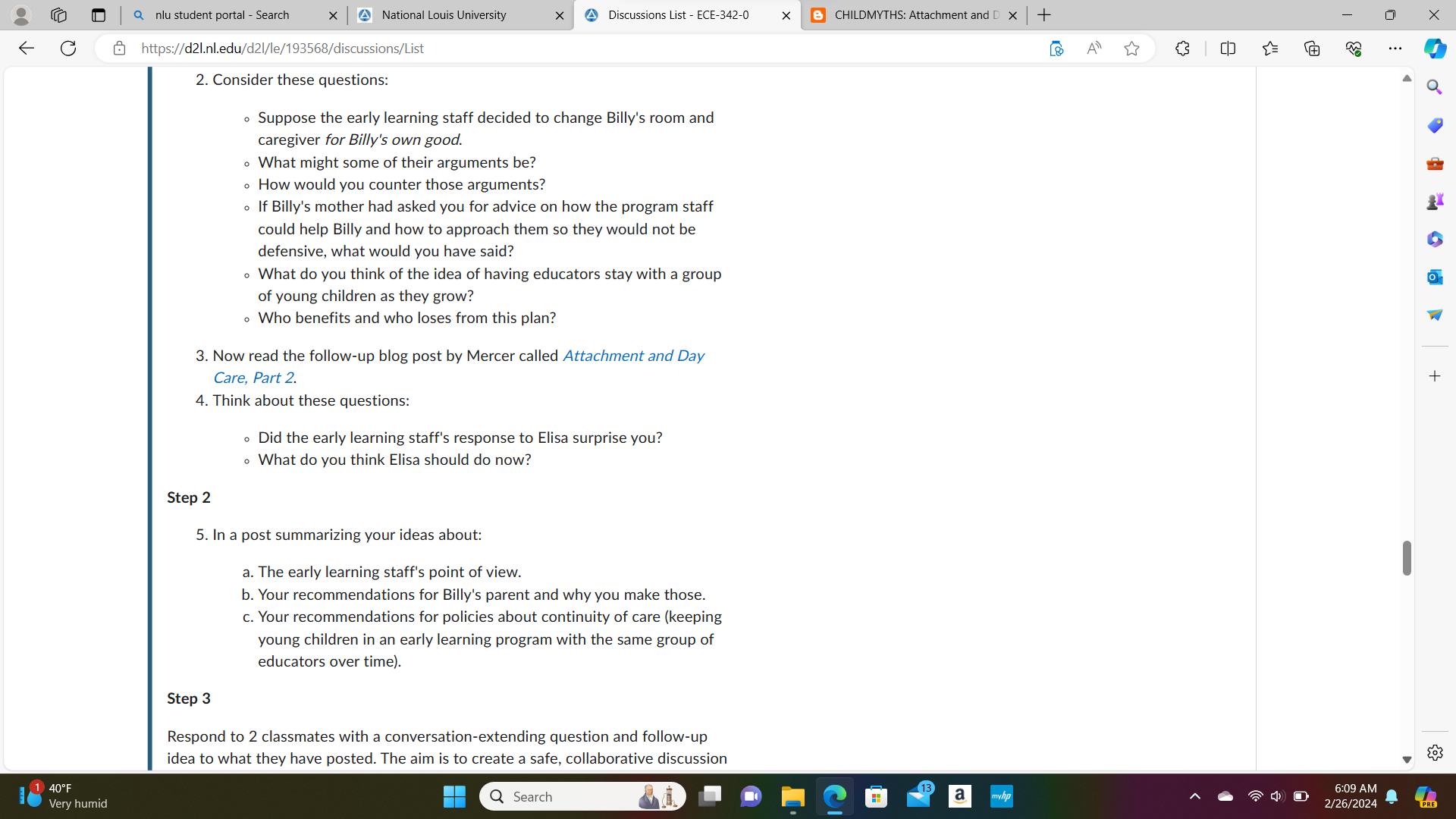
A Qnlu sonia - Search https://childmyths.blogspot.com/2012/07/attachment-and-day-care-part-1.html Sonia - Winter 2024 ECE 342: Cul X A Discussions List - ECE-342-0 B CHILDMYTHS: Attachment and D X + 67F Sunny { Alternative Psychotherapies: Evaluating Unconventional Mental Health Treatments TUESDAY, JULY 17, 2012 Attachment and Day Care, Part 1 A few days ago I had an e-mail from a young mother who is concerned about her toddler and his behavior at day care. She commented correctly I think, that many parents have concerns similar to hers but don't know how to find answers to their questions. I told her I would answer her by means of blog posts and there are so many issues to be considered that I think this will require several posts. I should point out, by the way that I have never met this lady whom I will call Elisa B., or her child. I am not a clinical psychologist, but a developmentalist, in any case, so I can't offer clinical suggestions-- but even if I were trained in that way, it would be against professional ethics for me to comment on individuals I have never worked with. Elisa also kindly offered to pay me for my time, but it would be inappropriate for me to accept payment. I'll summarize some elements of Elisa's story. Her little boy, whom we can call Billy because as far as I know that isn't his name, is two years and three months old. He has been attending a day care center since he was 13 months old. Billy was very attached to one teacher, but several weeks ago his group of children was moved to a different level. His favorite friend is now in a different group, and he rarely sees the favorite teacher. He cries when his mother leaves and when he sees the favorite teacher in the hall. The new teachers say he is adjusting, but Elisa says he gets quiet when she asks about the new people. Elisa says Billy has always been shy around other people, even TRANSLATE Select Language Powered by Google Translate FOLLOWERS Followers (146) Next A D A N E i C NOBORDER S Follow BLOG ARCHIVE 2023 (2) 2022 (7) 2021 (12) 2020 (19) 2019 (21) 2018 (47) 2017 (44) 2016 (58) Q Search + a [b myhp " + + 3:49 PM 2/25/2024 PRE A { [b " + Qnlu sonia - Search Sonia - Winter 2024 ECE 342: Cul X A Discussions List - ECE-342-0 https://childmyths.blogspot.com/2012/07/attachment-and-day-care-part-1.html tatt in the main acutis say it is adjusting, but Elisa says he gets quiet when she asks about the new people. Elisa says Billy has always been shy around other people, even if his parents are there, and she describes him as always having cried a lot. She also says of herself that she is inclined to be anxious and depressed and that she decided on day care for Billy because she was worried that being at home with a depressed mother was not good for him. (Incidentally, I would like to point out how important it is that Elisa is considering her own possible contribution to the situation-this is a difficult step for most people to take.) Elisa wants to know what the day care center might do to help and how she can communicate with the staff without making them get defensive. She also asked whether it would be good to have Billy's attachment status evaluated and whether some intervention might be possible. Like most real-life situations, this is a complicated one. Some factors at work are the day care center's practices, Billy's temperament and why he cries when he sees his favorite teacher, Elisa's own personality, and the advisability of evaluation and treatment. I know there is a lot to say about each of these, so I'm going to give each topic a post of its own, starting with day care practices today. High-quality child care centers comply with the standards for voluntary accreditation set by the National Association for the Education of Young Children and administered by its state affiliates. Important among the NAEYC standards are staff to child ratio and group size. NAEYC recommends that for children in Billy's toddler age group the ratio of adult caregivers to children should be no higher than one adult to six children, and that the whole group of children together in a room should be no more than 12. NAEYC also recommends Q Search e CHILDMYTHS: Attachment and D X + 2018 (47) 2017 (44) 2016 (58) 2015 (48) 2014 (54) 2013 (77) 2012 (80) December (4) November (10) October (5) September (10) August (4) July (11) It Ain't Necessarily So: Mistaken Conclusions From... The Colorado Shootings and Young Children Attachment and Day Care, Part 3 Attachment and Day Care, Part 2 Attachment and Day Care, Part 1 The Russia-U.S. Adoption Agreement: Some Supernatu... If You See Something, Say Something, But Don't Exp... Evolution, Attachment, and Megafamilies Abusive Adoptive Megafamilies H 67F Sunny + a myhp 3:49 PM 2/25/2024 PRE { [b " 67F Sunny A Qnlu sonia - Search Sonia - Winter 2024 ECE 342: Cul X A Discussions List - ECE-342-0 CHILDMYTHS: Attachment and D X + https://childmyths.blogspot.com/2012/07/attachment-and-day-care-part-1.html no one else is dealing with, unless there is a real emergency. These rules are aimed at providing a comfortable, familiar social setting in which each caregiver can genuinely learn to know each child, and each child will feel at home with his or her caregivers. Because children are often at a center for periods that overlap two caregiver shifts, the rules emphasize assuring that all the caregivers are familiar to the children they will meet-- even when there is a "substitute" (which there often must be, because people who work with young children catch colds often). Without specifically addressing attachment issues, these rules attempt to create a supportive, responsive social environment for young children and to help them respond with resilience to any disturbing events. Standards for NAEYC accreditation also include center rules that allow parents to drop in at any time and that name support of the family as a center goal. About 20 years ago, incidentally, there was a serious proposal in early childhood circles that young children not be moved from one room and teacher to another, as Billy was moved. The idea was that a caregiver would begin with a group of young children and continue with them from infancy right up to kindergarten entry. This excellent proposal, which would have allowed teachers and children to know each other very well, never developed any traction, in part because it was rejected by many teachers. When I asked day care staff and preschool teachers about it at the time, almost every one declared that she was a "two-year-old teacher" (or three-, or four--) and that she wanted to go on doing the things she did to teach children in that age group; the group was more important to the caregiver than the individuals within it, in many cases. For whatever reason, the proposal was never widely accepted and is not part of accreditation standards-- but how much difficulty for children could be prevented if it were! If Billy's day care center is NAEYC accredited Elisa's problem Q Search Mama On Babywearing June (6) May (6) April (4) March (5) February (7) January (8) 2011 (93) 2010 (37) 2009 (21) ABOUT ME HTTPS://EN.WIKIPEDIA.ORG/WIKI/ JEAN MERCER e JEAN MERCER Jean Mercer has a Ph.D in Psychology from Brandeis University, earned when that institution was 20 years old (you do the math). She is Professor Emerita of Psychology at Richard Stockton College, where for many years she taught developmental psychology, research methods, perception, and history of psychology. Since about 2000 her focus has been on potentially dangerous child psychotherapies, and she has published several related books and a number of articles in professional H a myhp + + 3:49 PM 2/25/2024 PRE A { [b " + Qnlu sonia - Search Sonia - Winter 2024 ECE 342: Cul X A Discussions List - ECE-342-0 https://childmyths.blogspot.com/2012/07/attachment-and-day-care-part-1.html of accreditation standards-- but how much difficulty for children could be prevented if it were! If Billy's day care center is NAEYC accredited, Elisa's problem about consulting with the staff is much simplified. The accreditation standards require that this be done (although not necessarily without a planned appointment), and specifically require compliance with standards that help give children a familiar social group. But accreditation is not the same as licensure, and state-licensed, unaccredited day care centers may stay within the law without meeting the high standards mentioned earlier. Those centers may be much less available for consultation than Elisa would like, and especially if they are for-profit franchises of national companies, they may be under great pressure to maintain the "bottom line" by reducing the staff expenses that are the major cost of running a day care center. For-profit centers may turn a higher profit by hiring staff part-time or even by failing to provide a substitute for a sick caregiver, thus reducing for all practical purposes the staff to child ratio they advertise. Under those circumstances, Elisa's concerns would not be likely to be heard. What if Billy's center will not cooperate, or if Elisa goes on feeling that she cannot make herself heard without making staff members angry? With a sensitive child like Billy, of course, one dreads the idea of changing to a new care setting. However, if the present situation is too difficult, it may be best to make a change to a place that will help him feel secure over the next several years. I would suggest that Elisa and her husband look into family day care rather than center-based care. The small group and consistent caregiving of this form of care can be much more comforting for some children than the experience of a large day care center. A family day care program is ideally part of a day care network that offers support and education to care providers and often helps them with business insurance and benefits like health care. Parents who perceive nonparental Q Search B CHILDMYTHS: Attachment and D X + psychotherapies, and she has published several related books and a number of articles in professional journals. Her CV can be seen at http://childmyths.blogspot.com/200 9/12/curriculum-vitae-jean.mercer- richard.html. VIEW MY COMPLETE PROFILE + a myhp 67F Sunny + 3:50 PM 2/25/2024 PRE A Qnlu sonia - Search Sonia - Winter 2024 ECE 342: Cul X A Discussions List - ECE-342-0 B CHILDMYTHS: Attachment and D X + https://childmyths.blogspot.com/2012/07/attachment-and-day-care-part-1.html of a large day care center. A family day care program is ideally part of a day care network that offers support and education to care providers and often helps them with business insurance and benefits like health care. Parents who perceive nonparental care as "school" may turn up their noses at family day care, but for a young and anxious child like Billy, it's probable that much more learning will go on when he feels comfortable than can possibly happen in a highly academic but emotionally uncomfortable day care center. 67F Sunny POSTED BY JEAN MERCER AT 7:23 PM MBt f 4 COMMENTS: Nora July 24, 2012 at 6:44 PM I agree that a family daycare can be superior to a commercial "preschool". My twins (2.5yrs) go to school at an in home daycare. Not only are they receiving great intellectual guidance, but also a smaller class size, and very consistent environment. Also important, it is MUCH less expensive that the national chains. Their teacher is a licensed preschool teacher. I looked very hard to find her(shout out to Craigslist), but I have no doubt that it is a gem of a school! Reply Jean Mercer July 24, 2012 at 7:27PM Family day care arrangements can be wonderful, but everyone should remember that they usually have only one caregiver present. This means that if there's an emergency, there's no one to give back-up. Also, some family day care providers are unaware that their homeowner's insurance will not cover any problems that arise in the course of doing business in their home. like most things in life, choosing a day care arrangement is a matter of trade-offs. Nora, I wonder why you say the twins "go to school" there. Q Search + { a [b myhp " + + 3:50 PM 2/25/2024 PRE A Qnlu student portal - Search A National Louis University A Discussions List - ECE-342-0 B CHILDMYTHS: Attachment and D X + { USD/EUR -0.29% https://childmyths.blogspot.com/2012/07/attachment-and-day-care-part-2.html Attachment and Day Care, Part 2 In yesterday's post, I commented on the concerns of Elisa B., the mother of two-year-old Billy, about his distress in day care after he was moved to a new classroom and separated from his favorite teacher. Elisa said Billy had been in day care since he was 13 months old and had adjusted slowly, but now cried when being dropped off and cried when he saw the favorite teacher in the hall. Elisa has now told me that she talked to Billy's teachers and they stated that the separation from the favorite teacher had been intentional. The day care staff felt that by age 2 children should be discouraged from attachments to a few people and encouraged to be friendly with many caregivers. They also told Elisa that the plan is to move Billy to yet another classroom six weeks from now. As I pointed out yesterday, the National Association for the Education of Young Children and other early childhood groups like Zero to Three favor limiting children's caregivers to a small number of familiar people until at least 36 months of age. One of the reasons for this guideline is that familiar attachment figures can serve as "secure bases" for young children. In the presence of the attachment figure, the child can explore new territory, checking back or going back to the adult for reassurance from time to time. Without an adult who can be a secure base (and unfamiliar people cannot do much of a job on this), young children are often reluctant to explore and may appear withdrawn or even go into a tantrum of protest. Their ability to learn under these circumstances is limited, in comparison with that of children who can draw on a secure base person for support. As they move into the preschool (age 3 to 5) period, children become more self-reliant and more skilled at dealing with strangers and depending on friends of their own Q Search Select Language Powered by Google Translate FOLLOWERS Followers (146) Next A A N E i S Follow BLOG ARCHIVE 2023 (2) 2022 (7) 2021 (12) 2020 (19) 2019 (21) 2018 (47) 2017 (44) 2016 (58) 2015 (48) 2014 (54) 2013 (77) + C NOBORDER a myhp [b " + + 6:01 AM 2/26/2024 PRE 40F Clear A Qnlu student portal - Search A National Louis University A Discussions List - ECE-342-0 X CHILDMYTHS: Attachment and D X + https://childmyths.blogspot.com/2012/07/attachment-and-day-care-part-2.html adity to learn under these circumstances is limited, in comparison with that of children who can draw on a secure base person for support. As they move into the preschool (age 3 to 5) period, children become more self-reliant and more skilled at dealing with strangers and depending on friends of their own age. They can then cope reasonably well with larger groups, larger staff to child ratios, and staff changes-- except that even these older children will handle injuries, illness, or fear much better when they can be with familiar, sensitive, responsive caregivers Organizing day care around the characteristics of infants and toddlers is one aspect of Developmentally Appropriate Practice (DAP). DAP is a central theme of all current professional guidelines about child care and early childhood education and is essential to NAEYC accreditation. It's not at all clear to me why Elisa's day care center staff seem to reject standard DAP guidelines, but it should not be forgotten that high-quality, DAP-oriented care is expensive, and that a center can be much more profitable if it embraces a philosophy claiming that it is good for young children to be forced into unfamiliar situations and discouraged from using a secure base created by an attachment relationship. This is one reason why not-for-profit day care centers tend to be of higher quality than the for-profit kind. It's often easiest to think of DAP in terms of children's chronological ages, but in fact age is not the only factor determining a child's needs. Development in different areas-- like physical and social abilities can be quite different in a given individual, and development in any area may move rapidly and then take a long pause on a developmental plateau. This means that understanding what is developmentally appropriate for a given child depends on knowing that child as a unique person. Day care providers cannot do this effectively unless they have plenty of time with each child, so they can = Q Search 2015 (48) 2014 (54) 2013 (77) 2012 (80) December (4) November (10) October (5) September (10) August (4) July (11) It Ain't Necessarily So: Mistaken Conclusions From... The Colorado Shootings and Young Children Attachment and Day Care, Part 3 Attachment and Day Care, Part 2 Attachment and Day Care, Part 1 The Russia-U.S. Adoption Agreement: Some Supernatu... If You See Something, Say Something, But Don't Exp... Evolution, Attachment, and Megafamilies Abusive Adoptive Megafamilies and Child Hoarding: ... Food Pouches, or, Bringing Up Mama a myhp { [b " + 6:03 AM 2/26/2024 PRE + A 40F Very humid Qnlu student portal - Search National Louis University A Discussions List - ECE-342-0 B CHILDMYTHS: Attachment and D X + https://childmyths.blogspot.com/2012/07/attachment-and-day-care-part-2.html appropriate for a given child depends on knowing that child as a unique person. Day care providers cannot do this effectively unless they have plenty of time with each child, so they can work with individuals rather than with groups most of the time. (Large amounts of the day spent in group work are a sign of poor-quality care for infants and toddlers; what might be acceptable for a 5- or 6-year-old does not work well for young children.) One of the problems created by concentrating on group work is the making of arbitrary decisions like the one Elisa reports as a plan to put Billy through another change of classrooms soon, even though he has clearly not yet adjusted to the last change. Knowing a child as an individual involves more than being able to assess his or her skill levels. A critical aspect of individualization is understanding a child's temperament, the personality characteristics created by biological factors. I will be talking about those tomorrow and showing how relevant they are to Elisa's and Billy's situation. POSTED BY JEAN MERCER AT 6:37 PM Metf and Child Hoarding: ... Food Pouches, or, Bringing Up Mama On Babywearing June (6) May (6) April (4) March (5) February (7) January (8) 2011 (93) 2010 (37) 2009 (21) ABOUT ME HTTPS://EN.WIKIPEDIA.ORG/WIKI/ JEAN MERCER e JEAN MERCER NO COMMENTS: POST A COMMENT Enter Comment Newer Post Home Older Post Subscribe to: Post Comments (Atom) Q Search Jean Mercer has a Ph.D in Psychology from Brandeis University, earned when that institution was 20 years old (you do the math). She is Professor Emerita of Psychology at Richard Stockton College, where for many years she taught developmental psychology, research methods, perception, and history of psychology. Since about 2000 her focus has been on potentially dangerous child psychotherapies, and she has H a myhp { [b " + 6:04 AM 2/26/2024 PRE + A Qnlu student portal - Search X National Louis University A Discussions List - ECE-342-0 X B CHILDMYTHS: Attachment and D X + A https://d2l.nl.edu/d2l/le/193568/discussions/List 2. Consider these questions: Suppose the early learning staff decided to change Billy's room and caregiver for Billy's own good. What might some of their arguments be? How would you counter those arguments? If Billy's mother had asked you for advice on how the program staff could help Billy and how to approach them so they would not be defensive, what would you have said? What do you think of the idea of having educators stay with a group of young children as they grow? Who benefits and who loses from this plan? 3. Now read the follow-up blog post by Mercer called Attachment and Day Care, Part 2. 4. Think about these questions: Did the early learning staff's response to Elisa surprise you? Step 2 What do you think Elisa should do now? 5. In a post summarizing your ideas about: a. The early learning staff's point of view. b. Your recommendations for Billy's parent and why you make those. c. Your recommendations for policies about continuity of care (keeping young children in an early learning program with the same group of educators over time). 40F Very humid Respond to 2 classmates with a conversation-extending question and follow-up idea to what they have posted. The aim is to create a safe, collaborative discussion Q Search Step 3
Step by Step Solution
There are 3 Steps involved in it

Get step-by-step solutions from verified subject matter experts
 Study Help