







Question: a Question 5: In this question, I will walk you step by step through an APV calculation. You are valuing a potential target of an
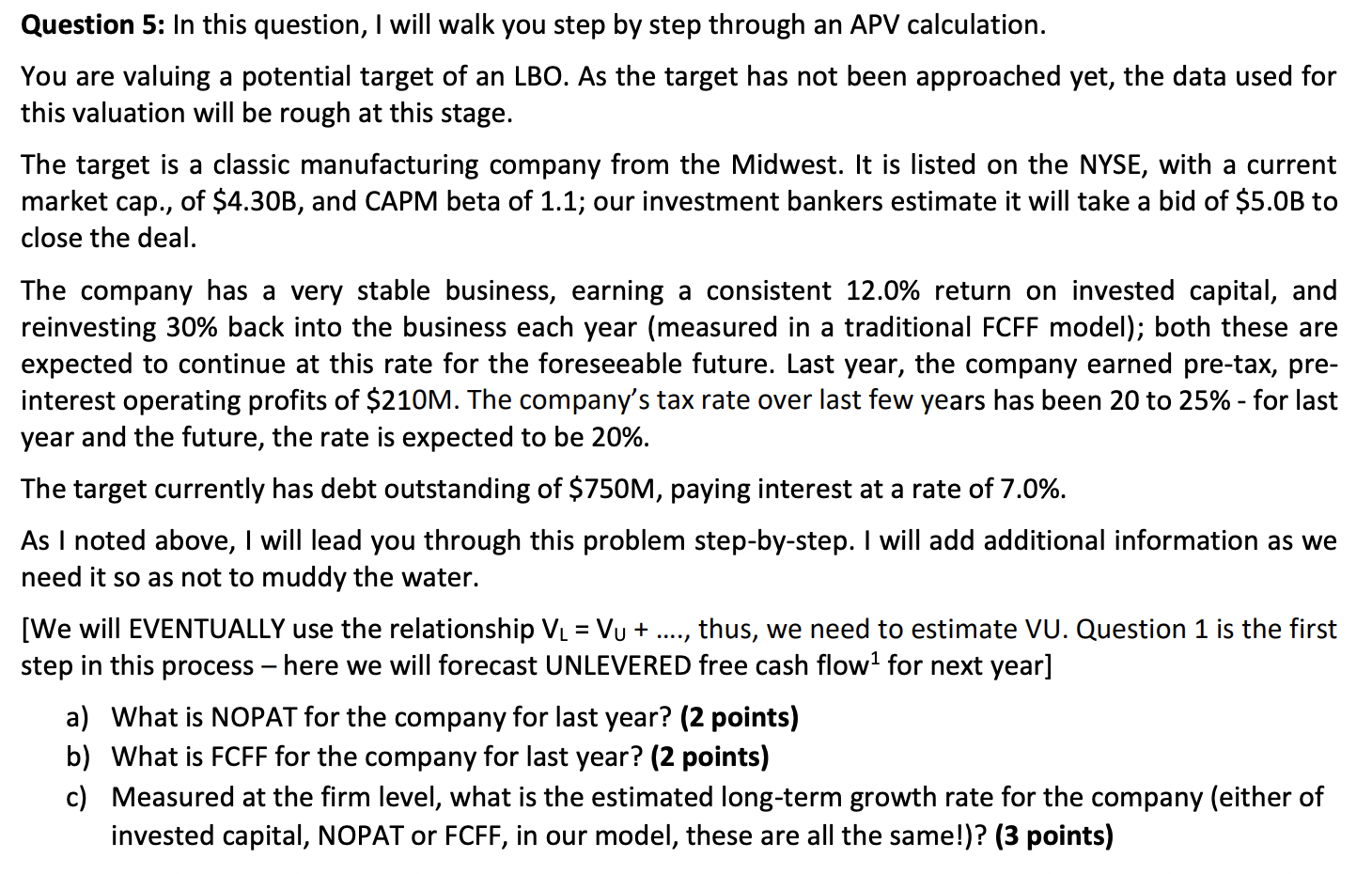
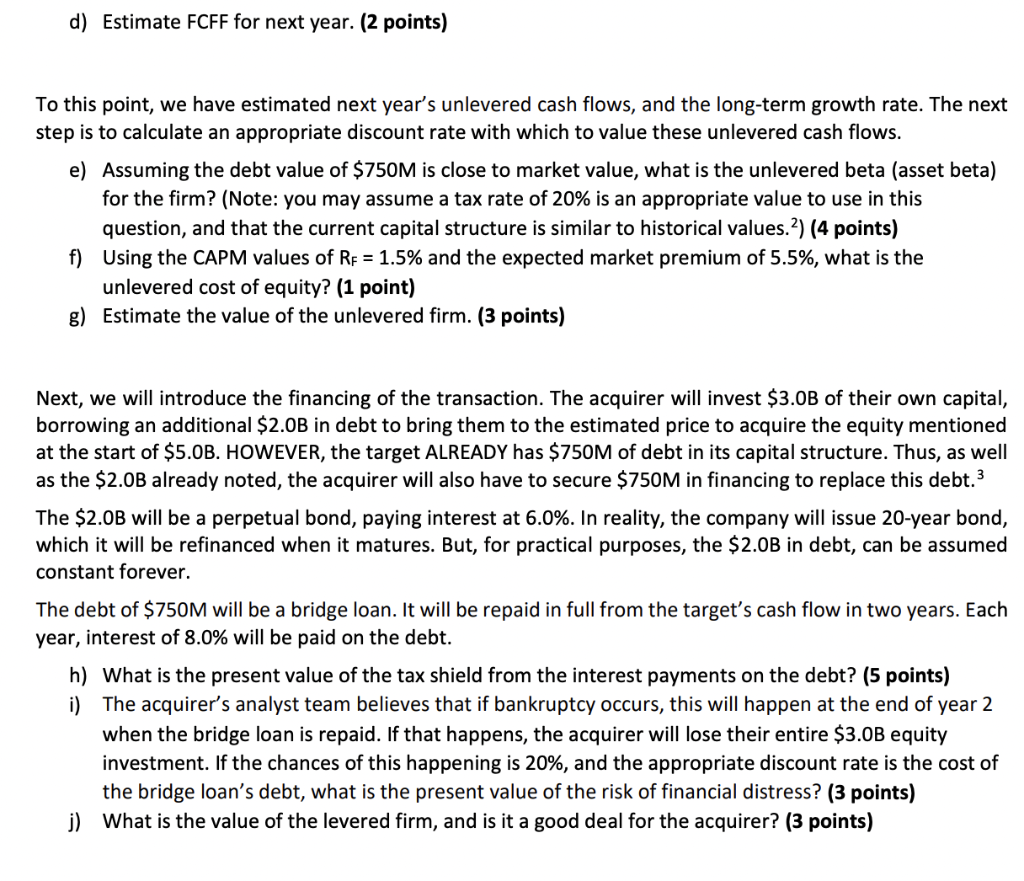
a Question 5: In this question, I will walk you step by step through an APV calculation. You are valuing a potential target of an LBO. As the target has not been approached yet, the data used for this valuation will be rough at this stage. The target is a classic manufacturing company from the Midwest. It is listed on the NYSE, with a current market cap., of $4.30B, and CAPM beta of 1.1; our investment bankers estimate it will take a bid of $5.0B to close the deal. The company has a very stable business, earning a consistent 12.0% return on invested capital, and reinvesting 30% back into the business each year (measured in a traditional FCFF model); both these are expected to continue at this rate for the foreseeable future. Last year, the company earned pre-tax, pre- interest operating profits of $210M. The company's tax rate over last few years has been 20 to 25% - for last year and the future, the rate is expected to be 20%. The target currently has debt outstanding of $750M, paying interest at a rate of 7.0%. As I noted above, I will lead you through this problem step-by-step. I will add additional information as we need it so as not to muddy the water. [We will EVENTUALLY use the relationship VL = VU + ...., thus, we need to estimate VU. Question 1 is the first step in this process here we will forecast UNLEVERED free cash flow1 for next year] a) What is NOPAT for the company for last year? (2 points) b) What is FCFF for the company for last year? (2 points) c) Measured at the firm level, what is the estimated long-term growth rate for the company (either of invested capital, NOPAT or FCFF, in our model, these are all the same!)? (3 points) + d) Estimate FCFF for next year. (2 points) To this point, we have estimated next year's unlevered cash flows, and the long-term growth rate. The next step is to calculate an appropriate discount rate with which to value these unlevered cash flows. e) Assuming the debt value of $750M is close to market value, what is the unlevered beta (asset beta) for the firm? (Note: you may assume a tax rate of 20% is an appropriate value to use in this question, and that the current capital structure is similar to historical values.2) (4 points) f) Using the CAPM values of RF = 1.5% and the expected market premium of 5.5%, what is the unlevered cost of equity? (1 point) g) Estimate the value of the unlevered firm. (3 points) Next, we will introduce the financing of the transaction. The acquirer will invest $3.0B of their own capital, borrowing an additional $2.0B in debt to bring them to the estimated price to acquire the equity mentioned at the start of $5.0B. HOWEVER, the target ALREADY has $750M of debt in its capital structure. Thus, as well as the $2.0B already noted, the acquirer will also have to secure $750M in financing to replace this debt.3 The $2.0B will be a perpetual bond, paying interest at 6.0%. In reality, the company will issue 20-year bond, which it will be refinanced when it matures. But, for practical purposes, the $2.0B in debt, can be assumed constant forever. The debt of $750M will be a bridge loan. It will be repaid in full from the target's cash flow in two years. Each year, interest of 8.0% will be paid on the debt. h) What is the present value of the tax shield from the interest payments on the debt? (5 points) i) The acquirer's analyst team believes that if bankruptcy occurs, this will happen at the end of year 2 when the bridge loan is repaid. If that happens, the acquirer will lose their entire $3.0B equity investment. If the chances of this happening is 20%, and the appropriate discount rate is the cost of the bridge loan's debt, what is the present value of the risk of financial distress? (3 points) j) What is the value of the levered firm, and is it a good deal for the acquirer? (3 points) a Question 5: In this question, I will walk you step by step through an APV calculation. You are valuing a potential target of an LBO. As the target has not been approached yet, the data used for this valuation will be rough at this stage. The target is a classic manufacturing company from the Midwest. It is listed on the NYSE, with a current market cap., of $4.30B, and CAPM beta of 1.1; our investment bankers estimate it will take a bid of $5.0B to close the deal. The company has a very stable business, earning a consistent 12.0% return on invested capital, and reinvesting 30% back into the business each year (measured in a traditional FCFF model); both these are expected to continue at this rate for the foreseeable future. Last year, the company earned pre-tax, pre- interest operating profits of $210M. The company's tax rate over last few years has been 20 to 25% - for last year and the future, the rate is expected to be 20%. The target currently has debt outstanding of $750M, paying interest at a rate of 7.0%. As I noted above, I will lead you through this problem step-by-step. I will add additional information as we need it so as not to muddy the water. [We will EVENTUALLY use the relationship VL = VU + ...., thus, we need to estimate VU. Question 1 is the first step in this process here we will forecast UNLEVERED free cash flow1 for next year] a) What is NOPAT for the company for last year? (2 points) b) What is FCFF for the company for last year? (2 points) c) Measured at the firm level, what is the estimated long-term growth rate for the company (either of invested capital, NOPAT or FCFF, in our model, these are all the same!)? (3 points) + d) Estimate FCFF for next year. (2 points) To this point, we have estimated next year's unlevered cash flows, and the long-term growth rate. The next step is to calculate an appropriate discount rate with which to value these unlevered cash flows. e) Assuming the debt value of $750M is close to market value, what is the unlevered beta (asset beta) for the firm? (Note: you may assume a tax rate of 20% is an appropriate value to use in this question, and that the current capital structure is similar to historical values.2) (4 points) f) Using the CAPM values of RF = 1.5% and the expected market premium of 5.5%, what is the unlevered cost of equity? (1 point) g) Estimate the value of the unlevered firm. (3 points) Next, we will introduce the financing of the transaction. The acquirer will invest $3.0B of their own capital, borrowing an additional $2.0B in debt to bring them to the estimated price to acquire the equity mentioned at the start of $5.0B. HOWEVER, the target ALREADY has $750M of debt in its capital structure. Thus, as well as the $2.0B already noted, the acquirer will also have to secure $750M in financing to replace this debt.3 The $2.0B will be a perpetual bond, paying interest at 6.0%. In reality, the company will issue 20-year bond, which it will be refinanced when it matures. But, for practical purposes, the $2.0B in debt, can be assumed constant forever. The debt of $750M will be a bridge loan. It will be repaid in full from the target's cash flow in two years. Each year, interest of 8.0% will be paid on the debt. h) What is the present value of the tax shield from the interest payments on the debt? (5 points) i) The acquirer's analyst team believes that if bankruptcy occurs, this will happen at the end of year 2 when the bridge loan is repaid. If that happens, the acquirer will lose their entire $3.0B equity investment. If the chances of this happening is 20%, and the appropriate discount rate is the cost of the bridge loan's debt, what is the present value of the risk of financial distress? (3 points) j) What is the value of the levered firm, and is it a good deal for the acquirer? (3 points)
Step by Step Solution
There are 3 Steps involved in it

Get step-by-step solutions from verified subject matter experts
 Study Help