







Question: A random vector has the joint p.d.f. fr(x, y) given by T-(*) fr(x,y) = { k(x + 2y +1) 0 2 and 0y3-r otherwise
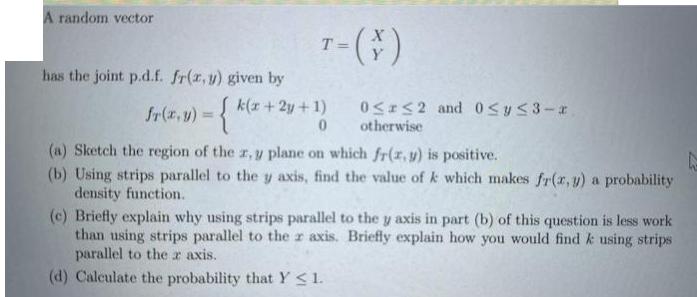
A random vector has the joint p.d.f. fr(x, y) given by T-(*) fr(x,y) = { k(x + 2y +1) 0 2 and 0y3-r otherwise (a) Sketch the region of the z, y plane on which fr(x,y) is positive. (b) Using strips parallel to the y axis, find the value of k which makes fr(x, y) a probability density function. (c) Briefly explain why using strips parallel to the y axis in part (b) of this question is less work than using strips parallel to the r axis. Briefly explain how you would find k using strips parallel to the r axis. (d) Calculate the probability that Y 1. L
Step by Step Solution
There are 3 Steps involved in it
Lets tackle each part of the question one at a time a Sketch the region of the x y plane on which fXYxy is positive For fx y to be positive we need bo... View full answer

Get step-by-step solutions from verified subject matter experts
 Study Help