Question: A Randomised Controlled Tria X Gemini x ChatGPT X G apa citation format for journal X G where to find volume of journ X +
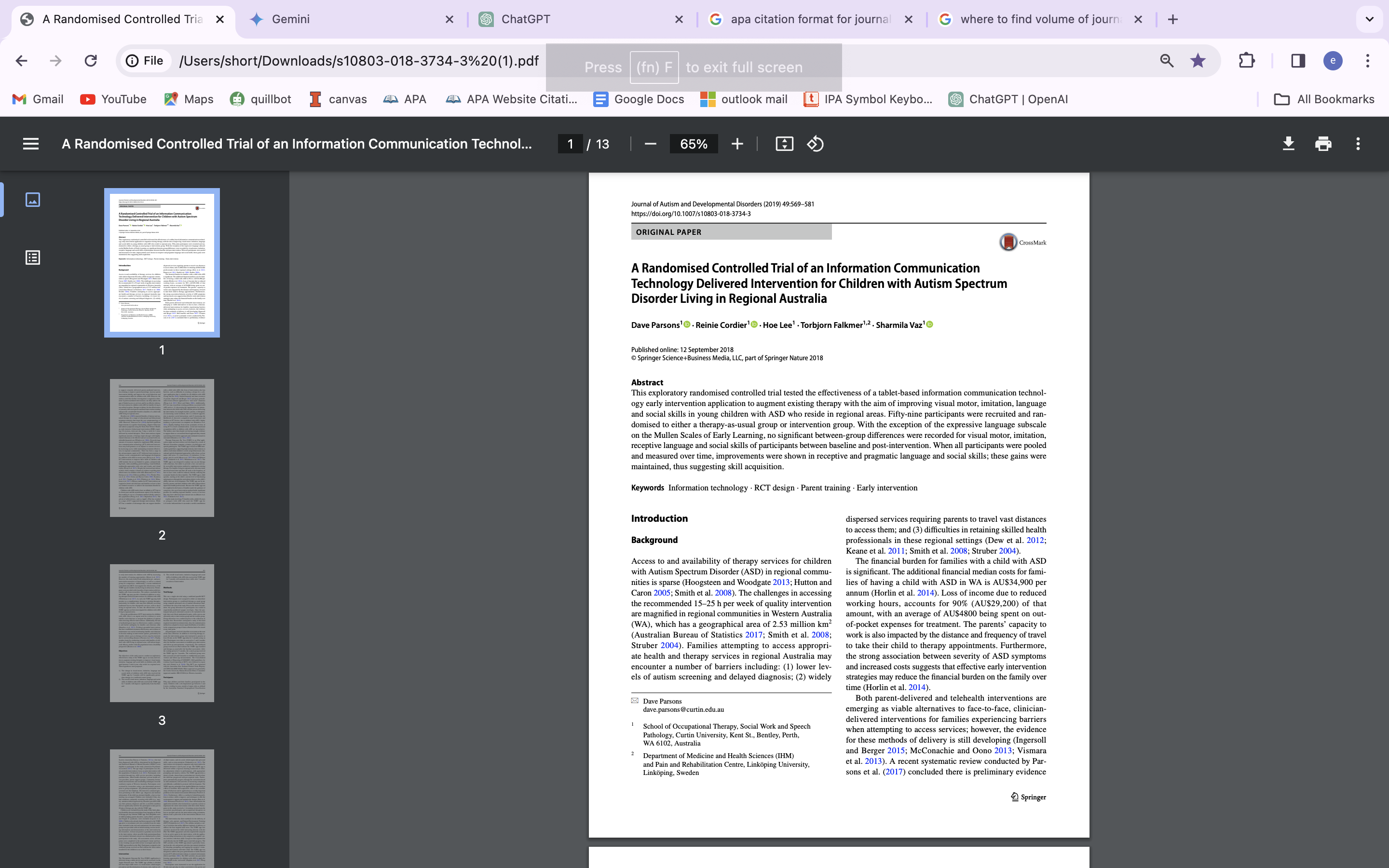
A Randomised Controlled Tria X Gemini x ChatGPT X G apa citation format for journal X G where to find volume of journ X + @ File /Users/short/Downloads/s10803-018-3734-3%20(1).pdf Press (fn) F | to exit full screen M Gmail YouTube Maps quillbot I canvas 4 APA 4 APA Website Citati... = Google Docs outlook mail t IPA Symbol Keybo... ChatGPT | OpenAl All Bookmarks E A Randomised Controlled Trial of an Information Communication Technol... 1 / 13 65% + Journal of Autism and Developmental Disorders (2019) 49:569-581 https://doi.org/10.1007/s10803-018-3734-3 ORIGINAL PAPER CrossMark A Randomised Controlled Trial of an Information Communication Technology Delivered Intervention for Children with Autism Spectrum Disorder Living in Regional Australia Dave Parsons'. Reinie Cordier'. Hoe Lee' . Torbjorn Falkmer,2 . Sharmila Vaz'D Published online: 12 September 2018 Springer Science+Business Media, LLC, part of Springer Nature 2018 Abstract This exploratory randomised controlled trial tested the effectiveness of a tablet-based information communication technol- ogy early intervention application to augment existing therapy with the aim of improving visual motor, imitation, language and social skills in young children with ASD who resid egional areas. Fifty-nine participants were recruited and ran- domised to either a therapy-as-usual group or intervention group. With the exception of the expressive language subscale on the Mullen Scales of Early Learning, no significant between-group differences were recorded for visual motor, imitation, receptive language and social skills of par ntion. When all participants were pooled and measured over time, improvements were shown in receptive and pragmatic language and social skills; these gains were maintained, thus suggesting skill acquisition. Keywords Information technology . RCT design . Parent training . Early intervention Introduction dispersed services requiring parents to travel vast distances 2 to access them; and (3) difficulties in retaining skilled health Background professionals in these regional settings (Dew et al. 2012; Keane et al. 201 1; Smith et al. 2008; Struber 2004). Access to and availability of therapy services for children The financial burden for families with a child with ASD with Autism Spectrum Disorder (ASD) in regional commu- is significant. The additional financial median costs for fami- nities is sparse (Hoogsteen and Woodgate 2013; Hutton and lies of having a child A is AU$34,900 per Caron 2005; Smith et al. 2008). The challenges in accessing annum (Horlin et al. 2014). Loss of income due to reduced the recommended 15-25 h per week of quality intervention working hours, accounts for 90% (AU$29,200) of that are magnified in regional communities n Western Australia amou being spent on out- (WA), which has a geographical area of 2.53 million km of-pocket expenses for treatment. The parents' capacity to (Australian Bureau of Statistics 2017; Smith et al. 2008; work is also impacted by the distance and frequency of travel Struber 2004). Families attempting to access appropri- ld to therapy appointments. Furthermore, ate health and therapy services in regional Australia may the strong association between severity of ASD symptoms encounter a number of barriers including: (1) lower lev- and increased costs suggests that effective early intervention els of autism screening and delayed diagnosis; (2) widely financial burden on the family over time (Horlin et al. 2014). Dave Parsons Both parent-delivered and telehealth interventions are dave. parsons @curtin.edu.au emerging as viable alternatives to face-to-face, clinician- 3 1 delivered interventions for families experiencing barriers School of Occupational Therapy, Social Work and Speech Pathology. Curtin University, Kent St., Bentley, Perth, when attempting to access services; however, the evidence WA 6102, Australia for these methods of delivery is still developing (Ingersoll 2 Department of Medicine and Health Sciences (IHM) and Berger 2015; McConachie and Oono 2013; Vismara and Pain and Rehabilitation Centre, Linkoping Un et al. 2013). A recent systematic review conducted by Par- Linkoping, Sweden sons et al. (2017) concluded there is preliminary evidence 2 Springer
Step by Step Solution
There are 3 Steps involved in it
1 Expert Approved Answer
Step: 1 Unlock
Question Has Been Solved by an Expert!
Get step-by-step solutions from verified subject matter experts
Step: 2 Unlock
Step: 3 Unlock
Students Have Also Explored These Related Business Writing Questions!