







Question: A Read aloud T Add text | Draw Hi Physics 030 Atomic Physics Assignment 1. An ionic air purifier uses UV rays to ionize dust.
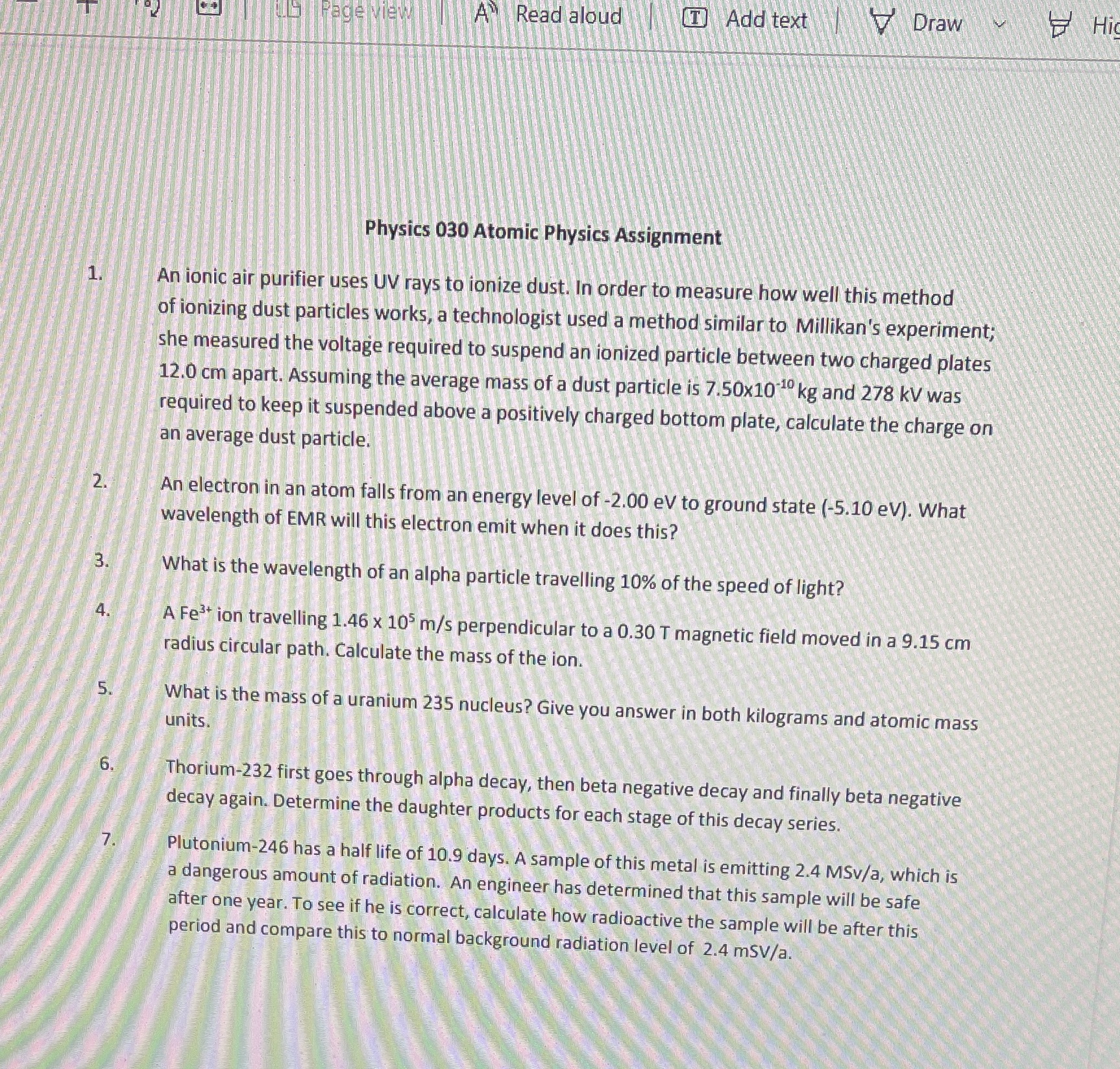
A Read aloud \\T Add text | Draw Hi Physics 030 Atomic Physics Assignment 1. An ionic air purifier uses UV rays to ionize dust. In order to measure how well this method of ionizing dust particles works, a technologist used a method similar to Millikan's experiment; she measured the voltage required to suspend an ionized particle between two charged plates 12.0 cm apart. Assuming the average mass of a dust particle is 7.50x10¹⁰ kg and 278 kV was required to keep it suspended above a positively charged bottom plate, calculate the charge on an average dust particle. An electron in an atom falls from an energy level of -2.00 ev to ground state (-5.10 ev). What wavelength of EMR will this electron emit when it does this? What is the wavelength of an alpha particle travelling 10% of the speed of light? A Fest ion travelling 1.46 x 10⁵ m/s perpendicular to a 0.30 T magnetic field moved in a 9.15 cm radius circular path. Calculate the mass of the ion. 5. What is the mass of a uranium 235 nucleus? Give you answer in both kilograms and atomic mass units. 6 Thorium-232 first goes through alpha decay, then beta negative decay and finally beta negative decay again. Determine the daughter products for each stage of this decay series. Plutonium-246 has a half life of 10.9 days. A sample of this metal is emitting 2.4 MSv/a, which is a dangerous amount of radiation. An engineer has determined that this sample will be safe after one year. To see if he is correct, calculate how radioactive the sample will be after this period and compare this to normal background radiation level of 2.4 mSV/a
Step by Step Solution
There are 3 Steps involved in it

Get step-by-step solutions from verified subject matter experts
 Study Help