







Question: A recent study at a local college claimed that theproportion, p , of students who commute more than fifteen miles to school is no more
A recent study at a local college claimed that theproportion,p, of students who commute more than fifteen miles to school is no more than25%. If a random sample of275students at this college is selected, and it is found that86commute more than fifteen miles to school, can we reject the college's claim at the0.05level of significance?
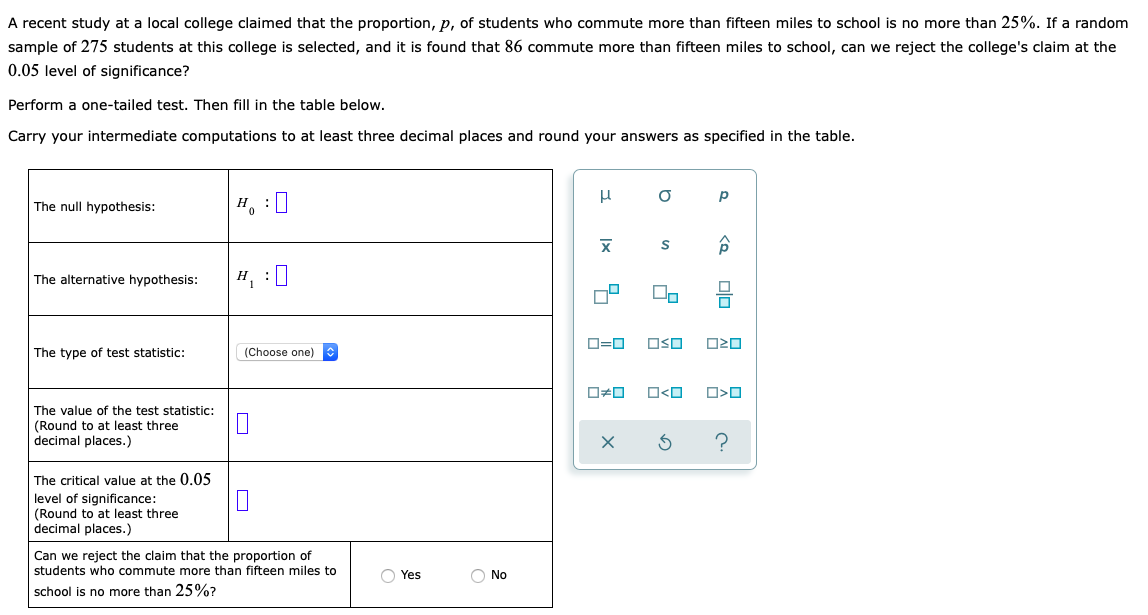
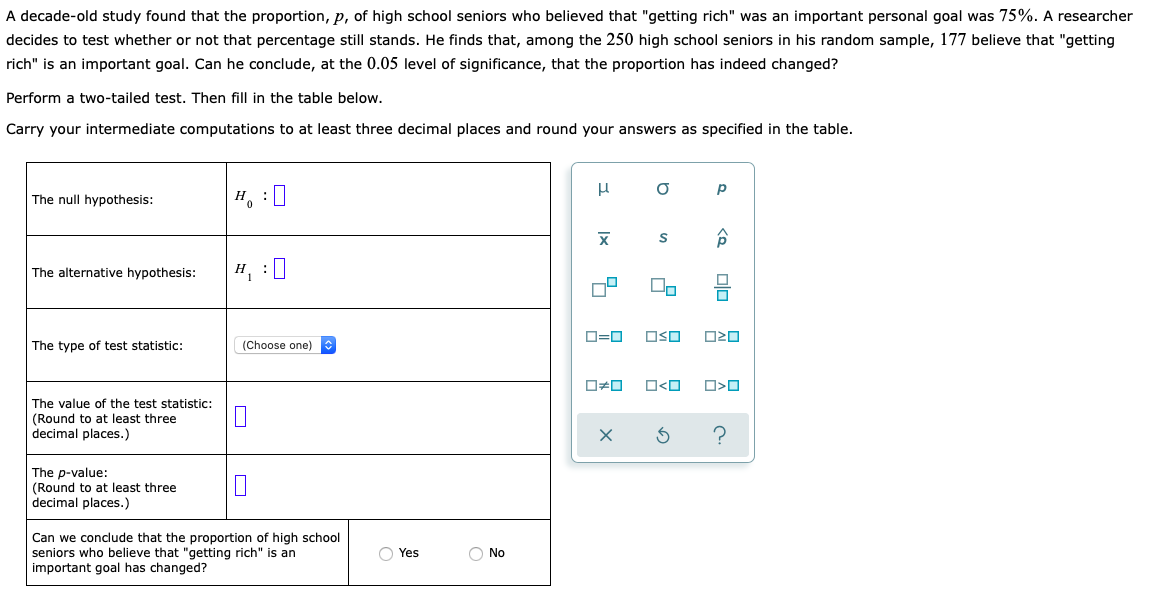
A recent study at a local college claimed that the proportion, p, of students who commute more than fifteen miles to school is no more than 25%. If a random sample of 275 students at this college is selected, and it is found that 86 commute more than fifteen miles to school, can we reject the college's claim at the 0.05 level of significance? Perform a one-tailed test. Then fill in the table below. Carry your intermediate computations to at least three decimal places and round your answers as specified in the table. The null hypothesis: H : I H P X S P The alternative hypothesis: H, : 1 The type of test statistic: (Choose one) C O=0 030 020 0#0 00 The value of the test statistic: (Round to at least three decimal places.) X 5 ? The critical value at the 0.05 level of significance: ( Round to at least three O decimal places.) Can we reject the claim that the proportion of students who commute more than fifteen miles to Yes No school is no more than 25%?A decade-old study found that the proportion, p, of high school seniors who believed that "getting rich" was an important personal goal was 75%. A researcher decides to test whether or not that percentage still stands. He finds that, among the 250 high school seniors in his random sample, 177 believe that "getting rich" is an important goal. Can he conclude, at the 0.05 level of significance, that the proportion has indeed changed? Perform a two-tailed test. Then fill in the table below. Carry your intermediate computations to at least three decimal places and round your answers as specified in the table. The null hypothesis: H : H P X S P The alternative hypothesis: H, : The type of test statistic: (Choose one) E O=0 030 020 0*0 00 The value of the test statistic: (Round to at least three decimal places.) X 5 ? The p-value: (Round to at least three decimal places.) Can we conclude that the proportion of high school seniors who believe that "getting rich" is an Yes No important goal has changed
Step by Step Solution
There are 3 Steps involved in it

Get step-by-step solutions from verified subject matter experts
 Study Help