







Question: A rectangular cross-section suction wind tunnel is designed with a curved upper wall and a straight bottom wall. We are interested in characterising the
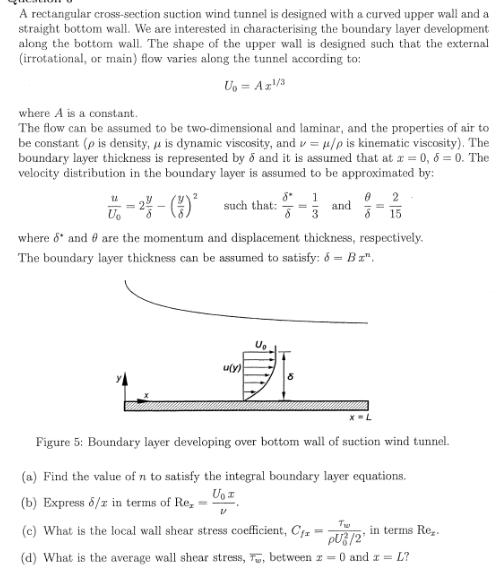
A rectangular cross-section suction wind tunnel is designed with a curved upper wall and a straight bottom wall. We are interested in characterising the boundary layer development along the bottom wall. The shape of the upper wall is designed such that the external (irrotational, or main) flow varies along the tunnel according to: U = Az/3 where A is a constant. The flow can be assumed to be two-dimensional and laminar, and the properties of air to be constant (p is density, is dynamic viscosity, and = /p is kinematic viscosity). The boundary layer thickness is represented by 5 and it is assumed that at x = 0,6 =0. The velocity distribution in the boundary layer is assumed to be approximated by: 7.-2-(2) such that: u(y) 8 3 U where 8* and are the momentum and displacement thickness, respectively. The boundary layer thickness can be assumed to satisfy: 6 = Bz", 8 and 8 2 315 Figure 5: Boundary layer developing over bottom wall of suction wind tunnel. (a) Find the value of n to satisfy the integral boundary layer equations. (b) Express 8/2 in terms of Re, UI V (c) What is the local wall shear stress coefficient, Cf= Tw in terms Reg. PU/2 (d) What is the average wall shear stress, T, between z = 0 and z=L?
Step by Step Solution
There are 3 Steps involved in it

Get step-by-step solutions from verified subject matter experts
 Study Help