







Question: A relation R on the set A is irreflexive if for every a elementof A, (a, a) NotElement R. That is, R is irreflexive if
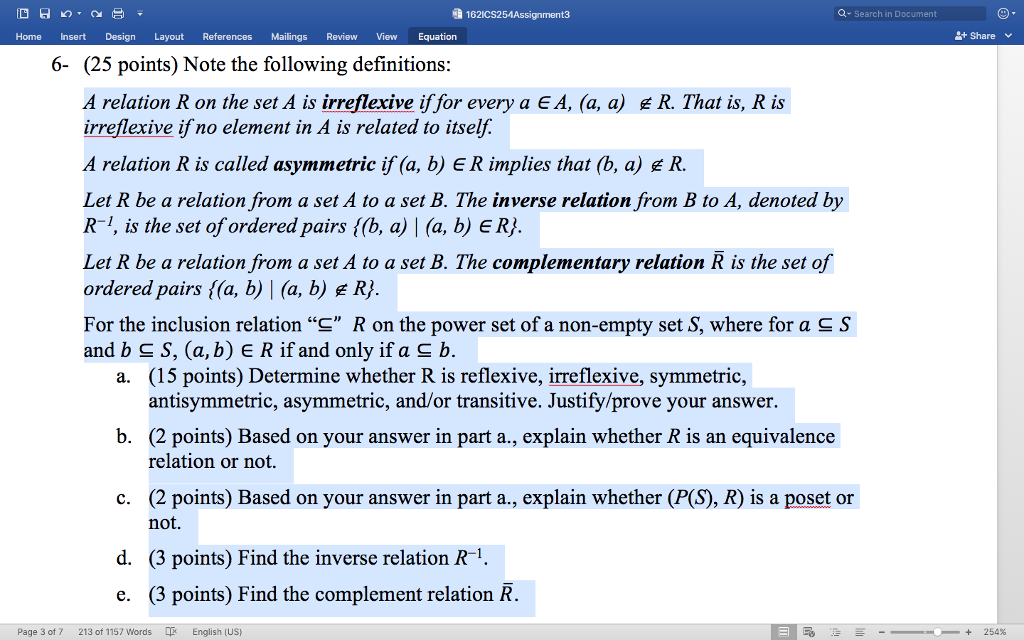
A relation R on the set A is irreflexive if for every a elementof A, (a, a) NotElement R. That is, R is irreflexive if no element in A is related to itself. A relation R is called asymmetric if (a, b) elementof R implies that (b, a) NotElement R. Let R be a relation from a set A to a set B. The inverse relation from B to A, denoted by R^-1, is the set of ordered pairs {(b, a) \ (a, b) elementof R}. Let R be a relation from a set A to a set B. The complementary relation R^bar is the set of ordered pairs {(a, b) \ (a, b) NotElement R} For the inclusion relation "subsetorequalto" R on the power set of a non-empty set S, where for a subsetorequalto s and b subsetorequalto S, (a, b) elementof R if and only if a subsetorequalto b. a. Determine whether R is reflexive, irreflexive. symmetric, antisymmetric, asymmetric, and/or transitive. Justify/prove your answer. b. Based on your answer in part a., explain whether R is an equivalence relation or not. c. Based on your answer in part a., explain whether (P(S), R) is a poset or not. d. Find the inverse relation R^-1. e. Find the complement relation R^bar. A relation R on the set A is irreflexive if for every a elementof A, (a, a) NotElement R. That is, R is irreflexive if no element in A is related to itself. A relation R is called asymmetric if (a, b) elementof R implies that (b, a) NotElement R. Let R be a relation from a set A to a set B. The inverse relation from B to A, denoted by R^-1, is the set of ordered pairs {(b, a) \ (a, b) elementof R}. Let R be a relation from a set A to a set B. The complementary relation R^bar is the set of ordered pairs {(a, b) \ (a, b) NotElement R} For the inclusion relation "subsetorequalto" R on the power set of a non-empty set S, where for a subsetorequalto s and b subsetorequalto S, (a, b) elementof R if and only if a subsetorequalto b. a. Determine whether R is reflexive, irreflexive. symmetric, antisymmetric, asymmetric, and/or transitive. Justify/prove your answer. b. Based on your answer in part a., explain whether R is an equivalence relation or not. c. Based on your answer in part a., explain whether (P(S), R) is a poset or not. d. Find the inverse relation R^-1. e. Find the complement relation R^bar
Step by Step Solution
There are 3 Steps involved in it

Get step-by-step solutions from verified subject matter experts
 Study Help