







Question: A response (or Y ) variable Is BAD, Which is coded as U (good credit risk) or 1 (bad credit risk). The other variables are:
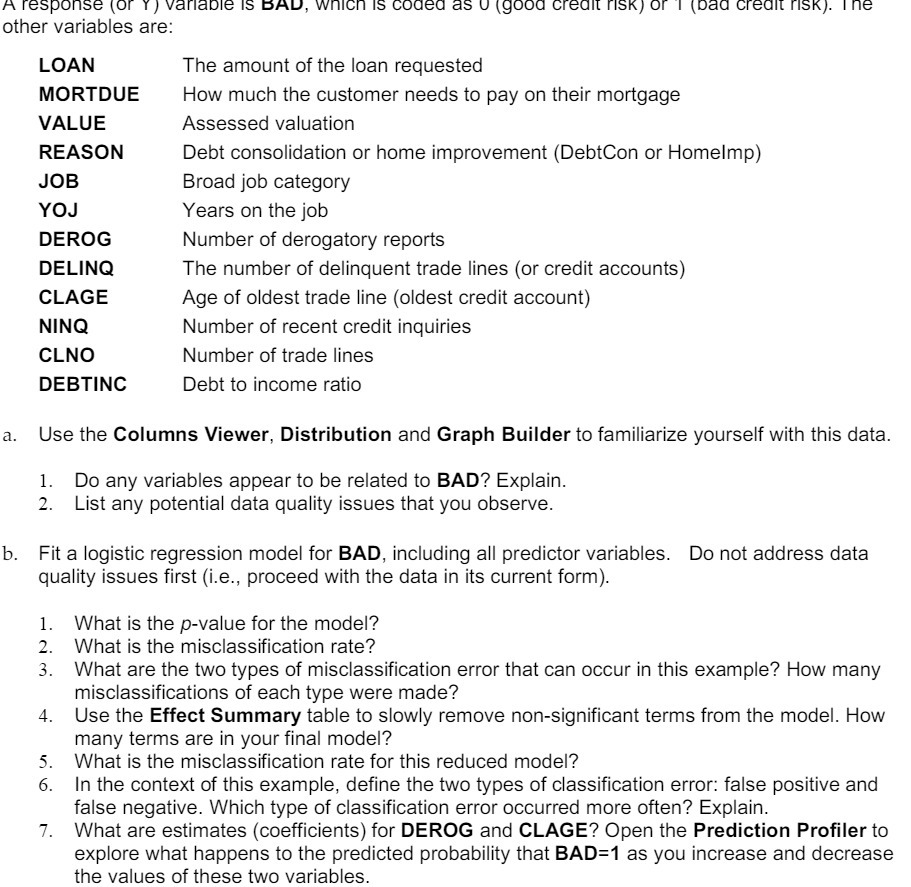
A response (or Y ) variable Is BAD, Which is coded as U (good credit risk) or 1 (bad credit risk). The other variables are: LOAN The amount of the loan requested MORTDUE How much the customer needs to pay on their mortgage VALUE Assessed valuation REASON Debt consolidation or home improvement (DebtCon or Homelmp) JOB Broad job category YOJ Years on the job DEROG Number of derogatory reports DELINQ The number of delinquent trade lines (or credit accounts) CLAGE Age of oldest trade line (oldest credit account) NINQ Number of recent credit inquiries CLNO Number of trade lines DEBTINC Debt to income ratio a. Use the Columns Viewer, Distribution and Graph Builder to familiarize yourself with this data. 1. Do any variables appear to be related to BAD? Explain. 2. List any potential data quality issues that you observe. b. Fit a logistic regression model for BAD, including all predictor variables. Do not address data quality issues first (i.e., proceed with the data in its current form). 1. What is the p-value for the model? What is the misclassification rate? 3. What are the two types of misclassification error that can occur in this example? How many misclassifications of each type were made? 4. Use the Effect Summary table to slowly remove non-significant terms from the model. How many terms are in your final model? 5. What is the misclassification rate for this reduced model? 6. In the context of this example, define the two types of classification error: false positive and false negative. Which type of classification error occurred more often? Explain. 7. What are estimates (coefficients) for DEROG and CLAGE? Open the Prediction Profiler to explore what happens to the predicted probability that BAD=1 as you increase and decrease the values of these two variables
Step by Step Solution
There are 3 Steps involved in it

Get step-by-step solutions from verified subject matter experts
 Study Help