Question: A restaurant chain is considering developing a special type of sandwiches to add to its standard product line. However, it is unclear whether the new
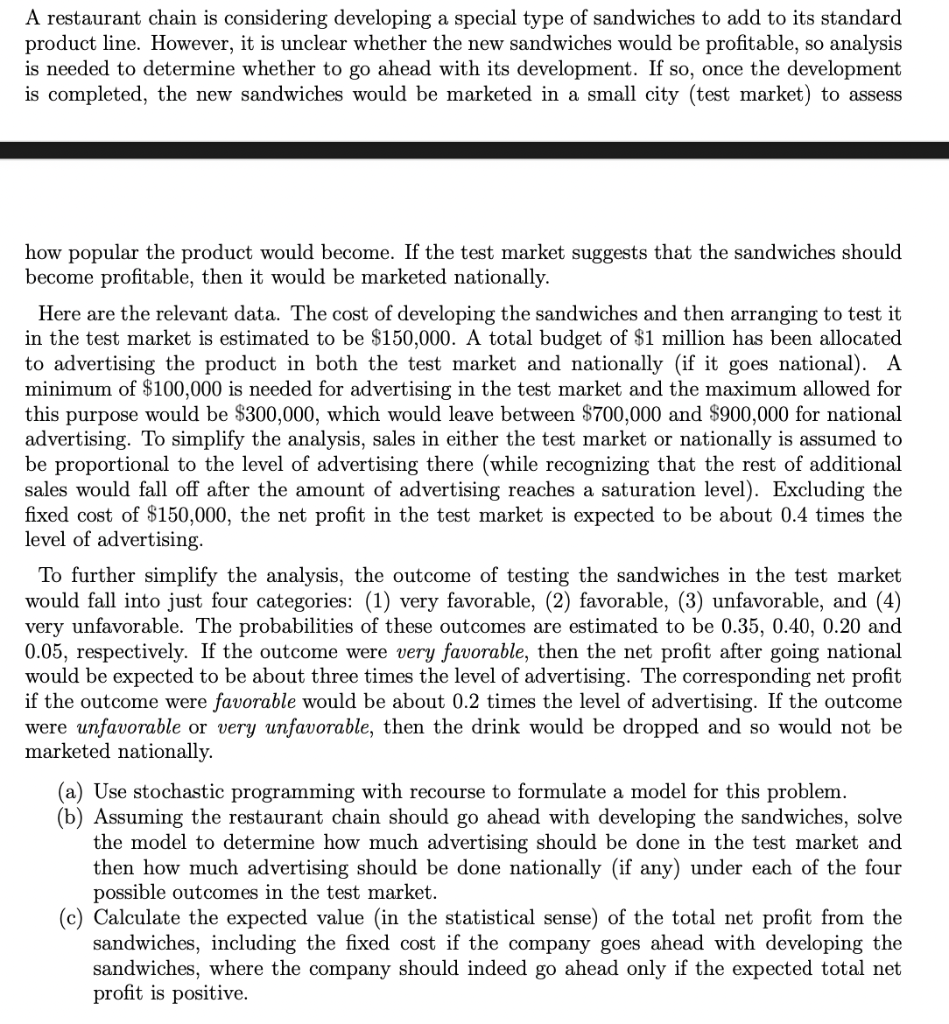
A restaurant chain is considering developing a special type of sandwiches to add to its standard product line. However, it is unclear whether the new sandwiches would be profitable, so analysis is needed to determine whether to go ahead with its development. If so, once the development is completed, the new sandwiches would be marketed in a small city (test market) to assess how popular the product would become. If the test market suggests that the sandwiches should become profitable, then it would be marketed nationally. Here are the relevant data. The cost of developing the sandwiches and then arranging to test it in the test market is estimated to be $150,000. A total budget of $1 million has been allocated to advertising the product in both the test market and nationally (if it goes national). A minimum of $100,000 is needed for advertising in the test market and the maximum allowed for this purpose would be $300,000, which would leave between $700,000 and $900,000 for national advertising. To simplify the analysis, sales in either the test market or nationally is assumed to be proportional to the level of advertising there (while recognizing that the rest of additional sales would fall off after the amount of advertising reaches a saturation level). Excluding the fixed cost of $150,000, the net profit in the test market is expected to be about 0.4 times the level of advertising. To further simplify the analysis, the outcome of testing the sandwiches in the test market would fall into just four categories: (1) very favorable, (2) favorable, (3) unfavorable, and (4) very unfavorable. The probabilities of these outcomes are estimated to be 0.35,0.40,0.20 and 0.05, respectively. If the outcome were very favorable, then the net profit after going national would be expected to be about three times the level of advertising. The corresponding net profit if the outcome were favorable would be about 0.2 times the level of advertising. If the outcome were unfavorable or very unfavorable, then the drink would be dropped and so would not be marketed nationally. (a) Use stochastic programming with recourse to formulate a model for this problem. (b) Assuming the restaurant chain should go ahead with developing the sandwiches, solve the model to determine how much advertising should be done in the test market and then how much advertising should be done nationally (if any) under each of the four possible outcomes in the test market. (c) Calculate the expected value (in the statistical sense) of the total net profit from the sandwiches, including the fixed cost if the company goes ahead with developing the sandwiches, where the company should indeed go ahead only if the expected total net profit is positive









 Study Help