



Question: A rm is making its production plans for next quarter, but the manager of the rm does not know what the price of the product
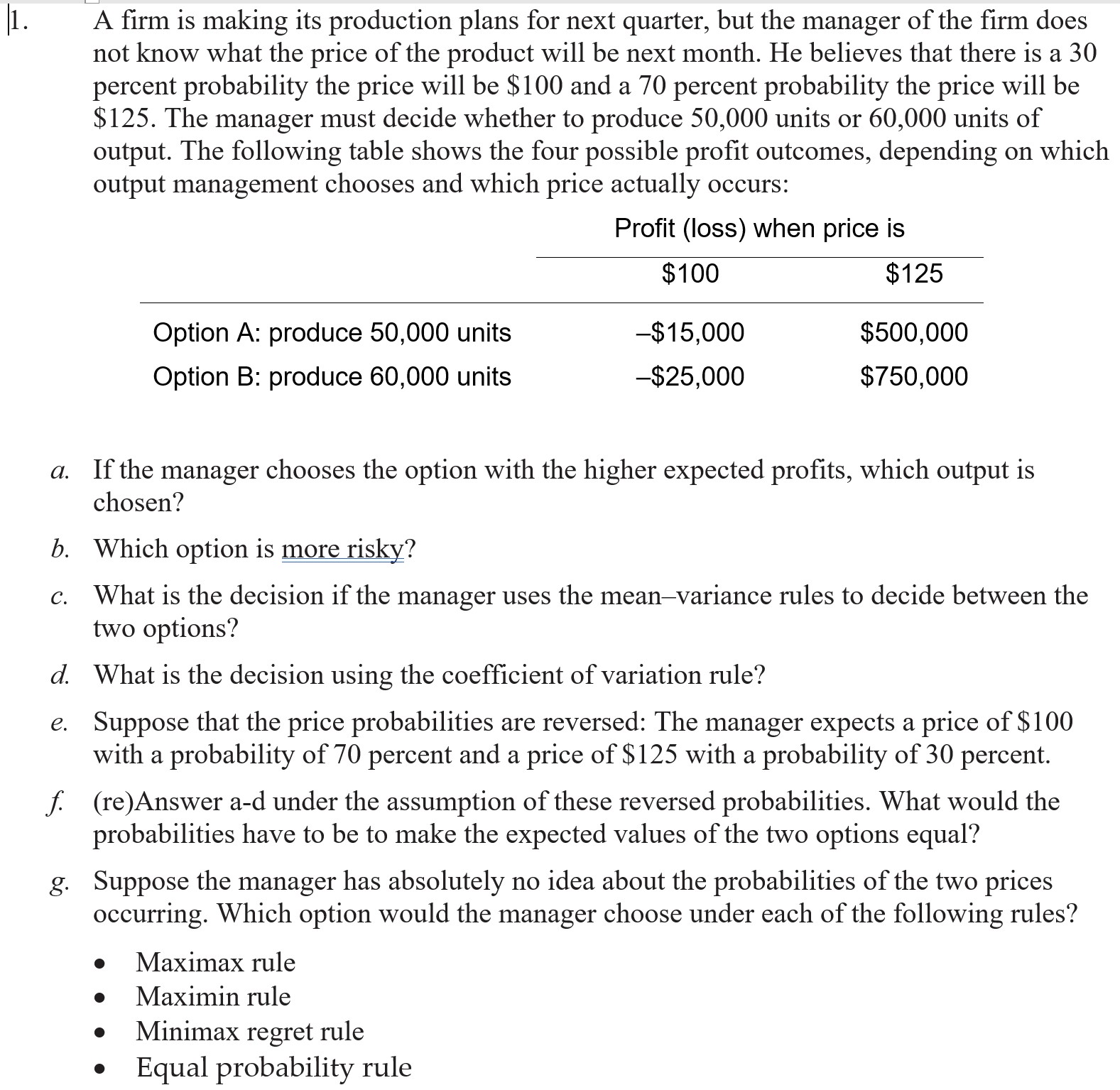
A rm is making its production plans for next quarter, but the manager of the rm does not know what the price of the product will be next month. He believes that there is a 30 percent probability the price will be $100 and a 70 percent probability the price will be $125. The manager must decide whether to produce 50,000 units or 60,000 units of output. The following table shows the four possible prot outcomes, depending on which output management chooses and which price actually occurs: Prot (loss) when price is $100 $125 Option A: produce 50,000 units $15,000 $500,000 Option B: produce 60,000 units $25,000 $750,000 If the manager chooses the option with the higher expected prots, which output is chosen? Which option is more risky? What is the decision if the manager uses the meanvariance rules to decide between the two options? What is the decision using the coefcient of variation ruie? Suppose that the price probabilities are reversed: The manager expects a price of $100 with a probability of 70 percent and a price of $125 with a probability of 30 percent. (re)Answer ad under the assumption of these reversed probabilities. What would the probabilities have to be to make the expected values of the two options equal? Suppose the manager has absolutely no idea about the probabilities of the two prices occurring. Which option would the manager choose under each of the following rules? 0 Maximax rule 0 Maximin rule I Minimax regret rule 0 Equal probability rule
Step by Step Solution
There are 3 Steps involved in it

Get step-by-step solutions from verified subject matter experts