



Question: A road between two cities has an average cost per trip given by: Average cost (S/ trip )=AC=100q100 where: q = flow. The demand function
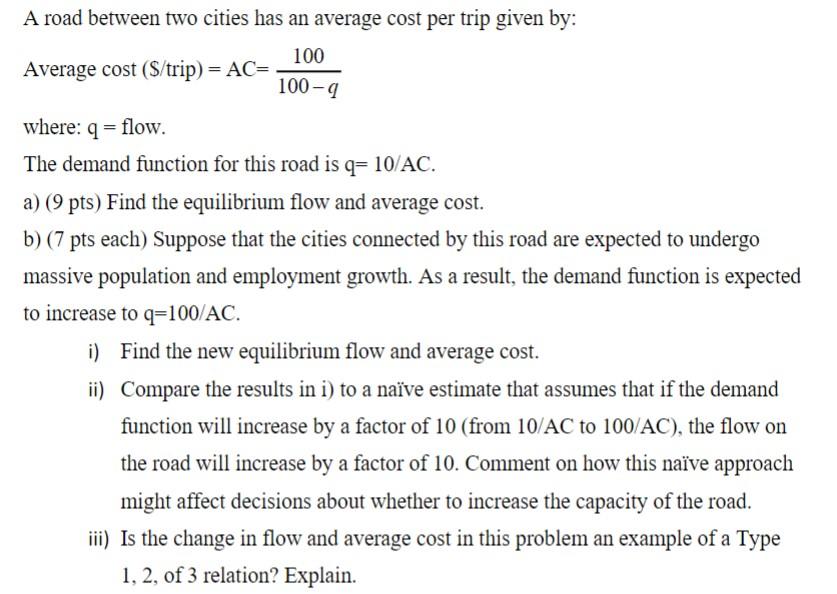
A road between two cities has an average cost per trip given by: Average cost (S/ trip )=AC=100q100 where: q = flow. The demand function for this road is q=10/AC. a) (9 pts ) Find the equilibrium flow and average cost. b) (7 pts each) Suppose that the cities connected by this road are expected to undergo massive population and employment growth. As a result, the demand function is expected to increase to q=100/AC. i) Find the new equilibrium flow and average cost. ii) Compare the results in i) to a nave estimate that assumes that if the demand function will increase by a factor of 10 (from 10/AC to 100/AC), the flow on the road will increase by a factor of 10 . Comment on how this nave approach might affect decisions about whether to increase the capacity of the road. iii) Is the change in flow and average cost in this problem an example of a Type 1, 2, of 3 relation? Explain. A road between two cities has an average cost per trip given by: Average cost (S/ trip )=AC=100q100 where: q = flow. The demand function for this road is q=10/AC. a) (9 pts ) Find the equilibrium flow and average cost. b) (7 pts each) Suppose that the cities connected by this road are expected to undergo massive population and employment growth. As a result, the demand function is expected to increase to q=100/AC. i) Find the new equilibrium flow and average cost. ii) Compare the results in i) to a nave estimate that assumes that if the demand function will increase by a factor of 10 (from 10/AC to 100/AC), the flow on the road will increase by a factor of 10 . Comment on how this nave approach might affect decisions about whether to increase the capacity of the road. iii) Is the change in flow and average cost in this problem an example of a Type 1, 2, of 3 relation? Explain
Step by Step Solution
There are 3 Steps involved in it

Get step-by-step solutions from verified subject matter experts