Question: A robot performs a loading and unloading operation for a machine tool. The work cycle consists of the following sequence of activities: Seq. Activity Time
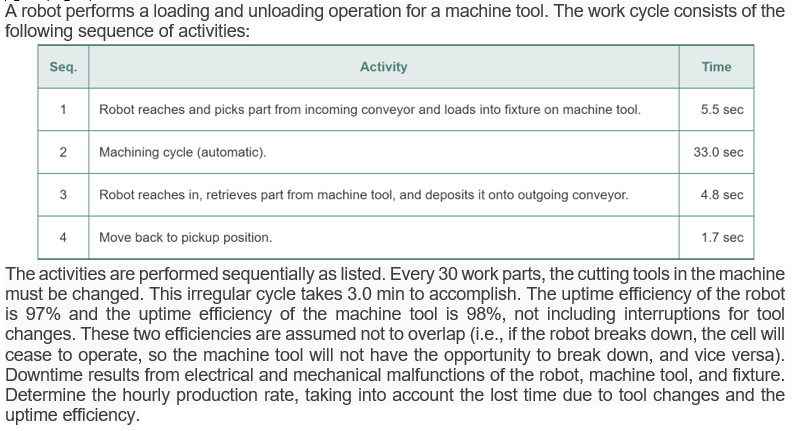
A robot performs a loading and unloading operation for a machine tool. The work cycle consists of the following sequence of activities: Seq. Activity Time 1 Robot reaches and picks part from incoming conveyor and loads into fixture on machine tool. 5.5 sec 2 Machining cycle (automatic). 33.0 sec 3 Robot reaches in, retrieves part from machine tool, and deposits it onto outgoing conveyor. 4.8 sec 4 Move back to pickup position. 1.7 sec The activities are performed sequentially as listed. Every 30 work parts, the cutting tools in the machine must be changed. This irregular cycle takes 3.0 min to accomplish. The uptime efficiency of the robot is 97% and the uptime efficiency of the machine tool is 98%, not including interruptions for tool changes. These two efficiencies are assumed not to overlap (i.e., if the robot breaks down, the cell will cease to operate, so the machine tool will not have the opportunity to break down, and vice versa). Downtime results from electrical and mechanical malfunctions of the robot, machine tool, and fixture. Determine the hourly production rate, taking into account the lost time due to tool changes and the uptime efficiency. A robot performs a loading and unloading operation for a machine tool. The work cycle consists of the following sequence of activities: Seq. Activity Time 1 Robot reaches and picks part from incoming conveyor and loads into fixture on machine tool. 5.5 sec 2 Machining cycle (automatic). 33.0 sec 3 Robot reaches in, retrieves part from machine tool, and deposits it onto outgoing conveyor. 4.8 sec 4 Move back to pickup position. 1.7 sec The activities are performed sequentially as listed. Every 30 work parts, the cutting tools in the machine must be changed. This irregular cycle takes 3.0 min to accomplish. The uptime efficiency of the robot is 97% and the uptime efficiency of the machine tool is 98%, not including interruptions for tool changes. These two efficiencies are assumed not to overlap (i.e., if the robot breaks down, the cell will cease to operate, so the machine tool will not have the opportunity to break down, and vice versa). Downtime results from electrical and mechanical malfunctions of the robot, machine tool, and fixture. Determine the hourly production rate, taking into account the lost time due to tool changes and the uptime efficiency









 Study Help