







Question: A rocket of initial mass mo and zero initial velocity ejects exhaust at a constant velocity vex relative to itself in outer space (no gravity).
A rocket of initial mass mo and zero initial velocity ejects exhaust at a constant velocity vex relative to itself in outer space (no gravity).
1) Using conservation of momentum, derive the "rocket equation" for the rocket velocity v as a function of the residual mass m of the rocket. Explain why space engineers use multistage rockets.
2) If the above rocket ejects mass at a constant rate: dm/dt = - c,
Find the rocket's distance traveled as a time function -- use integral for ln(t), and Discuss the limit when m ? 0.
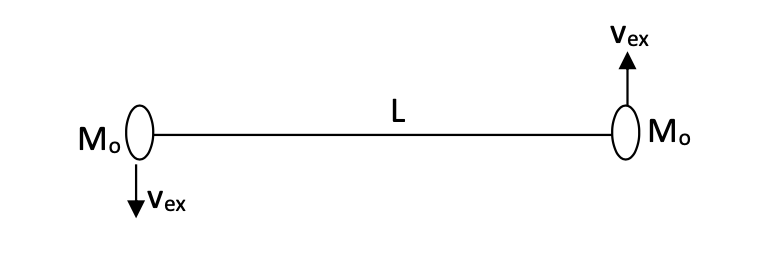
3) A long rigid massless rod of length L connects two rockets of initial mass M0 and infinitesimal size at opposite ends. If the two rockets eject gas with constant exhaust velocity V_ex in opposite directions perpendicular to the rod, draw the figure and find the angular velocity ? as a function of each rocket's residual mass m.
\f
Step by Step Solution
There are 3 Steps involved in it

Get step-by-step solutions from verified subject matter experts
 Study Help