



Question: A rocket's mass m(t) is a function of time t because it decreases as it burns fuel. Newton's law states that the equation of motion
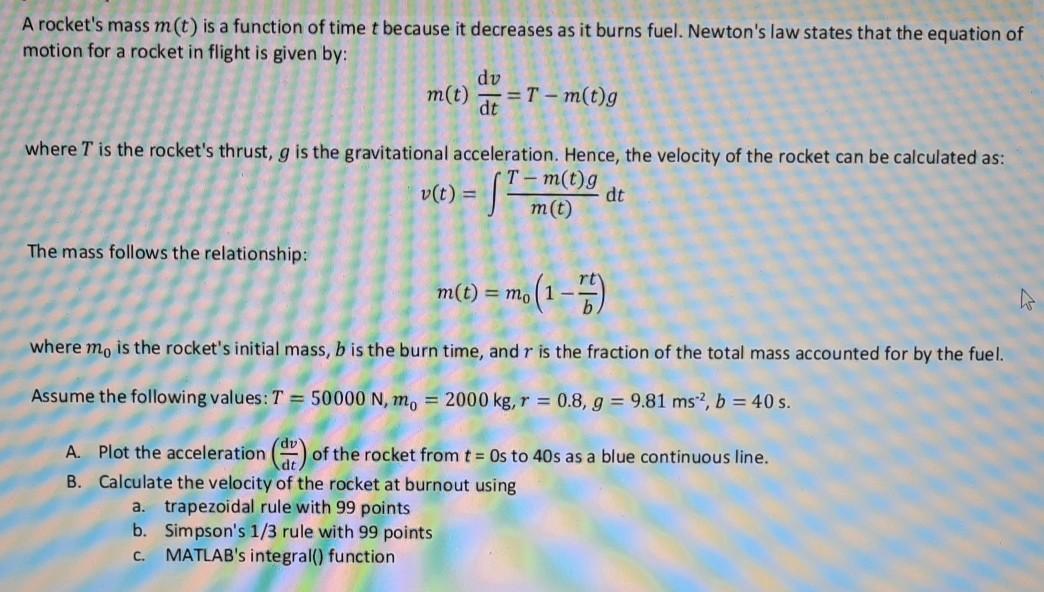
A rocket's mass m(t) is a function of time t because it decreases as it burns fuel. Newton's law states that the equation of motion for a rocket in flight is given by: dv m(t) = T - m(t)g dt where T is the rocket's thrust, g is the gravitational acceleration. Hence, the velocity of the rocket can be calculated as: T-m(t)g v(t) = dt m(t) The mass follows the relationship: m(t) = mo = mo (1-3) where mo is the rocket's initial mass, b is the burn time, and r is the fraction of the total mass accounted for by the fuel. Assume the following values: T = 50000 N, m, = 2000 kg, r = 0.8, g = 9.81 ms"?, b = 40 s. A. Plot the acceleration () of the rocket from t = Os to 40s as a blue continuous line. B. Calculate the velocity of the rocket at burnout using a. trapezoidal rule with 99 points b. Simpson's 1/3 rule with 99 points MATLAB's integral() function c
Step by Step Solution
There are 3 Steps involved in it

Get step-by-step solutions from verified subject matter experts