







Question: A rotating shaft carries three masses, ( A , B ) , and ( C ) rigidly attached to it; the
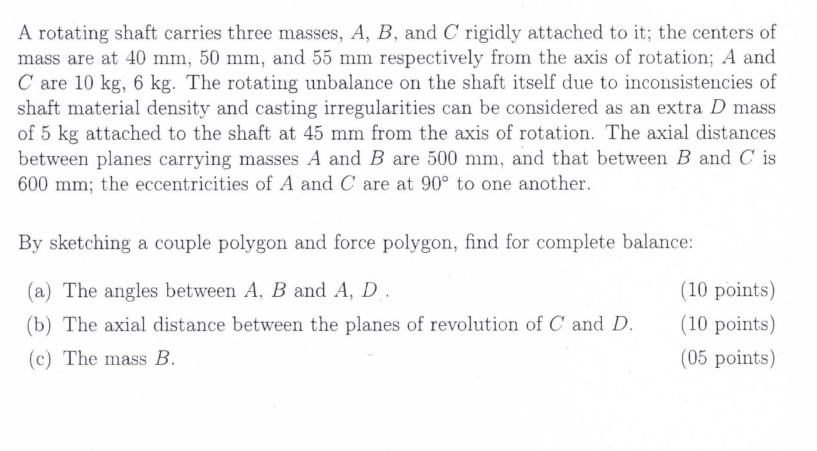
A rotating shaft carries three masses, A B and C rigidly attached to it; the centers of mass are at mathrm~mmmathrm~mm and mm respectively from the axis of rotation; A and C are mathrm~kgmathrm~kg The rotating unbalance on the shaft itself due to inconsistencies of shaft material density and casting irregularities can be considered as an extra D mass of kg attached to the shaft at mm from the axis of rotation. The axial distances between planes carrying masses A and B are mm and that between B and C is mm ; the eccentricities of A and C are at circ to one another.
By sketching a couple polygon and force polygon, find for complete balance:
a The angles between A B and A D
points
b The axial distance between the planes of revolution of C and D
points
c The mass B
points
Step by Step Solution
There are 3 Steps involved in it
1 Expert Approved Answer
Step: 1 Unlock

Question Has Been Solved by an Expert!
Get step-by-step solutions from verified subject matter experts
Step: 2 Unlock
Step: 3 Unlock
 Study Help