







Question: A scientist studies whether jogging leads to a reduction in one's pulse rate. To this end, 8 non-jogging volunteers participated in a one-month jogging program.
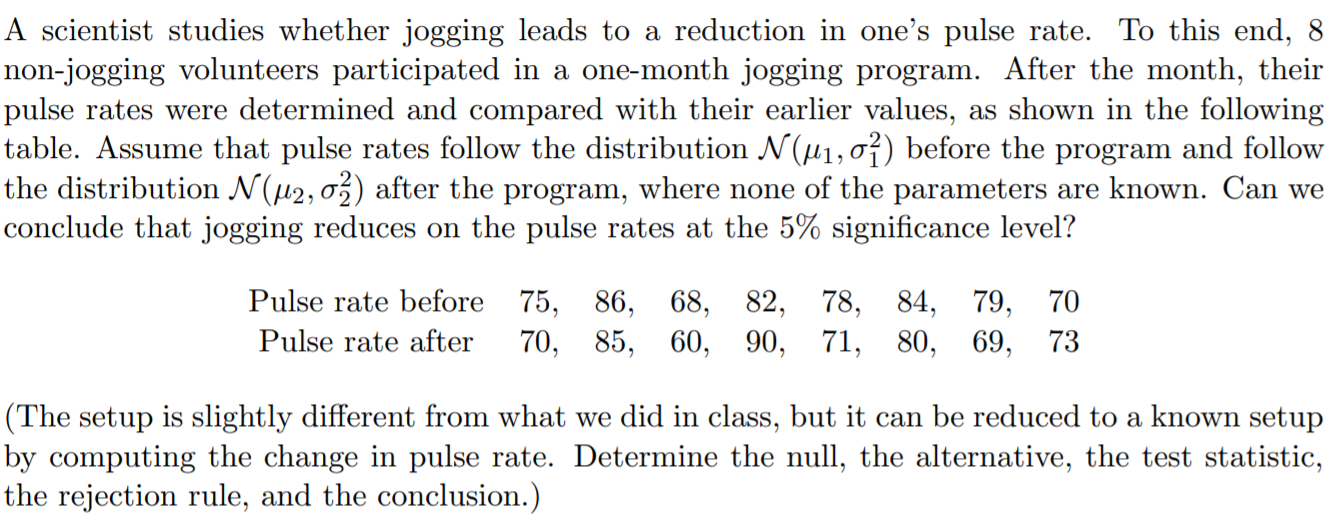
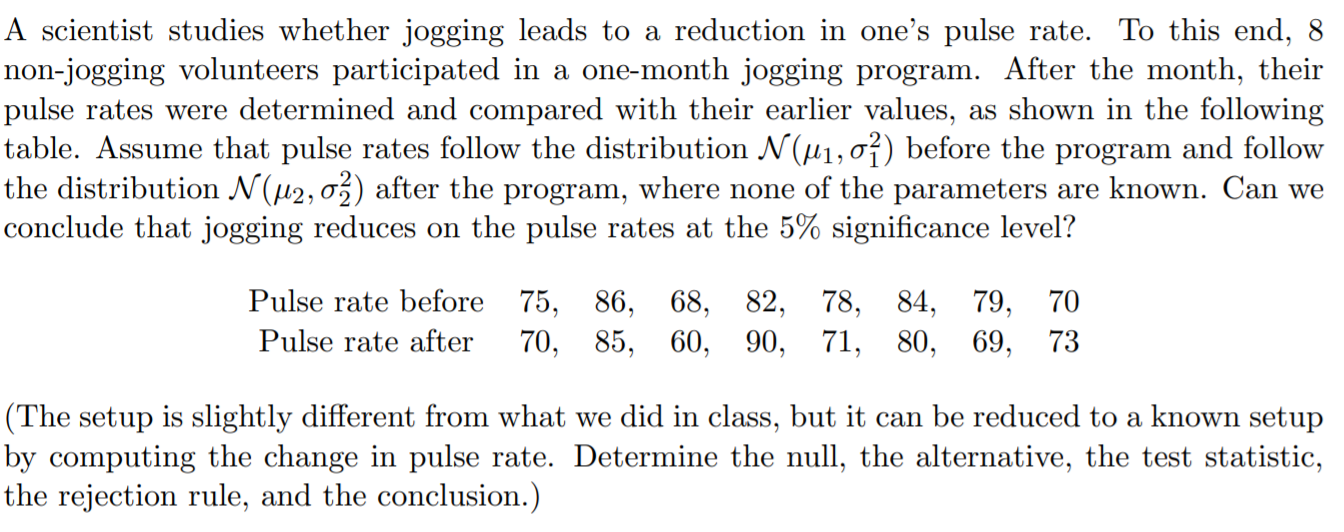
A scientist studies whether jogging leads to a reduction in one's pulse rate. To this end, 8 non-jogging volunteers participated in a one-month jogging program. After the month, their pulse rates were determined and compared with their earlier values, as shown in the following table. Assume that pulse rates follow the distribution N(,u1, 0%) before the program and follow the distribution NUJQ, 0'3) after the program, where none of the parameters are known. Can we conclude that jogging reduces on the pulse rates at the 5% signicance level? Pulse rate before 75, 86, 68, 82, 78, 84, 79, 70 Pulse rate after 70, 85, 60, 90, 71, 80, 69, 73 (The setup is slightly different from what we did in class, but it can be reduced to a known setup by computing the change in pulse rate. Determine the null, the alternative, the test statistic, the rejection rule, and the conclusion.)
Step by Step Solution
There are 3 Steps involved in it

Get step-by-step solutions from verified subject matter experts
 Study Help