



Question: a) Set up Lagrangian to represent the situation faced by the firm, assuming that it wishes to comply with the standard (i.e., treat the regulation
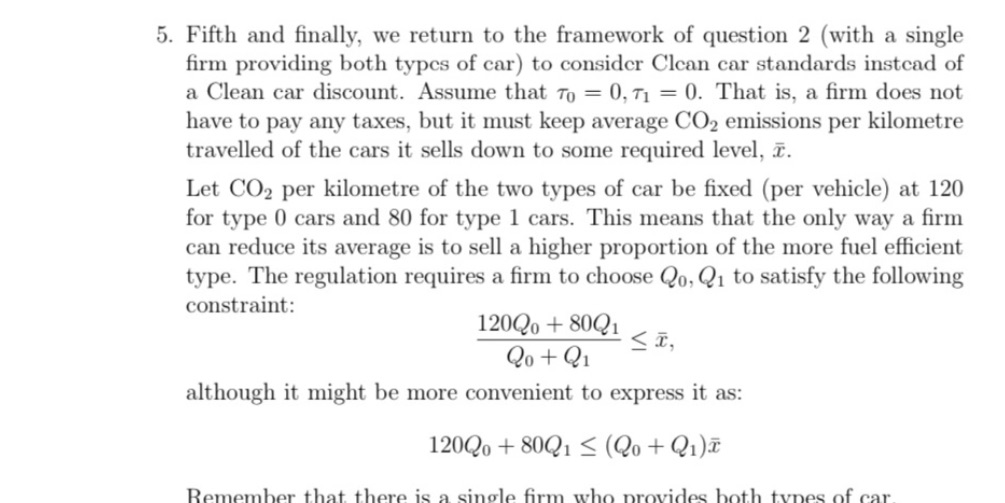
a) Set up Lagrangian to represent the situation faced by the firm, assuming that it wishes to comply with the standard (i.e., treat the regulation as a constraint). Remember to set both tax rates to zero.(b) Take first-order conditions.(c) Is there some value of the standard x ? that would induce the firm to choose the values of Q0, Q1 proposed in question 1(d) (i.e., Q0 = Q1 = 60)? If so, what is it?(d) What is the intuition for your answer to question 5(c)?
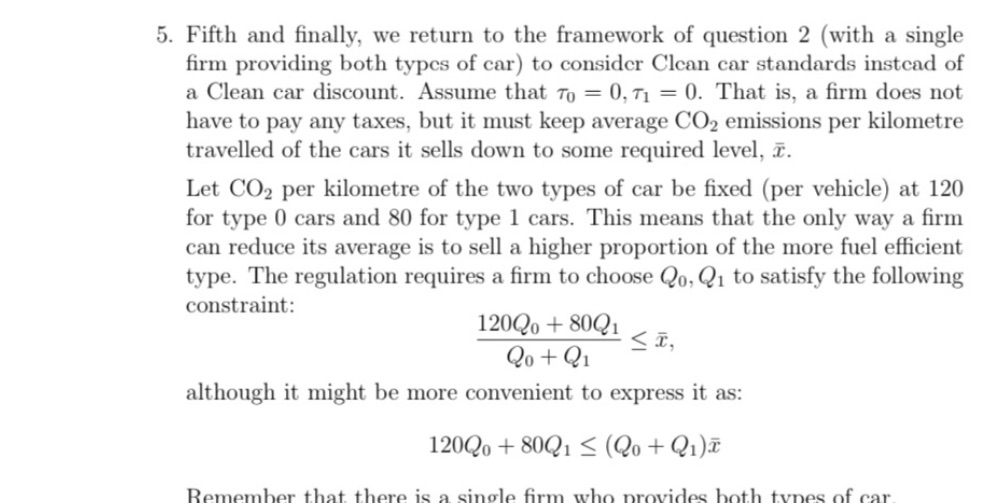
5. Fifth and nally, we return to the framework of question 2 (with a single rm providing both types of car) to consider Clean ear standards instead of a Clean car discount. Assume that To = 0,71 = 0. That is, a rm does not have to pay any taxes, but it must keep average CO: emissions per kilometre travelled of the cars it sells down to some required level, 5:. Let CO; per kilometre of the two types of car be xed (per vehicle) at 120 for type 0 cars and 80 for type 1 cars. This means that the only way a rm can reduce its average is to sell a higher proportion of the more fuel eicient type. The regulation requires a rm to choose Q0, 01 to satisfy the following constraint: 12000 + 3001
Step by Step Solution
There are 3 Steps involved in it

Get step-by-step solutions from verified subject matter experts