







Question: A silicon 'chip' has the dimensions 8 x 2 x 2 mm. (i) Calculate its resistance as measured between the square faces, assuming it
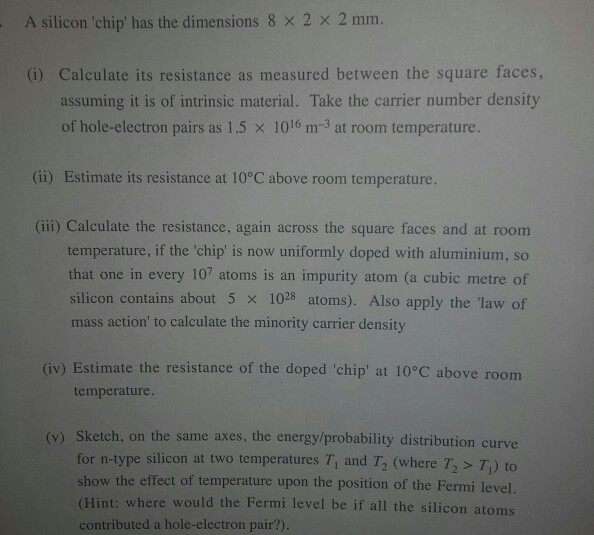
A silicon 'chip' has the dimensions 8 x 2 x 2 mm. (i) Calculate its resistance as measured between the square faces, assuming it is of intrinsic material. Take the carrier number density of hole-electron pairs as 1.5 x 10¹⁶ m-3 at room temperature. (ii) Estimate its resistance at 10C above room temperature. (iii) Calculate the resistance, again across the square faces and at room temperature, if the 'chip' is now uniformly doped with aluminium, so that one in every 107 atoms is an impurity atom (a cubic metre of silicon contains about 5 x 1028 atoms). Also apply the law of mass action' to calculate the minority carrier density (iv) Estimate the resistance of the doped 'chip' at 10C above room temperature. (v) Sketch, on the same axes, the energy/probability distribution curve for n-type silicon at two temperatures T, and T (where T > T) to show the effect of temperature upon the position of the Fermi level. (Hint: where would the Fermi level be if all the silicon atoms contributed a hole-electron pair?).
Step by Step Solution
3.41 Rating (157 Votes )
There are 3 Steps involved in it
To solve this problem well proceed step by step for each part i Calculate the Resistance for Intrinsic Silicon 1 Given Data Dimensions 8 textmm times ... View full answer

Get step-by-step solutions from verified subject matter experts
 Study Help