







Question: A simple pendulum consists of a small object (the pendulum bob) of mass m suspended from the end of a lightweight cord of length


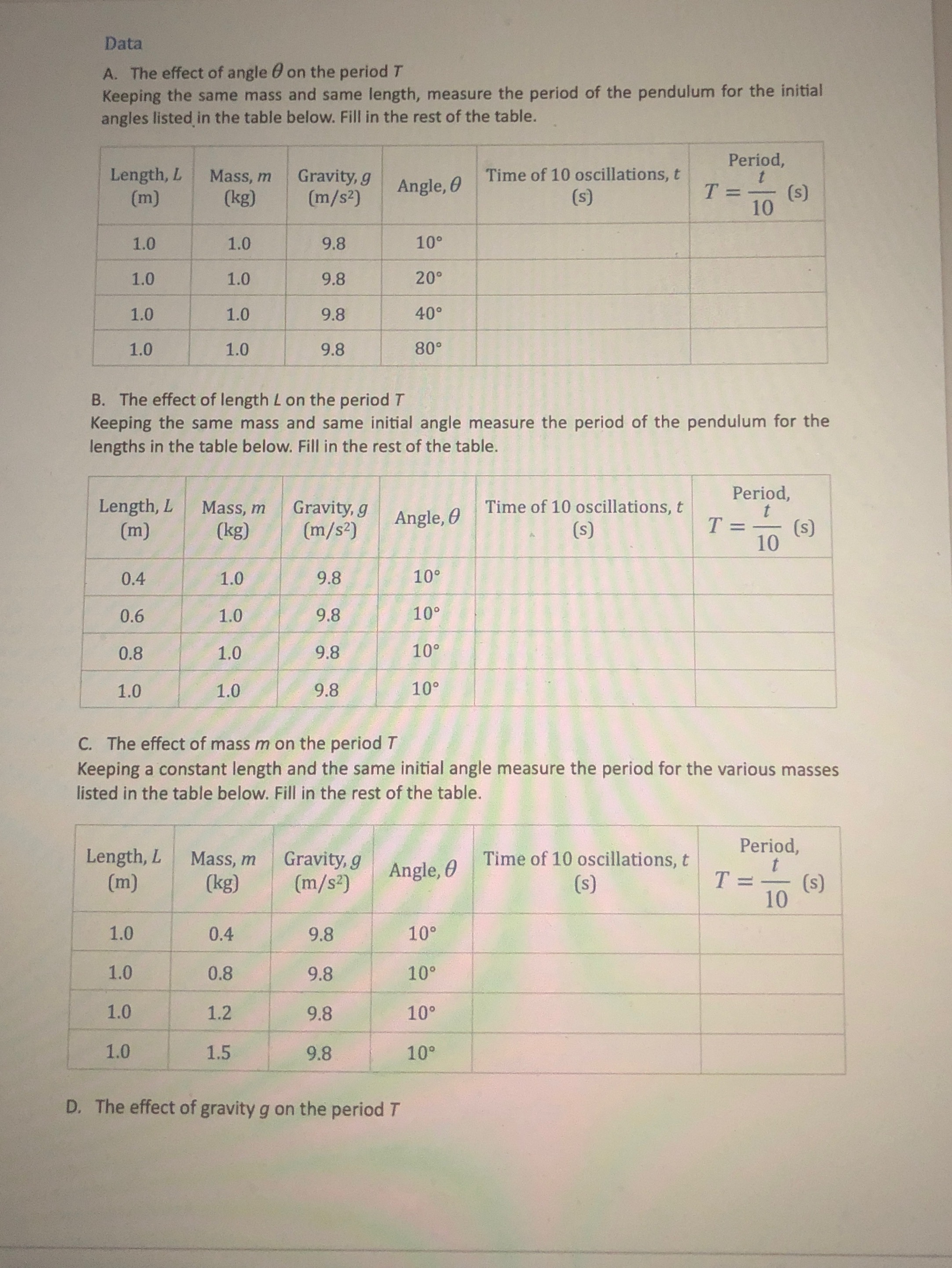
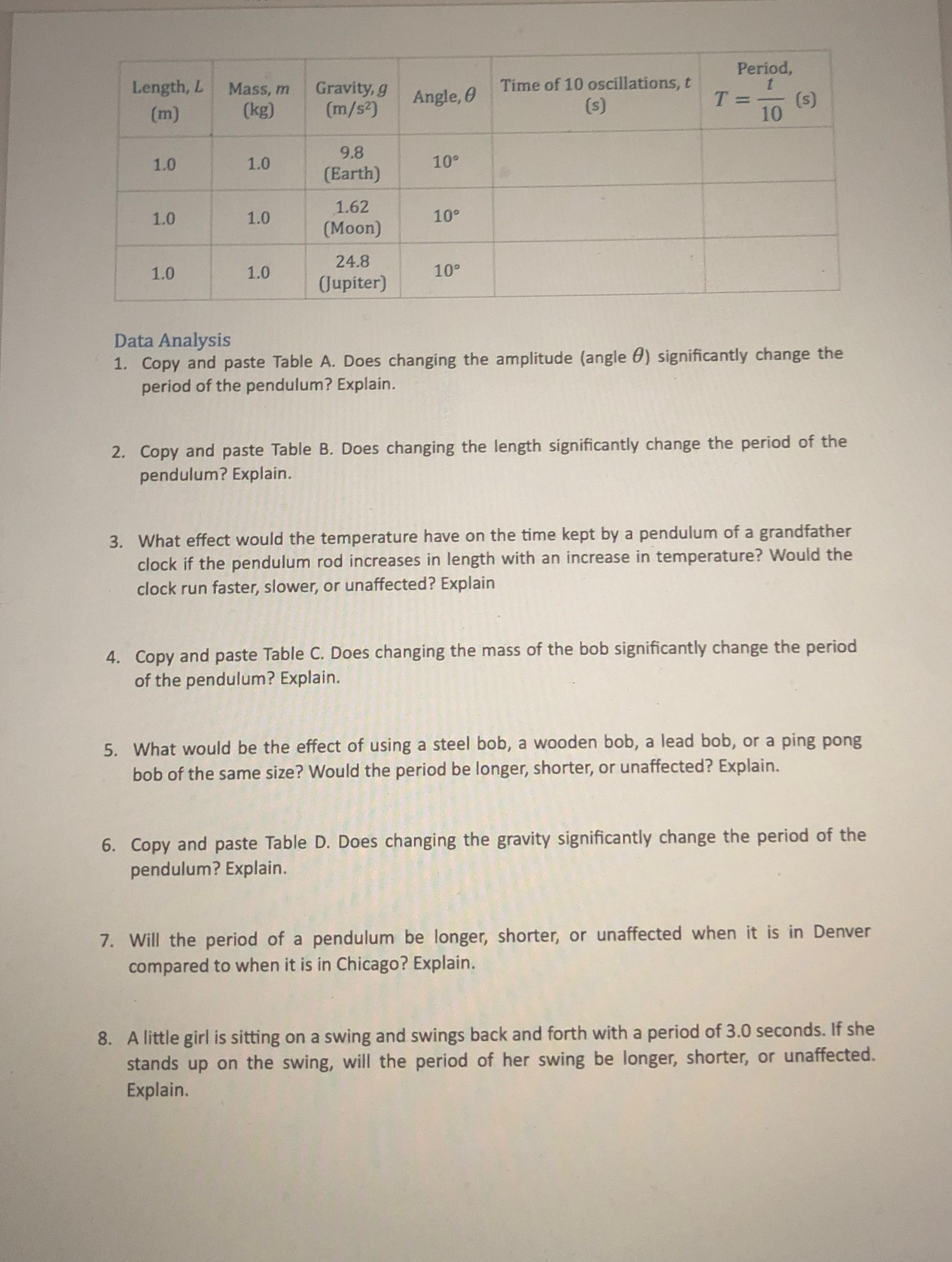
A simple pendulum consists of a small object (the pendulum bob) of mass m suspended from the end of a lightweight cord of length L. When a pendulum is displaced sideways from its equilibrium position, a restoring force due to gravity will accelerate it back toward the equilibrium position. frictionless pivot amplitude e massless rod bob's trajectory equilibrium position massive bob The period of oscillation is the time it takes the pendulum to make one full back and forth swing. The equation for the period of a simple pendulum for small arcs (small angle ) is given by L T= 2 g where T is the period, L is the length of the pendulum, and g is the acceleration due to gravity. Procedure Click the following link to run a simulation of an oscillating pendulum: . https://phet.colorado.edu/sims/html/pendulum-lab/latest/pendulum-lab_en.html Move the sliders to select values of L, m, and g. Pull the pendulum sideways and read the value of angle on the protractor. Release to make the pendulum swings back and forth. Start the stopwatch to measure the time t = 107 for ten full oscillations, and then calculate T by dividing t by 10. Example: If it takes 20.1 second for 10 swings, back and forth, the period is 2.01 second. Conduct data analysis on: A. The effect of angle on the period T B. The effect of length L on the period T C. The effect of mass m on the period T D. The effect of gravity g on the period T Data A. The effect of angle on the period T Keeping the same mass and same length, measure the period of the pendulum for the initial angles listed in the table below. Fill in the rest of the table. Length, L (m) Mass, m (kg) Gravity, g (m/s) Time of 10 oscillations, t Period, t Angle, (s) T = (s) 10 1.0 1.0 9.8 10 1.0 1.0 9.8 20 1.0 1.0 9.8 40 1.0 1.0 9.8 80 B. The effect of length L on the period T Keeping the same mass and same initial angle measure the period of the pendulum for the lengths in the table below. Fill in the rest of the table. Length, L Mass, m Gravity, g Angle, (m) (kg) (m/s) Time of 10 oscillations, t (s) Period, t T = (s) 10 0.4 1.0 9.8 10 0.6 1.0 9.8 10 0.8 1.0 9.8 10 1.0 1.0 9.8 10 C. The effect of mass m on the period T Keeping a constant length and the same initial angle measure the period for the various masses listed in the table below. Fill in the rest of the table. Period, Length, L Mass, m (m) (kg) Gravity, g (m/s) Angle, Time of 10 oscillations, t (s) T = (s) 10 1.0 0.4 9.8 10 1.0 0.8 9.8 10 1.0 1.2 9.8 10 1.0 1.5 9.8 10 D. The effect of gravity g on the period T Period, Length, L (m) (m) Mass, m (kg) Gravity, g Angle, 0 (m/s) Time of 10 oscillations, t (s) T = (s) 10 9.8 1.0 1.0 10 (Earth) 1.62 1.0 1.0 10 (Moon) 1.0 1.0 24.8 (Jupiter) 10 Data Analysis 1. Copy and paste Table A. Does changing the amplitude (angle 0) significantly change the period of the pendulum? Explain. 2. Copy and paste Table B. Does changing the length significantly change the period of the pendulum? Explain. 3. What effect would the temperature have on the time kept by a pendulum of a grandfather clock if the pendulum rod increases in length with an increase in temperature? Would the clock run faster, slower, or unaffected? Explain 4. Copy and paste Table C. Does changing the mass of the bob significantly change the period of the pendulum? Explain. 5. What would be the effect of using a steel bob, a wooden bob, a lead bob, or a ping pong bob of the same size? Would the period be longer, shorter, or unaffected? Explain. 6. Copy and paste Table D. Does changing the gravity significantly change the period of the pendulum? Explain. 7. Will the period of a pendulum be longer, shorter, or unaffected when it is in Denver compared to when it is in Chicago? Explain. 8. A little girl is sitting on a swing and swings back and forth with a period of 3.0 seconds. If she stands up on the swing, will the period of her swing be longer, shorter, or unaffected. Explain.
Step by Step Solution
There are 3 Steps involved in it

Get step-by-step solutions from verified subject matter experts
 Study Help