







Question: A single level warehouse building has a 5000 m2 floor area for storage and a two level office attached to one end of the warehouse.
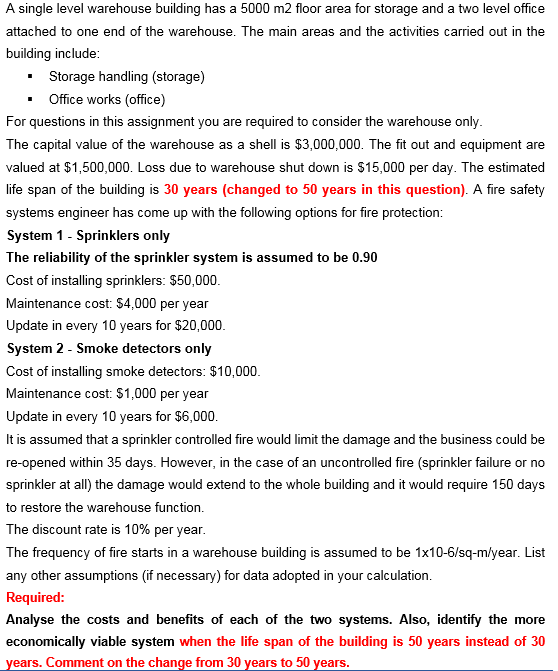
A single level warehouse building has a 5000 m2 floor area for storage and a two level office attached to one end of the warehouse. The main areas and the activities carried out in the building include: Storage handling (storage) Office works (office) For questions in this assignment you are required to consider the warehouse only. The capital value of the warehouse as a shell is $3,000,000. The fit out and equipment are valued at $1,500,000. Loss due to warehouse shut down is $15,000 per day. The estimated life span of the building is 30 years (changed to 50 years in this question). A fire safety systems engineer has come up with the following options for fire protection: System 1 - Sprinklers only The reliability of the sprinkler system is assumed to be 0.90 Cost of installing sprinklers: $50,000. Maintenance cost: $4,000 per year Update in every 10 years for $20,000. System 2 - Smoke detectors only Cost of installing smoke detectors: $10,000. Maintenance cost: $1,000 per year Update in every 10 years for $6,000. It is assumed that a sprinkler controlled fire would limit the damage and the business could be re-opened within 35 days. However, in the case of an uncontrolled fire (sprinkler failure or no sprinkler at all) the damage would extend to the whole building and it would require 150 days to restore the warehouse function. The discount rate is 10% per year. The frequency of fire starts in a warehouse building is assumed to be 1x10⁻⁶/sq-m/year. List any other assumptions (if necessary) for data adopted in your calculation. Required: Analyse the costs and benefits of each of the two systems. Also, identify the more economically viable system when the life span of the building is 50 years instead of 30 years. Comment on the change from 30 years to 50 years. A single level warehouse building has a 5000 m2 floor area for storage and a two level office attached to one end of the warehouse. The main areas and the activities carried out in the building include: Storage handling (storage) Office works (office) For questions in this assignment you are required to consider the warehouse only. The capital value of the warehouse as a shell is $3,000,000. The fit out and equipment are valued at $1,500,000. Loss due to warehouse shut down is $15,000 per day. The estimated life span of the building is 30 years (changed to 50 years in this question). A fire safety systems engineer has come up with the following options for fire protection: System 1 - Sprinklers only The reliability of the sprinkler system is assumed to be 0.90 Cost of installing sprinklers: $50,000. Maintenance cost: $4,000 per year Update in every 10 years for $20,000. System 2 - Smoke detectors only Cost of installing smoke detectors: $10,000. Maintenance cost: $1,000 per year Update in every 10 years for $6,000. It is assumed that a sprinkler controlled fire would limit the damage and the business could be re-opened within 35 days. However, in the case of an uncontrolled fire (sprinkler failure or no sprinkler at all) the damage would extend to the whole building and it would require 150 days to restore the warehouse function. The discount rate is 10% per year. The frequency of fire starts in a warehouse building is assumed to be 1x10⁻⁶/sq-m/year. List any other assumptions (if necessary) for data adopted in your calculation. Required: Analyse the costs and benefits of each of the two systems. Also, identify the more economically viable system when the life span of the building is 50 years instead of 30 years. Comment on the change from 30 years to 50 years
Step by Step Solution
There are 3 Steps involved in it

Get step-by-step solutions from verified subject matter experts
 Study Help