



Question: A single nail easily pops a balloon. Yet this balloon is laughing at you even while pressed on a bed of sharp nails. Why is
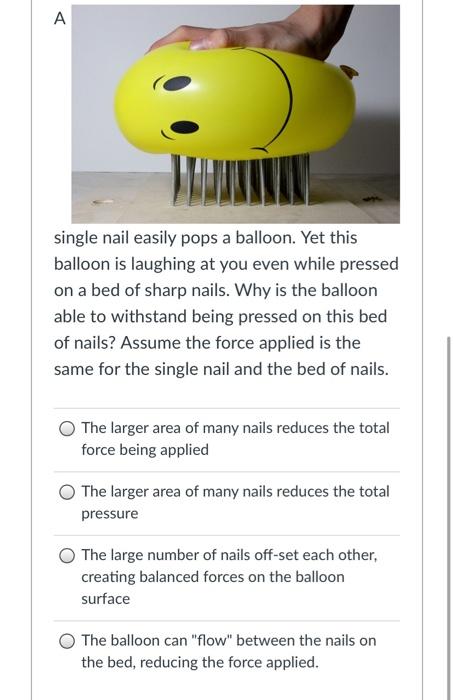
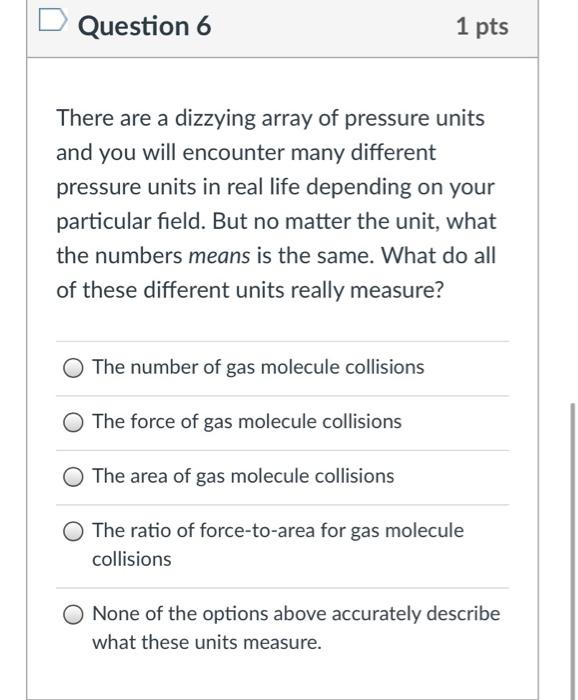
A single nail easily pops a balloon. Yet this balloon is laughing at you even while pressed on a bed of sharp nails. Why is the balloon able to withstand being pressed on this bed of nails? Assume the force applied is the same for the single nail and the bed of nails. The larger area of many nails reduces the total force being applied The larger area of many nails reduces the total pressure The large number of nails off-set each other, creating balanced forces on the balloon surface The balloon can "flow" between the nails on the bed, reducing the force applied. Question 3 1 pts The force of a single molecule colliding with a surface is completely negligible. If this is true, how can gases exert any meaningful, measurable pressure? Because each molecule is moving very fast Because of the massive quantity of molecules colliding with a surface Because each molecule collides multiple times at the same point Because each molecule collides with a very large force in a very tiny area (large foce-to- area ratio for each molecule) Question 4 1 pts If you hold one arm straight up and the other straight down, you cannot feel (or measure) any significant difference in pressure on your hands. Why is that? Because all gas molecules have the same mass and impact with the same force. Because all gas molecules have the same speed and impact with the same force. Because an equal number of molecules collides with each hand. All of the options above are correct. Question 5 1 pts Which of the values below is not equivalent to 1 atm of pressure? 0 760 torr 0 760 mmHg 760 mbar O 101,325 Pa O 101.3 kPa 1.013 bar O 1,013 mbar O 14.7 psi Question 6 1 pts There are a dizzying array of pressure units and you will encounter many different pressure units in real life depending on your particular field. But no matter the unit, what the numbers means is the same. What do all of these different units really measure? The number of gas molecule collisions The force of gas molecule collisions The area of gas molecule collisions The ratio of force-to-area for gas molecule collisions None of the options above accurately describe what these units measure
Step by Step Solution
There are 3 Steps involved in it

Get step-by-step solutions from verified subject matter experts