







Question: A situation that can arise in casecontrol sampling is where there is prior information on the odds ratio (OR), perhaps based on a previous case-control
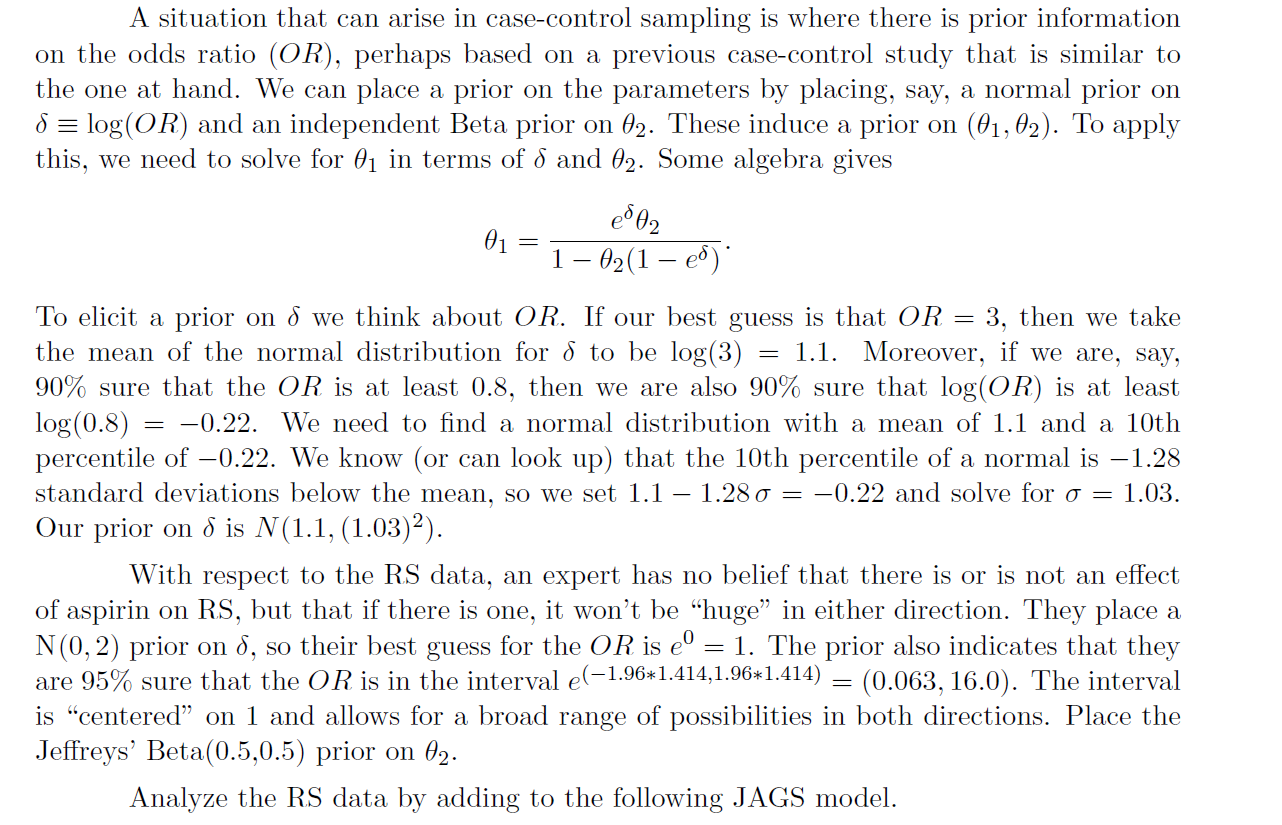
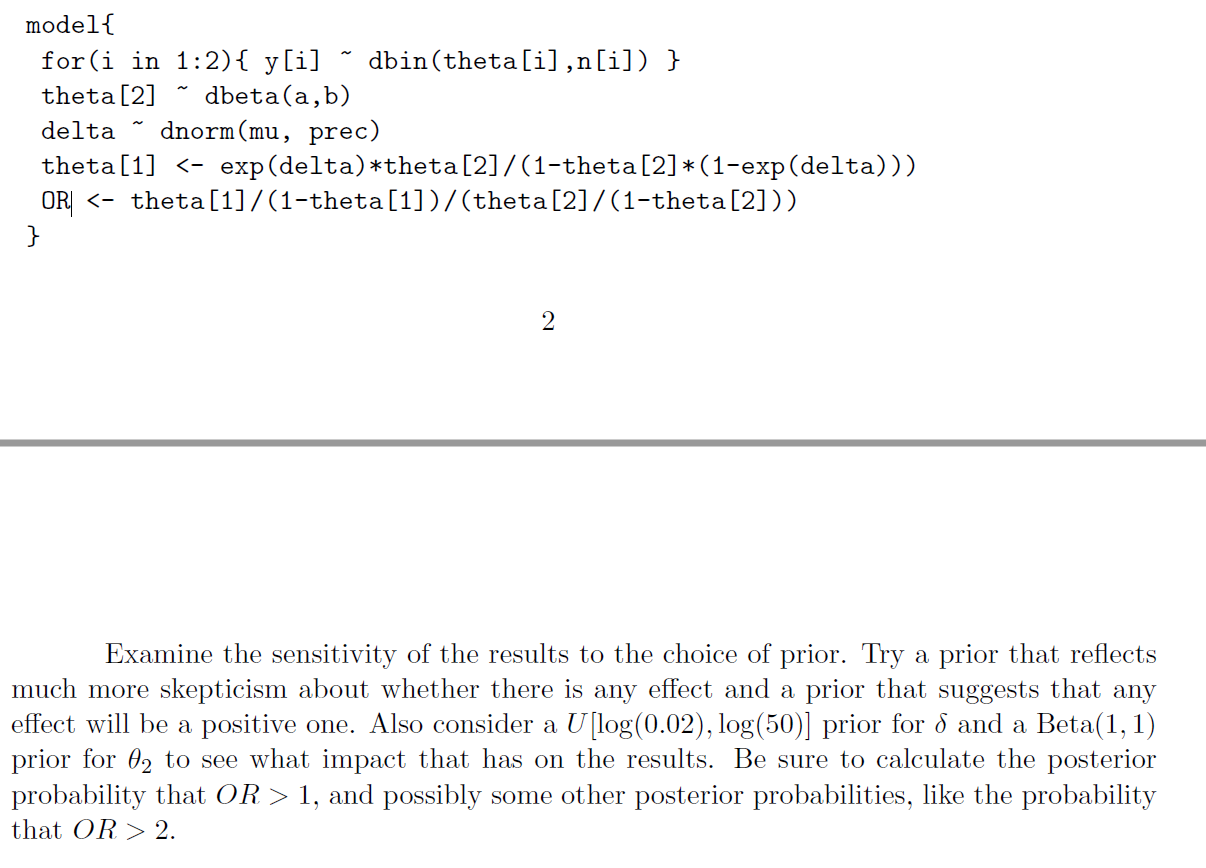
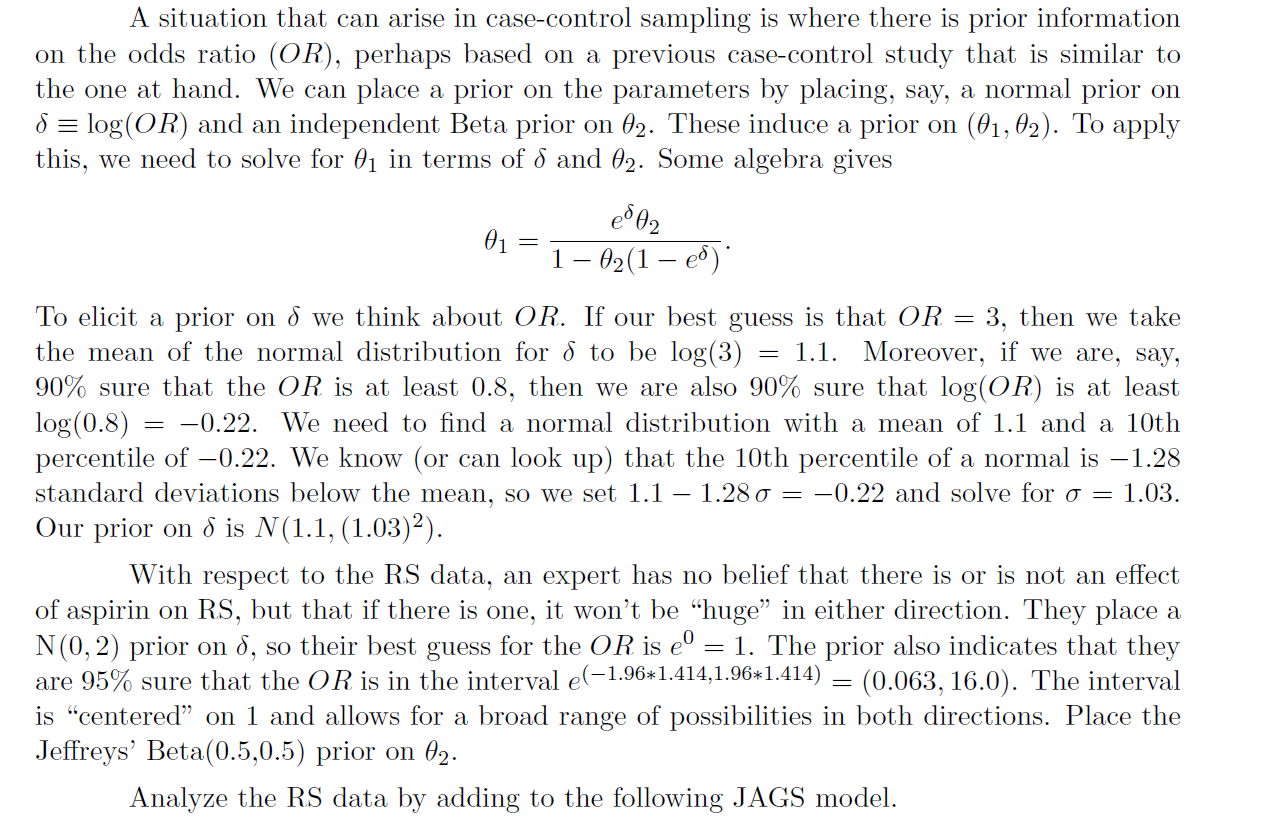
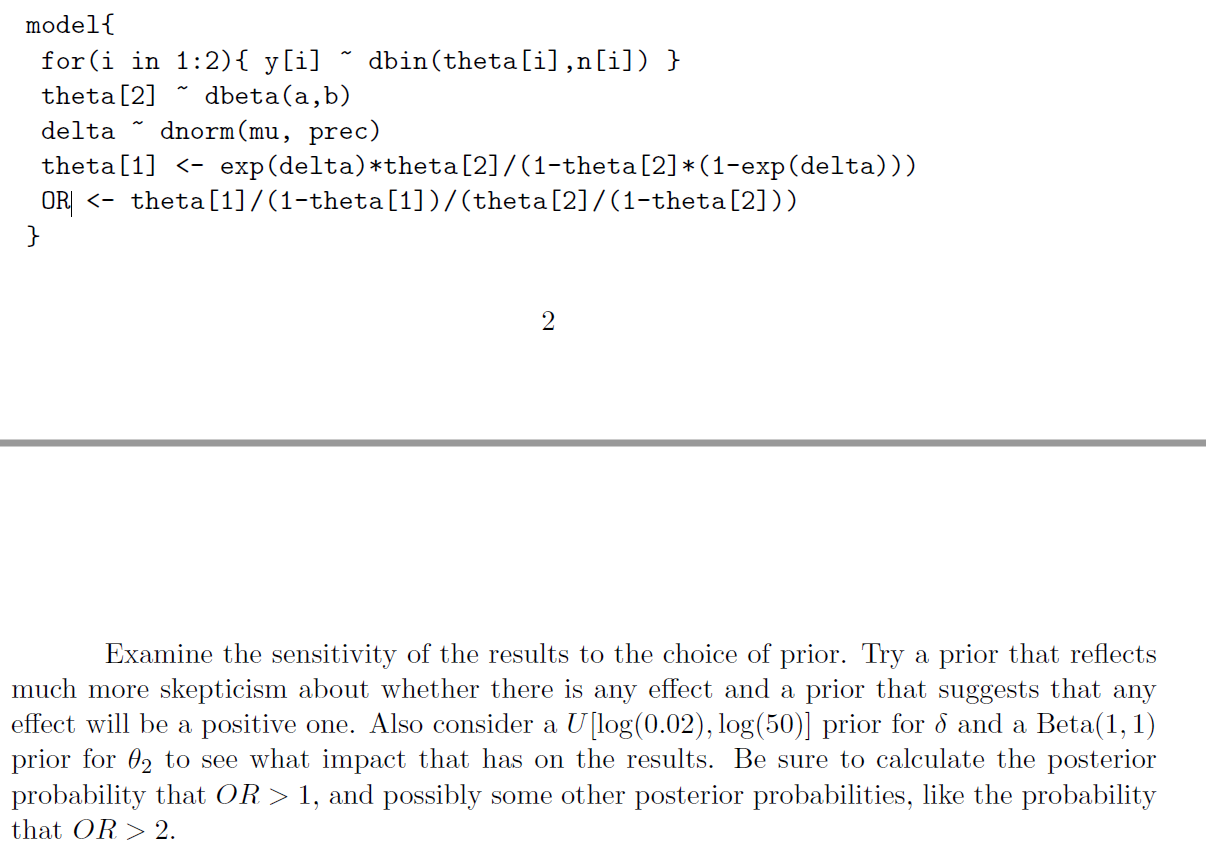
A situation that can arise in casecontrol sampling is where there is prior information on the odds ratio (OR), perhaps based on a previous case-control study that is similar to the one at hand. We can place a prior on the parameters by placing, say, a normal prior on 6 E log(OR) and an independent Beta prior on 92. These induce a prior on (01, (92). To apply this, we need to solve for 61 in terms of 6 and 92. Some algebra gives 692 91 : 1792(17'95)' To elicit a prior on 6 we think about OR. If our best guess is that OR : 3, then we take the mean of the normal distribution for 5 to be log(3) = 1.1. Moreover, if we are, say, 90% sure that the OR is at least 0.8, then we are also 90% sure that log(OR) is at least log(0.8) = 70.22. We need to nd a normal distribution with a mean of 1.1 and a 10th percentile of 0.22. We know (or can look up) that the 10th percentile of a normal is 1.28 standard deviations below the mean, so we set 1.1 1.280 = 0.22 and solve for a = 1.03. Our prior on 5 is N(1.1, (1.03)2). With respect to the RS data, an expert has no belief that there is or is not an effect of aspirin on RS, but that if there is one, it won't be \"huge\" in either direction. They place a N(0, 2) prior on 6, so their best guess for the OR is 80 = 1. The prior also indicates that they are 95% sure that the OR is in the interval e('1'96*1'414?1'96*1'414) : (0.063, 16.0). The interval is \"centered\" on 1 and allows for a broad range of possibilities in both directions. Place the Jeffreys' Beta(0.5,0.5) prior on 62. Analyze the RS data by adding to the following JAGS model. model{ for(i in 1:2){ yEi] " dbinCtheta[i],n[i]) } theta[2] " dbeta(a,b) delta " dnorm(mu, prec) theta[1] 1, and possibly some other posterior probabilities, like the probability that OR > 2
Step by Step Solution
There are 3 Steps involved in it

Get step-by-step solutions from verified subject matter experts
 Study Help