







Question: A small town's water needs fluctuate depending on the time of day, with more water being used during the times of day when more people
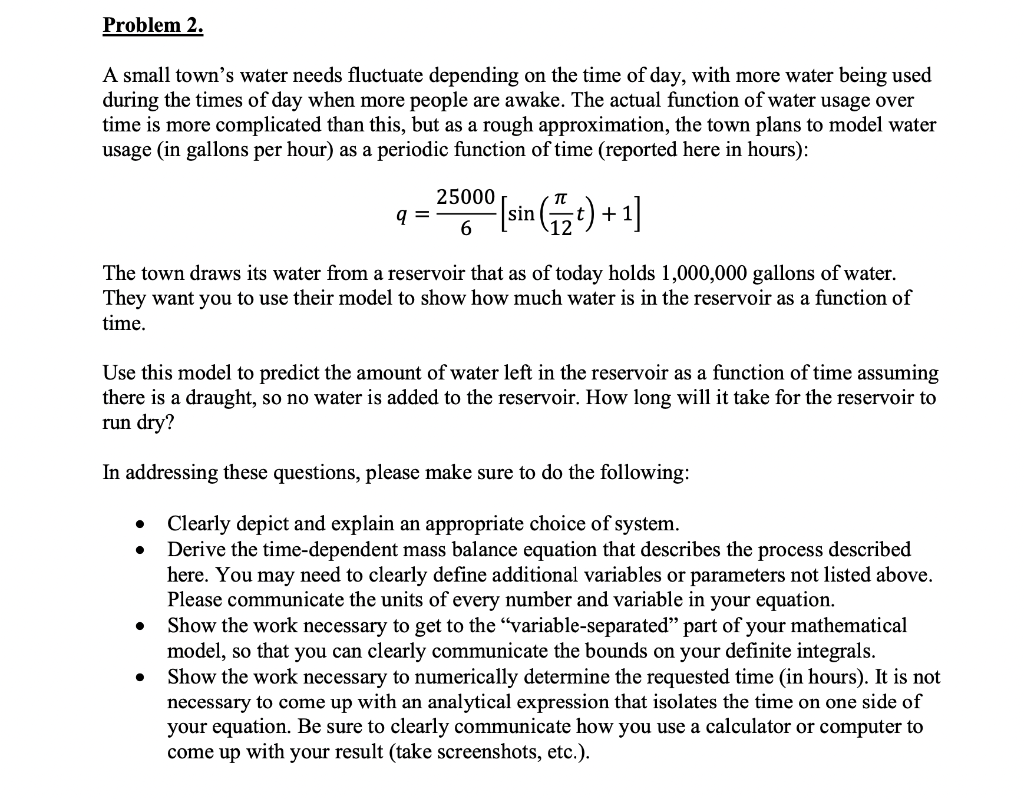
A small town's water needs fluctuate depending on the time of day, with more water being used during the times of day when more people are awake. The actual function of water usage over time is more complicated than this, but as a rough approximation, the town plans to model water usage (in gallons per hour) as a periodic function of time (reported here in hours): q=625000[sin(12t)+1] The town draws its water from a reservoir that as of today holds 1,000,000 gallons of water. They want you to use their model to show how much water is in the reservoir as a function of time. Use this model to predict the amount of water left in the reservoir as a function of time assuming there is a draught, so no water is added to the reservoir. How long will it take for the reservoir to run dry? In addressing these questions, please make sure to do the following: - Clearly depict and explain an appropriate choice of system. - Derive the time-dependent mass balance equation that describes the process described here. You may need to clearly define additional variables or parameters not listed above. Please communicate the units of every number and variable in your equation. - Show the work necessary to get to the "variable-separated" part of your mathematical model, so that you can clearly communicate the bounds on your definite integrals. - Show the work necessary to numerically determine the requested time (in hours). It is not necessary to come up with an analytical expression that isolates the time on one side of your equation. Be sure to clearly communicate how you use a calculator or computer to come up with your result (take screenshots, etc.)
Step by Step Solution
There are 3 Steps involved in it

Get step-by-step solutions from verified subject matter experts
 Study Help