







Question: A solid, frictionless cylindrical pulley has a radius R = 0.500 m. A block is attached to a cord that is wrapped around the
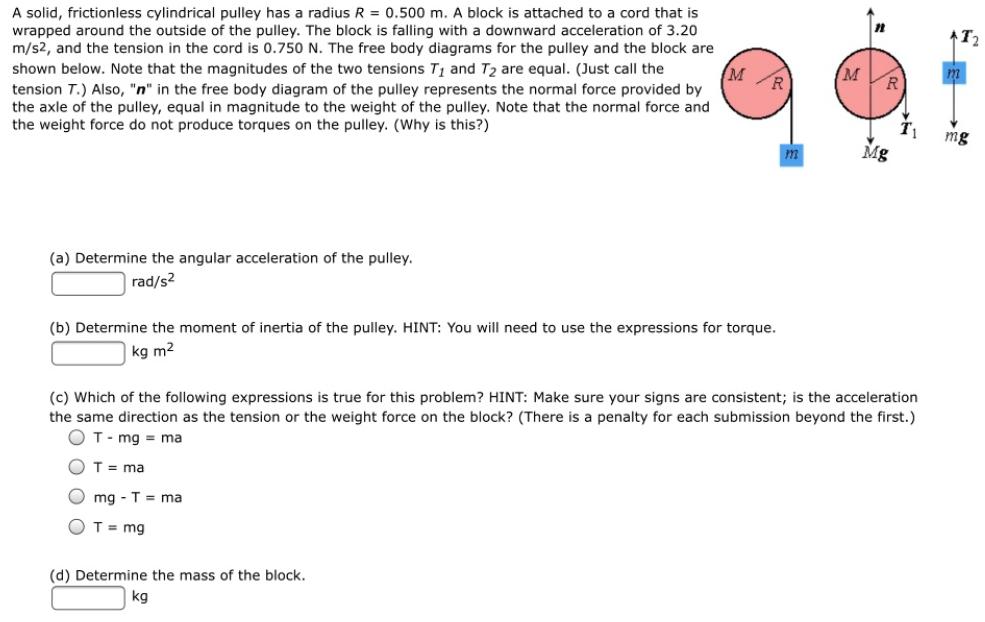
A solid, frictionless cylindrical pulley has a radius R = 0.500 m. A block is attached to a cord that is wrapped around the outside of the pulley. The block is falling with a downward acceleration of 3.20 m/s2, and the tension in the cord is 0.750 N. The free body diagrams for the pulley and the block are shown below. Note that the magnitudes of the two tensions T and T2 are equal. (Just call the M tension T.) Also, "n" in the free body diagram of the pulley represents the normal force provided by the axle of the pulley, equal in magnitude to the weight of the pulley. Note that the normal force and the weight force do not produce torques on the pulley. (Why is this?) (a) Determine the angular acceleration of the pulley. rad/s2 (b) Determine the moment of inertia of the pulley. HINT: You will need to use the expressions for torque. kg m2 R OT = mg (d) Determine the mass of the block. kg M R (c) Which of the following expressions is true for this problem? HINT: Make sure your signs are consistent; is the acceleration the same direction as the tension or the weight force on the block? (There is a penalty for each submission beyond the first.) T-mg = ma T = ma mg - T = ma Mg +12 m mg
Step by Step Solution
There are 3 Steps involved in it

Get step-by-step solutions from verified subject matter experts
 Study Help