







Question: A solid settling operation in which water is used as the settling medium is to be modeled and the terminal velocity is needed at various
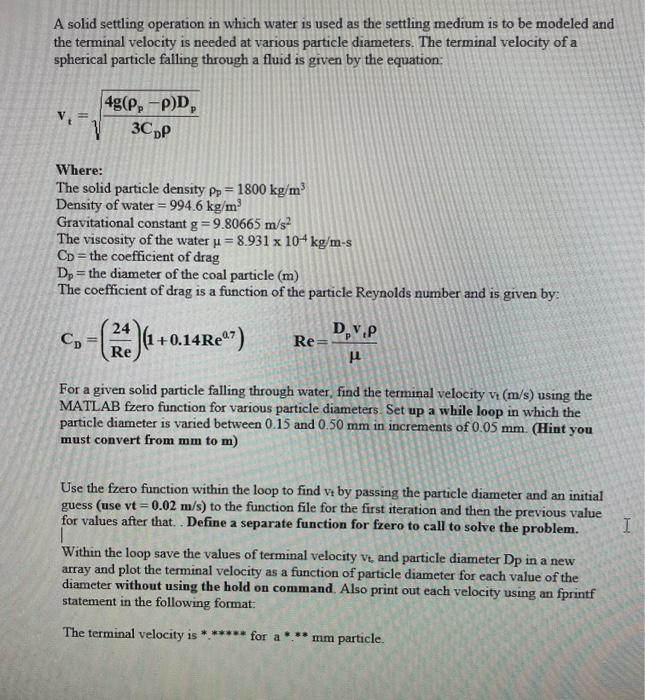
A solid settling operation in which water is used as the settling medium is to be modeled and the terminal velocity is needed at various particle diameters. The terminal velocity of a spherical particle falling through a fluid is given by the equation: vt=3Cp4g(p)Dp Where: The solid particle density p=1800kg/m3 Density of water =994.6kg/m3 Gravitational constant g=9.80665m/s2 The viscosity of the water =8.931104kg/ms CDD= the coefficient of drag Dp= the diameter of the coal particle (m) The coefficient of drag is a function of the particle Reynolds number and is given by: CD=(Re24)(1+0.14Re0.7)Re=Dpvt For a given solid particle falling through water, find the terminal velocity vt(m/s) using the MATLAB fzero function for various particle diameters. Set up a while loop in which the particle diameter is varied between 0.15 and 0.50mm in increments of 0.05mm. (Hint you must convert from mm to m ) Use the fzero function within the loop to find vt by passing the particle diameter and an initial guess (use vt=0.02m/s ) to the function file for the first iteration and then the previous value for values after that. Define a separate function for fzero to call to solve the problem. Within the loop save the values of terminal velocity vt and particle diameter Dp in a new array and plot the terminal velocity as a function of particle diameter for each value of the diameter without using the hold on command. Also print out each velocity using an fprintf statement in the following format: The terminal velocity is ****** for a mm particle
Step by Step Solution
There are 3 Steps involved in it

Get step-by-step solutions from verified subject matter experts
 Study Help