







Question: A solid uniform disk with radius ( R ) , mass ( M ) , and centroidal moment of inertia
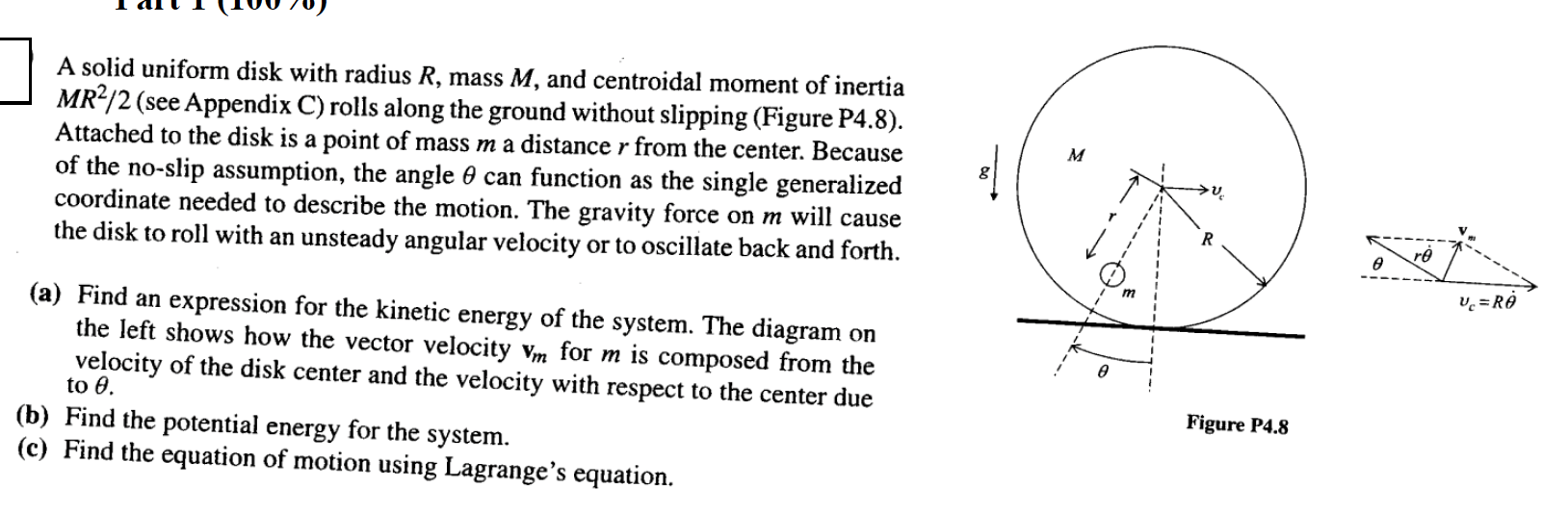
A solid uniform disk with radius R mass M and centroidal moment of inertia M Rsee Appendix C rolls along the ground without slipping Figure P Attached to the disk is a point of mass m distance r from the center. Because of the noslip assumption, the angle theta can function as the single generalized coordinate needed to describe the motion. The gravity force on m will cause the disk to roll with an unsteady angular velocity or to oscillate back and forth.
a Find an expression for the kinetic energy of the system. The diagram on the left shows how the vector velocity mathbfvm for m is composed from the velocity of the disk center and the velocity with respect to the center due to theta
Figure P
b Find the potential energy for the system.
c Find the equation of motion using Lagrange's equation.
Step by Step Solution
There are 3 Steps involved in it
1 Expert Approved Answer
Step: 1 Unlock

Question Has Been Solved by an Expert!
Get step-by-step solutions from verified subject matter experts
Step: 2 Unlock
Step: 3 Unlock
 Study Help