Question: A solution for adverse impact... CASE A Solution for Adverse Impact 97 96 PART 4 RECRUITING AND STAFFING 2 EXHIBIT 4.1 continued Number Group Who
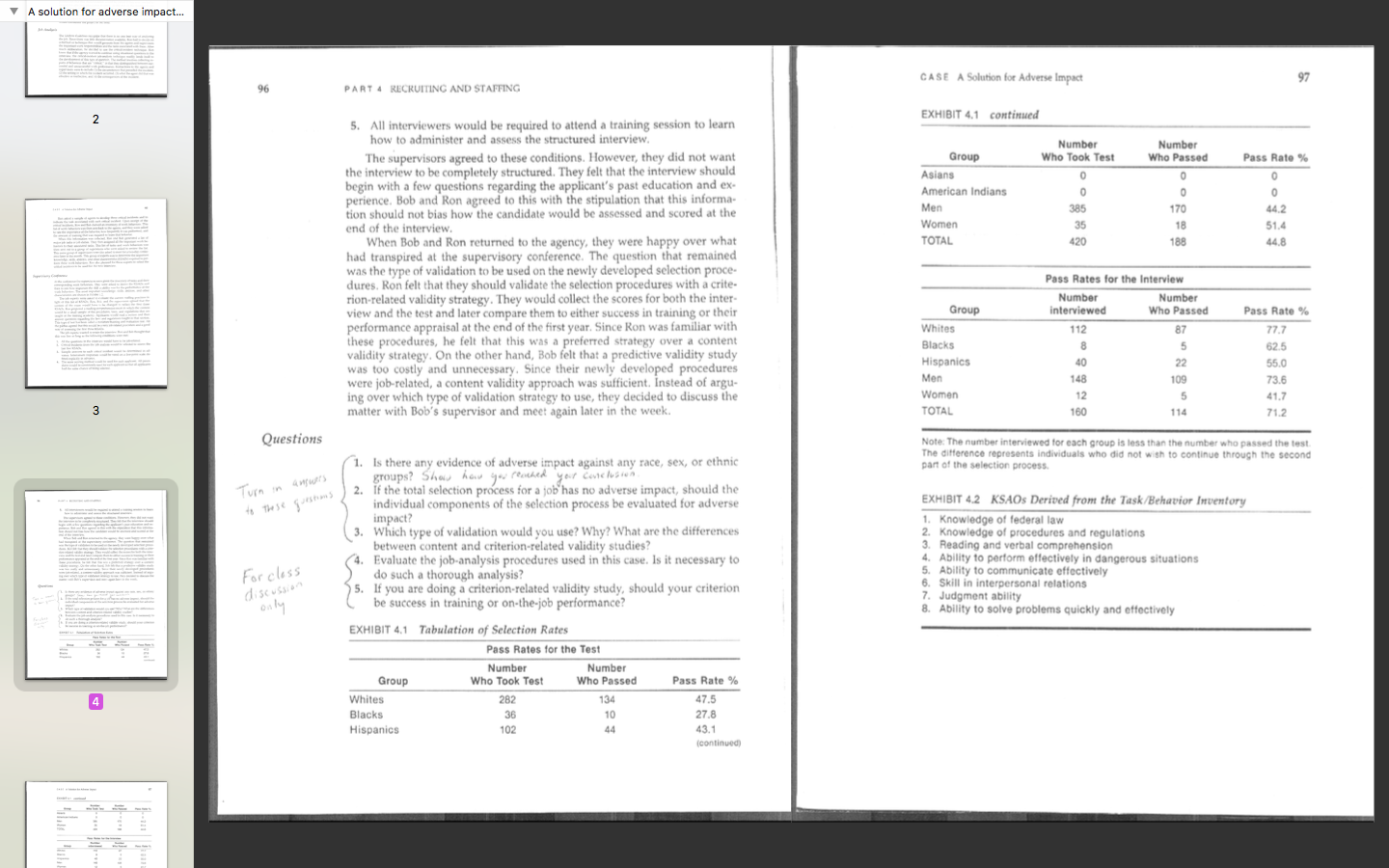
A solution for adverse impact... CASE A Solution for Adverse Impact 97 96 PART 4 RECRUITING AND STAFFING 2 EXHIBIT 4.1 continued Number Group Who Took Test Asians 0 American Indians 0 Men 385 Women 35 TOTAL 420 Number Who Passed 0 0 Pass Rate% 0 0 44.2 51.4 44,8 170 18 188 5. All interviewers would be required to attend a training session to learn how administer and assess the structured interview, The supervisors agreed to these conditions. However, they did not want the interview to be completely structured. They felt that the interview should begin with a few questions regarding the applicant's past education and ex- perience. Bob and Ron agreed to this with the stipulation that this informa- tion should not bias how the candidate would be assessed and scored at the end of the interview. When Bob and Ron returned to the agency, they were happy over what had transpired at the supervisory conference. The question that remained was the type of validation to be used on the newly developed selection proce dures. Ron felt that they should validate the selection procedures with a crite- rion-related validity strategy. They would collect the scores for both the inter- view and the test and later compare them to either success in training or their performance appraisal at the end of the first year. Since Ron was familiar with these procedures, he felt that this was a preferred strategy over a content validity strategy. On the other hand, Bob felt that a predictive validity study was too costly and unnecessary. Since their newly developed procedures were job-related, a content validity approach was sufficient. Instead of argu- ing over which type of validation strategy to use, they decided to discuss the matter with Bob's supervisor and meet again later in the week. Group Whites Blacks Hispanics Men Women TOTAL Pass Rates for the Interview Number Number interviewed Who Passed 112 87 8 5 40 22 148 109 12 5 160 114 Pass Rate % % 77.7 62.5 55.0 73.6 41.7 71.2 3 Questions Note: The number interviewed for each group is less than the number who passed the test. The difference represents individuals who did not wish to continue through the second part of the selection process Turn in answers to these questions EXHIBIT 4.2 KSAOs Derived from the Task/Behavior Inventory 1. Knowledge of federal law 2. Knowledge of procedures and regulations 3. Reading and verbal comprehension 4. Ability to perform effectively in dangerous situations 5. Ability to communicate effectively 6. Skill in interpersonal relations 7. Judgment ability 8. Ability to solve problems quickly and effectively For closs discussion 1. Is there any evidence of adverse impact against any race, sex, or ethnic groups? Show how you reached your conclusion 2. If the total selection process for a job has no adverse impact, should the individual components of the selection process be evaluated for adverse impact? 3. Which type of validation would you use? Why? What are the differences between content and criterion-related validity studies? Evaluate the job-analysis procedures used in this case. Is it necessary to do such a thorough analysis? 5. If you are doing a criterion-related validity study, should your criterion be success in training or on-the-job performance? EXHIBIT 4.1 Tabulation of Selection Rates Pass Rates for the Test Number Number Group Who Took Test Who Passed Pass Rate % Whites 282 134 47.5 Blacks 36 27.8 Hispanics 102 44 43.1 (continued only 4 10 A solution for adverse impact... CASE A Solution for Adverse Impact 97 96 PART 4 RECRUITING AND STAFFING 2 EXHIBIT 4.1 continued Number Group Who Took Test Asians 0 American Indians 0 Men 385 Women 35 TOTAL 420 Number Who Passed 0 0 Pass Rate% 0 0 44.2 51.4 44,8 170 18 188 5. All interviewers would be required to attend a training session to learn how administer and assess the structured interview, The supervisors agreed to these conditions. However, they did not want the interview to be completely structured. They felt that the interview should begin with a few questions regarding the applicant's past education and ex- perience. Bob and Ron agreed to this with the stipulation that this informa- tion should not bias how the candidate would be assessed and scored at the end of the interview. When Bob and Ron returned to the agency, they were happy over what had transpired at the supervisory conference. The question that remained was the type of validation to be used on the newly developed selection proce dures. Ron felt that they should validate the selection procedures with a crite- rion-related validity strategy. They would collect the scores for both the inter- view and the test and later compare them to either success in training or their performance appraisal at the end of the first year. Since Ron was familiar with these procedures, he felt that this was a preferred strategy over a content validity strategy. On the other hand, Bob felt that a predictive validity study was too costly and unnecessary. Since their newly developed procedures were job-related, a content validity approach was sufficient. Instead of argu- ing over which type of validation strategy to use, they decided to discuss the matter with Bob's supervisor and meet again later in the week. Group Whites Blacks Hispanics Men Women TOTAL Pass Rates for the Interview Number Number interviewed Who Passed 112 87 8 5 40 22 148 109 12 5 160 114 Pass Rate % % 77.7 62.5 55.0 73.6 41.7 71.2 3 Questions Note: The number interviewed for each group is less than the number who passed the test. The difference represents individuals who did not wish to continue through the second part of the selection process Turn in answers to these questions EXHIBIT 4.2 KSAOs Derived from the Task/Behavior Inventory 1. Knowledge of federal law 2. Knowledge of procedures and regulations 3. Reading and verbal comprehension 4. Ability to perform effectively in dangerous situations 5. Ability to communicate effectively 6. Skill in interpersonal relations 7. Judgment ability 8. Ability to solve problems quickly and effectively For closs discussion 1. Is there any evidence of adverse impact against any race, sex, or ethnic groups? Show how you reached your conclusion 2. If the total selection process for a job has no adverse impact, should the individual components of the selection process be evaluated for adverse impact? 3. Which type of validation would you use? Why? What are the differences between content and criterion-related validity studies? Evaluate the job-analysis procedures used in this case. Is it necessary to do such a thorough analysis? 5. If you are doing a criterion-related validity study, should your criterion be success in training or on-the-job performance? EXHIBIT 4.1 Tabulation of Selection Rates Pass Rates for the Test Number Number Group Who Took Test Who Passed Pass Rate % Whites 282 134 47.5 Blacks 36 27.8 Hispanics 102 44 43.1 (continued only 4 10









 Study Help