







Question: a solution for the case study Hertz Global Holdings, Inc. Christopher Noe, Lauren Pully, and Cate Reavis In the June 7-8, 2014 weekend edition of
a solution for the case study
Hertz Global Holdings, Inc. Christopher Noe, Lauren Pully, and Cate Reavis In the June 7-8, 2014 weekend edition of The Wall Street Journal, an article entitled Accounting Errors Hit Hertz Hard caught auto industry analyst Abby Devinss attention. Devins recalled that Hertz had hinted in March about the possibility of having to restate its 2011 financial statements, but by June the situation appeared worse than previously anticipated. Hertz Global Holdings, Inc., read the article, would have to restate and correct results from the past three years, according to a regulatory filing Friday that indicated more widespread accounting problems at the auto-rental company than had been thought.1 The article also mentioned that Hertzs stock had closed down about 9% in Fridays trading. Keenly aware that car rental companies like Hertz provided a significant source of steady demand for automotive manufacturers, Devins was curious whether Hertzs accounting issues could be related in some way to its large rental fleet and what impact this might have on the companys future vehicle acquisition plans. Car Rental Industry As of 2013, the U.S. car rental industry totaled approximately $36 billion in revenue, which was divided between leisure travelers, business travelers, and leasing, with rentals taking place both at airport and off-airport locations (Exhibit 1). Since the majority of car rental demand came from leisure and business travel, the industry suffered during the 2008-09 recession, with revenue growth plummeting into negative territory (Exhibit 2). Revenue growth resumed, however, as the subsequent economic recovery began to take hold. 1 Michael Calia, Accounting Errors Hit Hertz Hard, The Wall Street Journal, June 7-8, 2014. This case was prepared by Senior Lecturer Christopher Noe, Lauren Pully, MBA 2015, and Cate Reavis, Associate Director, Curriculum Development. Copyright 2015, This work is licensed under the Creative Commons Attribution-Noncommercial-No Derivative Works 3.0 Unported License. To view a copy of this license visit http://creativecommons.org/licenses/by-nc-nd/3.0/ or send a letter to Creative Commons, 171 Second Street, Suite 300, San Francisco, California 94105, USA. HERTZ GLOBAL HOLDINGS, INC. Christopher Noe, Lauren Pully, and Cate Reavis Due to a wave of consolidations, three companies dominated the market with a combined 71% market share Enterprise Holdings (Enterprise, National, and Alamo brands); Avis Budget Group (Avis, Budget, and Payless brands); and Hertz Global Holdings (Hertz, Dollar, and Thrifty brands).2 Company Background History Hertzs beginnings trace back to 1918 when 22-year old Walter L. Jacobs launched Rent-a-Car, Inc. in Chicago, Illinois, with a dozen Model T Fords that he repaired and painted himself. After having generated $1 million in revenue over five years, Jacobs sold his company to John D. Hertz who renamed the company in his name and made it a subsidiary of his Yellow Truck and Coach Manufacturing Company. Over the next century, Hertz changed hands several times and was owned on separate occasions by both General Motors and the Ford Motor Company. In 2005, Hertz was acquired by a trio of private equity investment companies, which then took the company public in 2006. See Exhibit 3 for a corporate timeline. At of the end of 2013, with over 30,000 employees, Hertz had almost 12,000 worldwide car rental locations, spanning 145 countries, and a rental fleet topping 700,000 cars (524,000 in the U.S. and 179,500 internationally).3 Operations and Financial Performance After going public in 2006, Hertz grew from a single brand with an on-airport focus on business travelers to a multi-brand operation.4 The company acquired the $1.5 billion annual revenue business of Dollar Thrifty in November 2012. Hertzs addition of the rental brands Dollar Rent A Car and Thrifty Car created an immediate leadership position in the budget-friendly leisure market. In 2013, Hertz launched a deep value brand, Firefly, focused on price conscious leisure travelers. That same year, Hertz expanded into the Chinese car rental market by acquiring a 20% stake in China Auto Rental, the largest car rental company in China. U.S. and international car rental revenue in 2013 totaled $6.3 billion and $2.4 billion, respectively (Exhibit 4). Through its Donlen subsidiary, acquired in September 2011, Hertz provided a comprehensive array of commercial fleet leasing and management services. Donlen leased car and light- to medium-truck fleets, generally with a minimum 12-month lease term. It also provided additional services during leases, including fuel purchasing and management, preventative maintenance, repair consultation, accident management, and telematics-based location and driver performance reporting. Hertz also 2 Zachary Harris, IBISWorld Industry Report Car Rental in the US, February 2015. 3 Hertz Global Holdings, Inc., 2013 Annual Report. 4 Details of Hertzs operations from Hertz Global Holdings, Inc., 2013 Annual Report. Rev. March 27, 2018 2 HERTZ GLOBAL HOLDINGS, INC. Christopher Noe, Lauren Pully, and Cate Reavis operated an industrial and construction equipment rental business. Exhibit 5 provides a breakdown of Hertzs 2013 revenue by business segment. Hertz stock more or less mirrored the S&P 500 Index from the end of 2006 until the summer of 2012 when it began to outperform the broader market (Exhibit 6). The pattern of Hertzs earnings closely tracked its stock price (Exhibit 7). Company earnings rose between 2006 and 2007 but turned sharply negative with the 2008 financial crisis as both business and leisure travel slowed. During the ensuing economic recovery, Hertzs earnings rebounded, once again entering positive territory in 2011. The company reported record revenue and EBITDA for 2013.5 Mark Frissora, Hertz Chairman and CEO, commented on the companys strong 2013 financial performance on an earnings call with analysts and investors: We continue to successfully drive both record revenue and earnings growth by leveraging industry leading rental car brands, capitalizing on strategic acquisitions, penetrating new markets in equipment rental, and being relentless on efficiency programs and cost management.6 Hertzs 2013 10-K indicated that the company had increased revenue by roughly 30% and more than doubled net income to common shareholders since 2011. Over this same three-year period, depreciation averaged around 25% of total expenses. See Exhibit 8 for Hertzs 2013 income statement. The relatively high level of depreciation was consistent with the capital intensive nature of Hertzs operations. The companys largest asset in 2012 and 2013 was revenue earning equipment (i.e., cars and trucks), which comprised in excess of 50% of total assets in both years. See Exhibit 9 for Hertzs 2013 balance sheet. Calculating Depreciation Once an asset like equipment is recorded on the balance sheet, its cost must be transferred over time from the balance sheet to the income statement and reported as an expense. This process is referred to as depreciation. Managers have a certain amount of discretion in recording depreciation expense because of the assumptions that underlie the calculations. Two estimates are required to compute the amount of depreciation expense for each accounting period: 1. Useful life is the period of time over which an asset is expected to provide economic benefits to a company, which need not correspond to its physical life. 2. Residual or salvage value is the expected value of an asset at the end of its useful life. The depreciable base is computed by subtracting the residual value from an assets acquisition cost. This amount is then depreciated over an assets useful life. The most common way for allocating depreciation over an assets useful life is the straight-line method. Exhibit 10 provides an example of 5 Hertz Report Fourth Quarter and Full Year 2013 Results, Hertz Global Holdings, Inc. Press Release, March 18, 2014. 6 Q4 2013 Hertz Global Holdings, Inc. Earnings Conference Call, March 18, 2014. Rev. March 27, 2018 3 HERTZ GLOBAL HOLDINGS, INC. Christopher Noe, Lauren Pully, and Cate Reavis depreciation of an automobile with a $50,000 acquisition cost, a $10,000 residual value, and a 5-year useful life. The amount of annual depreciation expense for the automobile in this example is $8,000. As this example also shows, when depreciation is recognized as an expense on the income statement, which has the effect of reducing retained earnings on the balance sheet, the book value of the corresponding asset is reduced by an equal amount with a balancing entry in accumulated depreciation, a contra asset account associated with PP&E. When an asset is disposed of, any difference between its sale price and net book value is recognized on the income statement as a gain/loss on sale. In the above example, a loss on sale of $2,500 would result if the automobile were sold at the end of Year 5 for $7,500, which reflects the fact that its sales price ($7,500) is lower than its net book value ($10,000) at that time. Depreciation of Rental Fleet Hertzs 2013 financial statements included a footnote disclosure that described how the company accounted for depreciation of revenue earning equipment: Generally, when revenue earning equipment is acquired, we estimate the period that we will hold the asset, primarily based on historical measures of the amount of rental activity (e.g., automobile mileage and equipment usage) and the targeted age of equipment at the time of disposal. We also estimate the residual value of the applicable revenue earning equipment at the expected time of disposal. The residual values for rental vehicles are affected by many factors, including make, model and options, age, physical condition, mileage, sale location, time of the year and channel of disposition (e.g., auction, retail, dealer direct). The residual value for rental equipment is affected by factors which include equipment age and amount of usage. Depreciation is recorded on a straight-line basis over the estimated holding period. Depreciation rates are reviewed on a quarterly basis based on managements ongoing assessment of present and estimated future market conditions, their effect on residual values at the time of disposal and the estimated holding periods. Market conditions for used vehicle and equipment sales can also be affected by external factors such as the economy, natural disasters, fuel prices and incentives offered by manufacturers of new cars. These key factors are considered when estimating future residual values and assessing depreciation rates. As a result of this ongoing assessment, we make periodic adjustments to depreciation rates of revenue earning equipment in response to changing market conditions.7 7 Hertz Global Holdings, Inc. 10-K, December 31, 2013. Rev. March 27, 2018 4 HERTZ GLOBAL HOLDINGS, INC. Christopher Noe, Lauren Pully, and Cate Reavis U.S. GAAP also required Hertz to disclose useful life estimates for its major asset classes. Exhibit 11 provides this information for each year between 2006-13. Hertzs car rental fleet comprised program and non-program cars. Program cars were purchased by rental car companies under repurchase or guaranteed depreciation programs. Under these programs, automotive manufacturers agreed to repurchase cars at a specified price or guarantee the depreciation rate on cars during a specified time period. Non-program cars, in contrast, were subject to residual price risk at the time of disposal. Exhibit 12 shows Hertzs program cars purchased as a percentage of total cars purchased for each year between 2006-13 by the U.S. and international operations. Exhibit 13 provides summary data on used car market pricing trends. Data Collection To begin her analysis, Devins pulled together Hertzs revenue earning equipment balances and associated depreciation expense amounts between 2006-13, doing the same for Avis Budget Group, Hertzs main publicly-traded competitor, for comparison purposes (Exhibit 14). As she was putting the finishing touches on her spreadsheet, Devins contemplated what significance, if any, depreciation would ultimately have in Hertzs larger than previously announced accounting issues
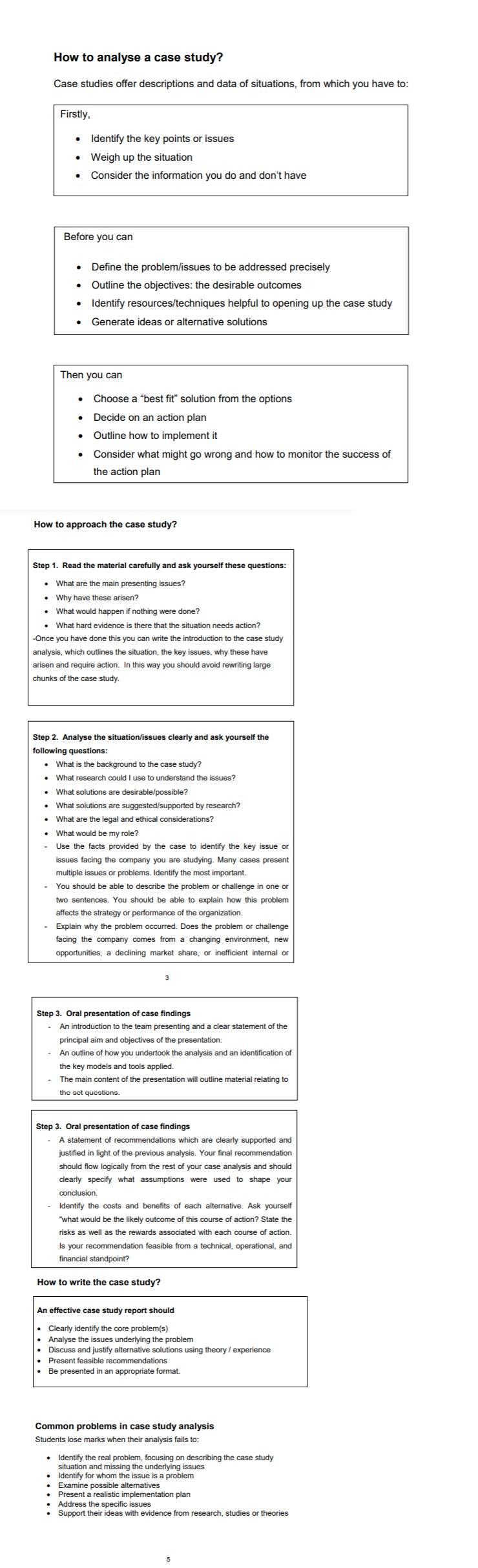
How to analyse a case study? Case studies offer descriptions and data of situations, from which you have to: Firstly, Identify the key points or issues Weigh up the situation Consider the information you do and don't have Before you can . . Define the problem/issues to be addressed precisely Outline the objectives: the desirable outcomes Identify resources/techniques helpful to opening up the case study Generate ideas or alternative solutions . Then you can . . Choose a "best fit" solution from the options Decide on an action plan Outline how to implement it Consider what might go wrong and how to monitor the success of the action plan . How to approach the case study? Step 1. Read the material carefully and ask yourself these questions: What are the main presenting issues? Why have these arisen? What would happen if nothing were done? What hard evidence is there that the situation needs action? -Once you have done this you can write the introduction to the case study analysis, which outlines the situation, the key issues, why these have arisen and require action. In this way you should avoid rewriting large chunks of the case study. Step 2. Analyse the situation/issues clearly and ask yourself the following questions: What is the background to the case study? What research could I use to understand the issues? What solutions are desirable/possible? What solutions are suggested/supported by research? What are the legal and ethical considerations? What would be my role? Use the facts provided by the case to identify the key issue or issues facing the company you are studying. Many cases present multiple issues or problems. Identify the most important. You should be able to describe the problem or challenge in one or two sentences. You should be able to explain how this problem affects the strategy or performance of the organization. Explain why the problem occurred. Does the problem or challenge facing the company comes from a changing environment, new opportunities, a declining market share, or inefficient internal or 3 Step 3. Oral presentation of case findings - An introduction to the team presenting and a clear statement of the principal aim and objectives of the presentation. An outline of how you undertook the analysis and an identification of the key models and tools applied. The main content of the presentation will outline material relating to the sct questions. Step 3. Oral presentation of case findings A statement of recommendations which are clearly supported and justified in light of the previous analysis. Your final recommendation should flow logically from the rest of your case analysis and should clearly specify what assumptions were used to shape your conclusion Identify the costs and benefits of each alternative. Ask yourself "What would be the likely outcome of this course of action? State the risks as well as the rewards associated with each course of action. Is your recommendation feasible from a technical, operational, and financial standpoint? How to write the case study? An effective case study report should Clearly identify the core problem(s) Analyse the issues underlying the problem Discuss and justify alternative solutions using theory / experience Present feasible recommendations Be presented in an appropriate format. Common problems in case study analysis Students lose marks when their analysis fails to: Identify the real problem, focusing on describing the case study situation and missing the underlying issues Identify for whom the issue is a problem Examine possible alternatives Present a realistic implementation plan Address the specific issues Support their ideas with evidence from research, studies or theories
Step by Step Solution
There are 3 Steps involved in it

Get step-by-step solutions from verified subject matter experts
 Study Help