







Question: a. Solve example 4.7 b. C. Figures 4.7 and 4.8 only reflect initial conditions. Demonstrate (with calculations) that for formation pressure is the same
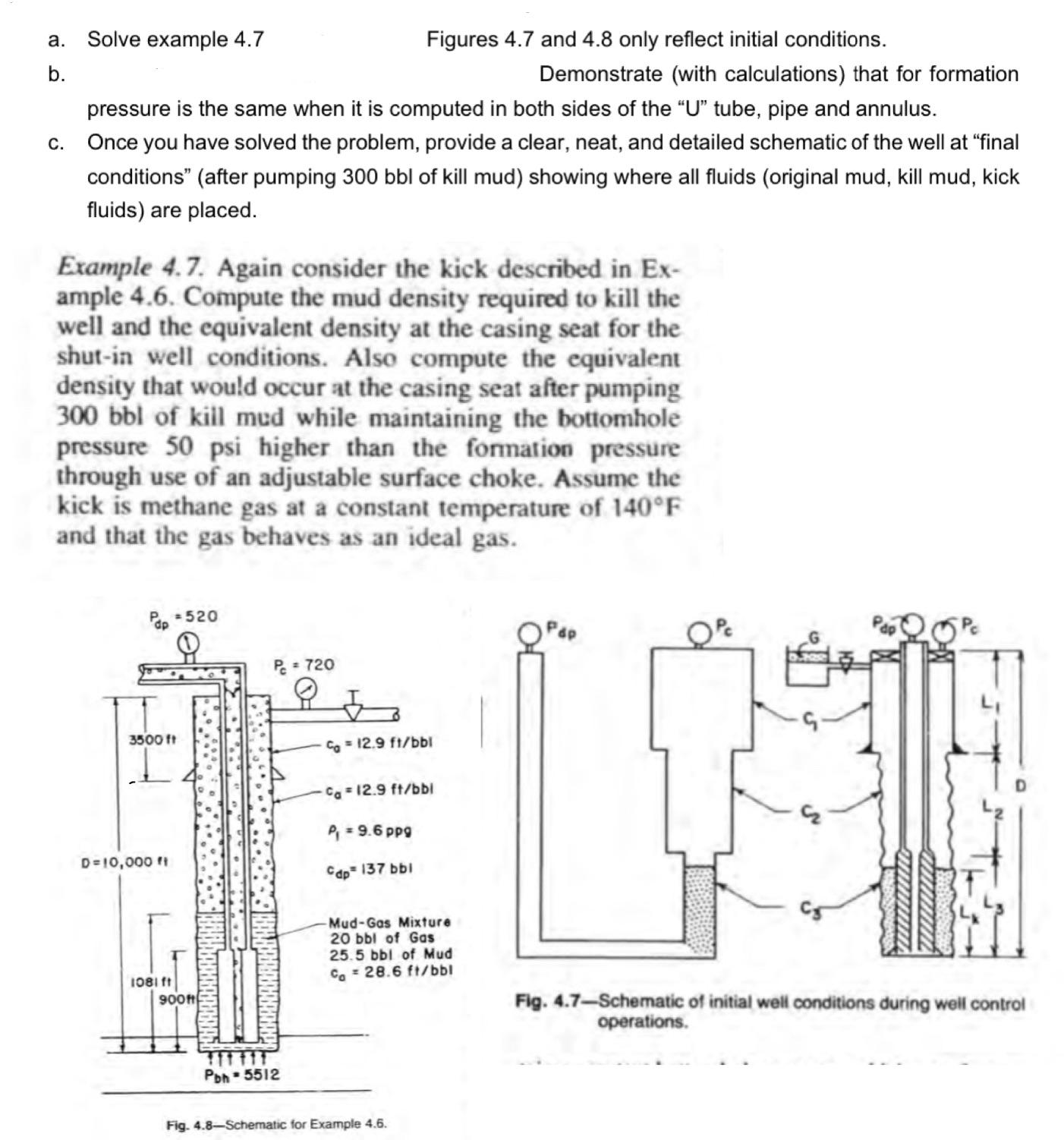
a. Solve example 4.7 b. C. Figures 4.7 and 4.8 only reflect initial conditions. Demonstrate (with calculations) that for formation pressure is the same when it is computed in both sides of the "U" tube, pipe and annulus. Once you have solved the problem, provide a clear, neat, and detailed schematic of the well at "final conditions" (after pumping 300 bbl of kill mud) showing where all fluids (original mud, kill mud, kick fluids) are placed. Example 4.7. Again consider the kick described in Ex- ample 4.6. Compute the mud density required to kill the well and the equivalent density at the casing seat for the shut-in well conditions. Also compute the equivalent density that would occur at the casing seat after pumping 300 bbl of kill mud while maintaining the bottomhole pressure 50 psi higher than the formation pressure through use of an adjustable surface choke. Assume the kick is methane gas at a constant temperature of 140F and that the gas behaves as an ideal gas. Pdp 3500 ft =520 Pe = 720 Co 12.9 ft/bbl D=10,000 ft Ca 12.9 ft/bbl P = 9.6 ppg Cdp= 137 bbl 1081 ft 900ft 0% -Mud-Gas Mixture 20 bbl of Gas 25.5 bbl of Mud Ca=28.6 ft/bbl Fig. 4.7-Schematic of initial well conditions during well control operations. Pbh-5512 Fig. 4.8-Schematic for Example 4.6.
Step by Step Solution
There are 3 Steps involved in it

Get step-by-step solutions from verified subject matter experts
 Study Help