



Question: A state-space representation for the converter is given by ci(t) aalt ) + sct) vin(t) ti(t) 1 2(t) Vout(t) RCT2(t) 22(t), = where xi(t) is
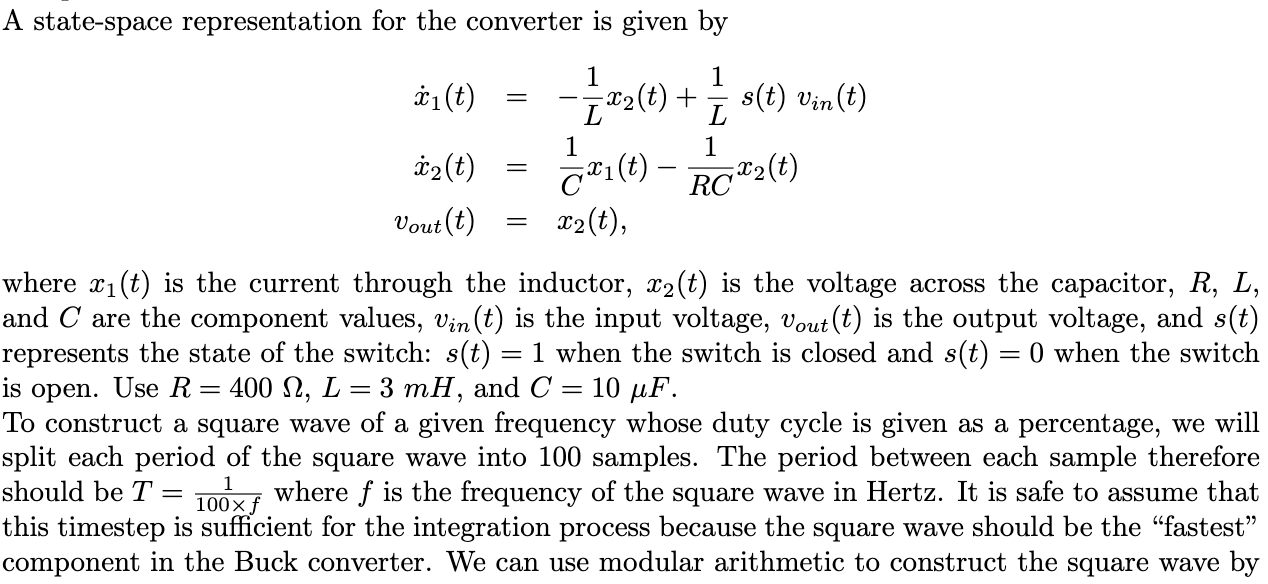
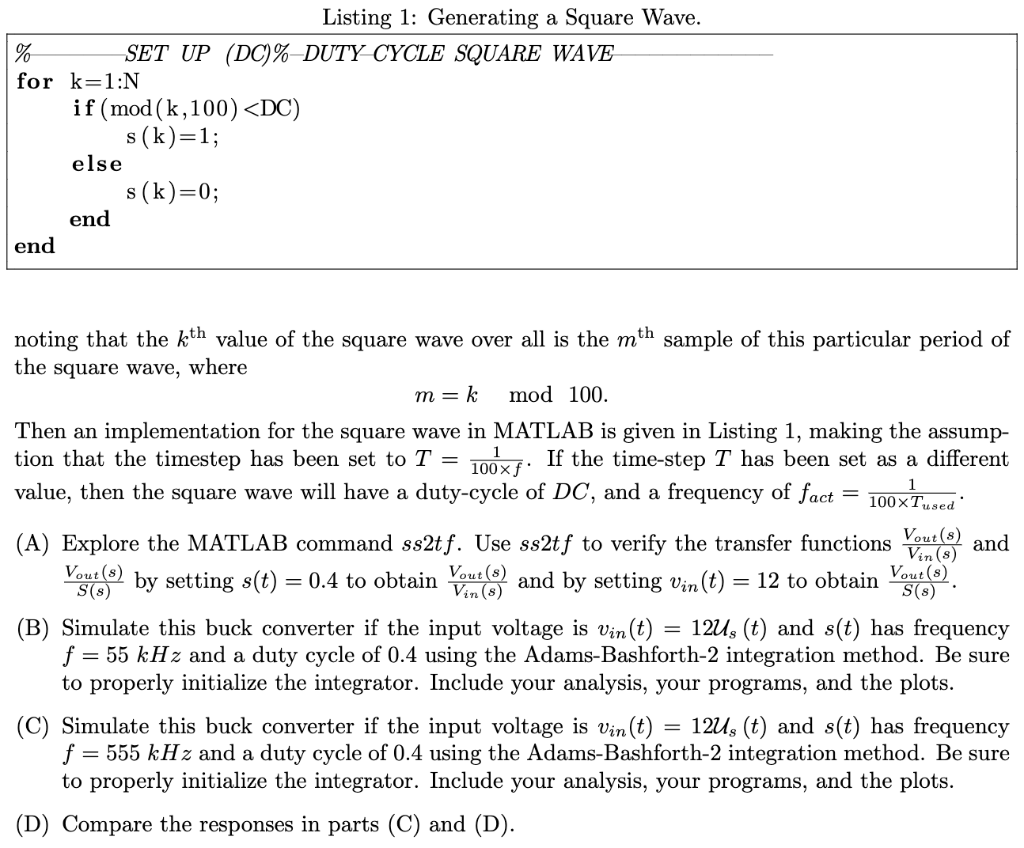
A state-space representation for the converter is given by ci(t) aalt ) + sct) vin(t) ti(t) 1 2(t) Vout(t) RCT2(t) 22(t), = where xi(t) is the current through the inductor, x2(t) is the voltage across the capacitor, R, L, and C are the component values, Vin(t) is the input voltage, Vout(t) is the output voltage, and s(t) represents the state of the switch: s(t) = 1 when the switch is closed and s(t) = 0 when the switch is open. Use R= 400 12, L :3 mH, and C = 10 uF. To construct a square wave of a given frequency whose duty cycle is given as a percentage, we will split each period of the square wave into 100 samples. The period between each sample therefore should be T= 100x 1 where f is the frequency of the square wave in Hertz. It is safe to assume that this timestep is sufficient for the integration process because the square wave should be the fastest component in the Buck converter. We can use modular arithmetic to construct the square wave by Listing 1: Generating a Square Wave. % SET UP (DC)%-DUTY CYCLE SQUARE WAVE for k=1:N if (mod (k,100)
Step by Step Solution
There are 3 Steps involved in it

Get step-by-step solutions from verified subject matter experts