







Question: A statistics professor was lecturing about collecting data and stated that whatever data was collected needed to be current, as metrics can change over time.
A statistics professor was lecturing about collecting data and stated that whatever data was collected needed to be current, as metrics can change over time. One of the students in the class understood what the professor was trying to state but wanted an example. A few days later the professor brought in a math textbook that was published in 1916 that he had inherited. One of the problems in the textbook stated that a random sample of 75 eighteen-year-old males in 1915 was taken and the mean height for those subjects was66.5incheswith a standard deviation of3.75inches.The professor then looked on the Internet and found that a random sample of 65 eighteen-year-old males was taken and the mean height of those teens was69.5incheswith a standard deviation of4inches.Assuming that both sets of information are accurate, can we conclude the professor was correct? In order to do that, we need to show that one of the means is greater than the other. Specifically test if the mean height of all 18-year-old males in 1915 (population 1) is less than that of all 18-year-old males today at the 5% significance level.
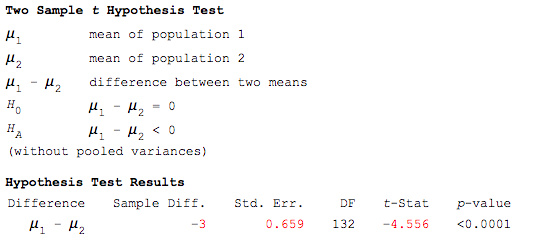
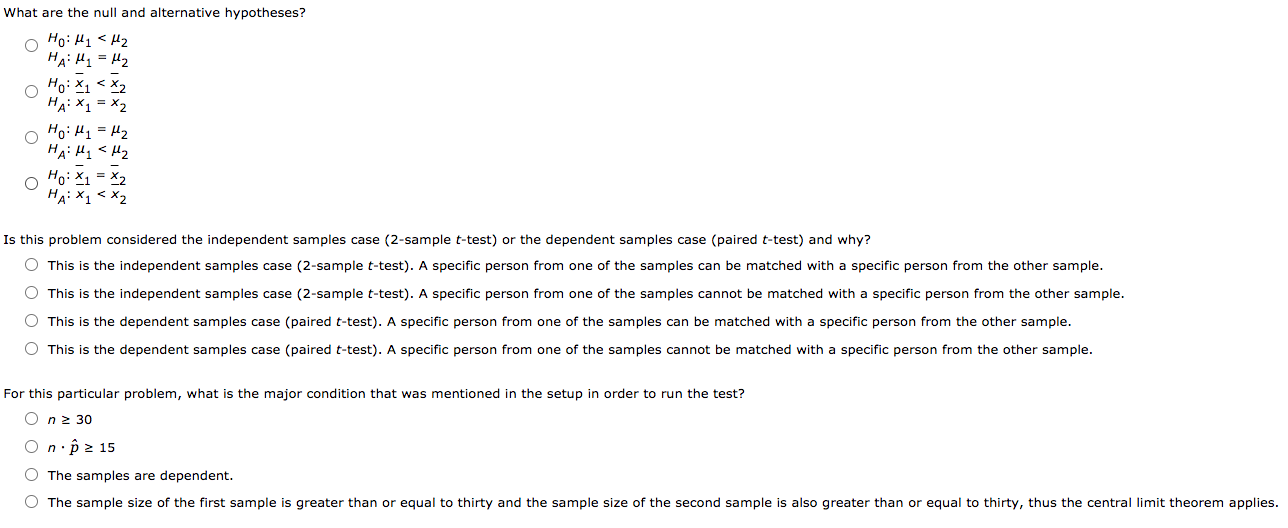
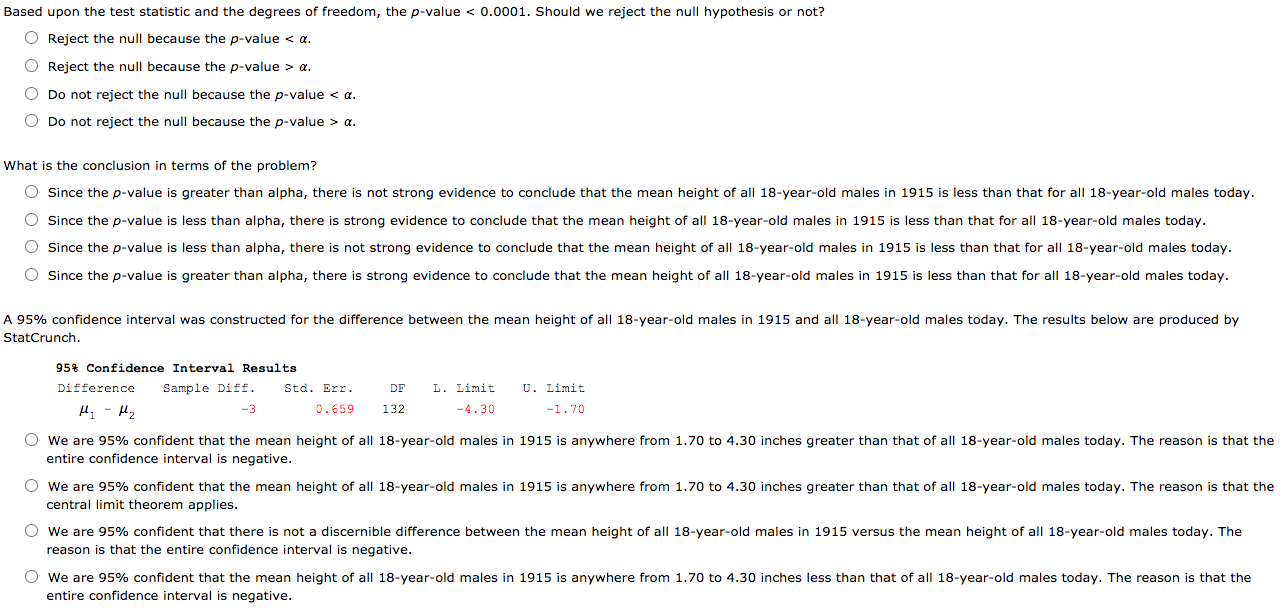
Two Sample t Hypothesis Test mean of population 1 H 2 mean of population 2 H - H2 difference between two means H - H2 = 0 H A (without pooled variances) Hypothesis Test Results Difference Sample Diff. Std. Err. DF t-Stat p-value Ly - H2 -3 0. 659 132 -4 . 556 a. O Do not reject the null because the p-value a. What is the conclusion in terms of the problem? Since the p-value is greater than alpha, there is not strong evidence to conclude that the mean height of all 18-year-old males in 1915 is less than that for all 18-year-old males today. Since the p-value is less than alpha, there is strong evidence to conclude that the mean height of all 18-year-old males in 1915 is less than that for all 18-year-old males today. O Since the p-value is less than alpha, there is not strong evidence to conclude that the mean height of all 18-year-old males in 1915 is less than that for all 18-year-old males today. Since the p-value is greater than alpha, there is strong evidence to conclude that the mean height of all 18-year-old males in 1915 is less than that for all 18-year-old males today. A 95% confidence interval was constructed for the difference between the mean height of all 18-year-old males in 1915 and all 18-year-old males today. The results below are produced by StatCrunch. 951 Confidence Interval Results Difference Sample Diff. Std. Err. DF L. Limit U. Limit #1 - H2 -3 0 . 659 132 -4.30 -1. 70 We are 95% confident that the mean height of all 18-year-old males in 1915 is anywhere from 1.70 to 4.30 inches greater than that of all 18-year-old males today. The reason is that the entire confidence interval is negative. O We are 95% confident that the mean height of all 18-year-old males in 1915 is anywhere from 1.70 to 4.30 inches greater than that of all 18-year-old males today. The reason is that the central limit theorem applies. O We are 95% confident that there is not a discernible difference between the mean height of all 18-year-old males in 1915 versus the mean height of all 18-year-old males today. The reason is that the entire confidence interval is negative. O We are 95% confident that the mean height of all 18-year-old males in 1915 is anywhere from 1.70 to 4.30 inches less than that of all 18-year-old males today. The reason is that the entire confidence interval is negative
Step by Step Solution
There are 3 Steps involved in it

Get step-by-step solutions from verified subject matter experts
 Study Help