







Question: A stock lending transaction can be seen as collateralized borrowing. One lends shares in exchange for cash. One typically pays a lower interest rate on
A stock lending transaction can be seen as collateralized borrowing. One lends shares in exchange for cash. One typically pays a lower interest rate on this cash borrowing than one would if one borrowed the cash without collateral. If the risk-free rate of interest is rr for uncollateralized borrowing and the rate of interest on borrowing collateralized by the shares is rbr-b then bb is called the borrow cost.
Assume, that both rates are quoted as continuously compounded.
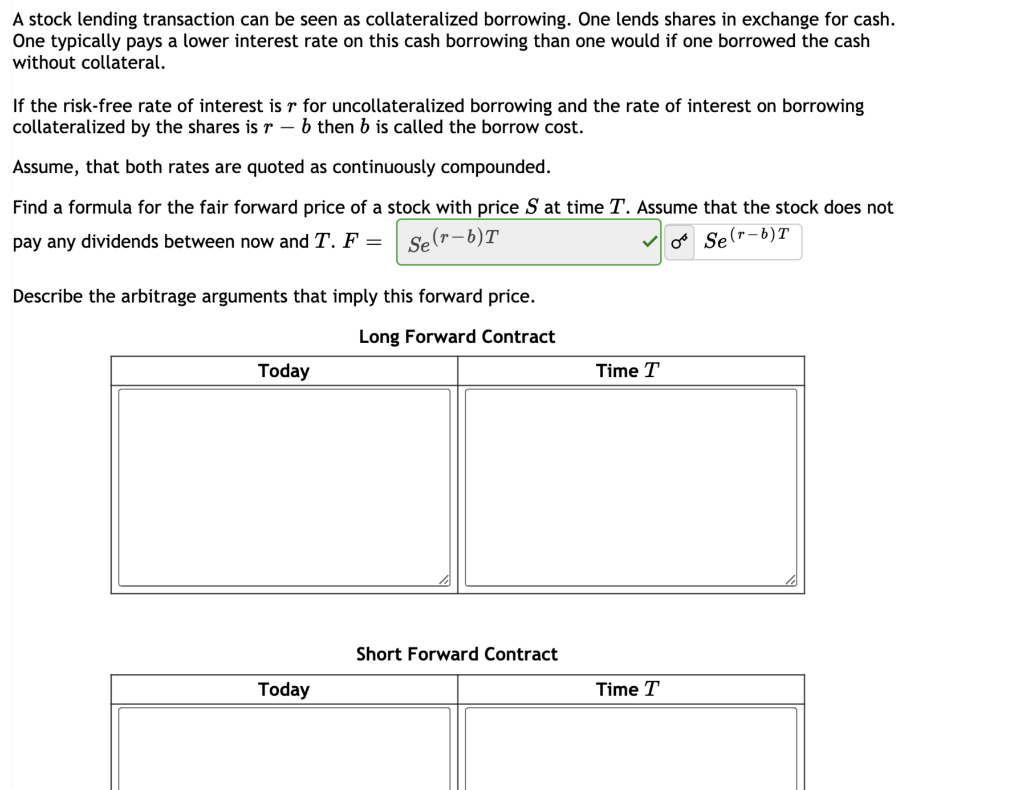
A stock lending transaction can be seen as collateralized borrowing. One lends shares in exchange for cash. One typically pays a lower interest rate on this cash borrowing than one would if one borrowed the cash without collateral. If the risk-free rate of interest is r for uncollateralized borrowing and the rate of interest on borrowing collateralized by the shares is r - b then b is called the borrow cost. Assume, that both rates are quoted as continuously compounded. Find a formula for the fair forward price of a stock with price S at time T. Assume that the stock does not pay any dividends between now and T. F= Se (r-b)T O Ser-b)T Describe the arbitrage arguments that imply this forward price. Long Forward Contract Today Time T Short Forward Contract Today Time T
Step by Step Solution
There are 3 Steps involved in it

Get step-by-step solutions from verified subject matter experts
 Study Help