







Question: A straight and non-moving linear vortex of the initial circulation T, is submerged into a viscous fluid of viscosity u and density p, thus kinematic
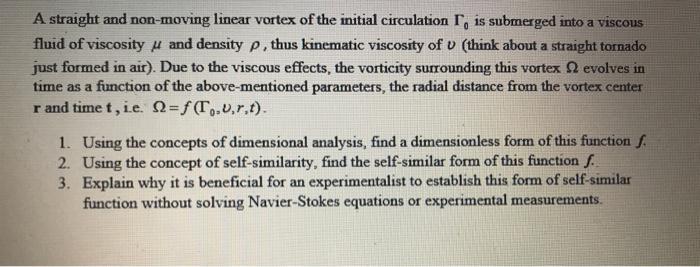 A straight and non-moving linear vortex of the initial circulation T, is submerged into a viscous fluid of viscosity u and density p, thus kinematic viscosity of v (think about a straight tornado just formed in air). Due to the viscous effects, the vorticity surrounding this vortex A evolves in time as a function of the above-mentioned parameters, the radial distance from the vortex center r and time t, i.e. Q=f(1.0.r.t). 1. Using the concepts of dimensional analysis, find a dimensionless form of this function 2. Using the concept of self-similarity, find the self-similar form of this function f. 3. Explain why it is beneficial for an experimentalist to establish this form of self-similar function without solving Navier-Stokes equations or experimental measurements
A straight and non-moving linear vortex of the initial circulation I, is submerged into a viscous fluid of viscosity u and density p, thus kinematic viscosity of v (think about a straight tornado just formed in air). Due to the viscous effects, the vorticity surrounding this vortex 2 evolves in time as a function of the above-mentioned parameters, the radial distance from the vortex center r and time t, ie. 2=f(T.0,r,t). 1. Using the concepts of dimensional analysis, find a dimensionless form of this function f. 2. Using the concept of self-similarity, find the self-similar form of this function f. 3. Explain why it is beneficial for an experimentalist to establish this form of self-similar function without solving Navier-Stokes equations or experimental measurements.
Step by Step Solution
3.55 Rating (165 Votes )
There are 3 Steps involved in it
To tackle this problem we will use dimensional analysis and the concept of selfsimilarity 1 Dimensio... View full answer

Get step-by-step solutions from verified subject matter experts
 Study Help