







Question: A strain gauge is a resistive sensor that changes its resistance according to the strain applied to it. Strain, denoted as &, is the
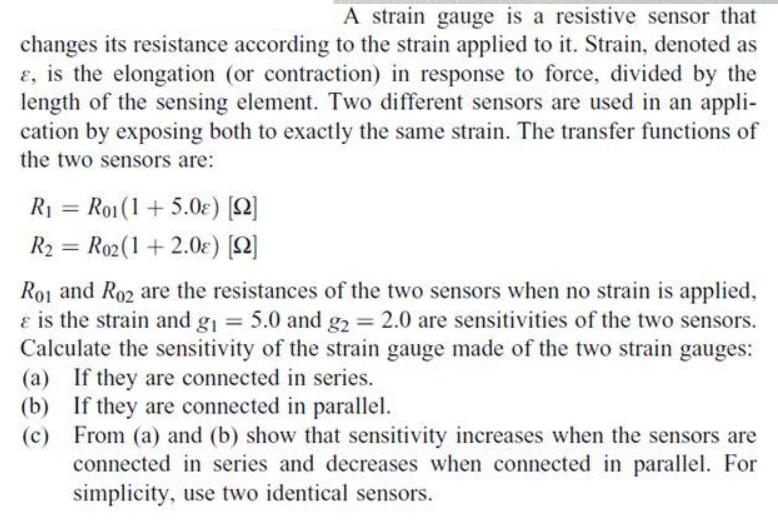
A strain gauge is a resistive sensor that changes its resistance according to the strain applied to it. Strain, denoted as &, is the elongation (or contraction) in response to force, divided by the length of the sensing element. Two different sensors are used in an appli- cation by exposing both to exactly the same strain. The transfer functions of the two sensors are: R = R01 (1+5.08) [2] R R02 (1+2.08) [2] = Ro1 and Ro2 are the resistances of the two sensors when no strain is applied, & is the strain and g = 5.0 and g2 = 2.0 are sensitivities of the two sensors. Calculate the sensitivity of the strain gauge made of the two strain gauges: (a) If they are connected in series. (b) If they are connected in parallel. (c) From (a) and (b) show that sensitivity increases when the sensors are connected in series and decreases when connected in parallel. For simplicity, use two identical sensors.
Step by Step Solution
There are 3 Steps involved in it
To find the sensitivity of the strain gauge made of the two sensors when connected in series and par... View full answer

Get step-by-step solutions from verified subject matter experts
 Study Help