







Question: A studear obtained a clean flask. She weighed the tlask and stoppet on an anahtical halance and found the tocal mass to be 22.534 e.
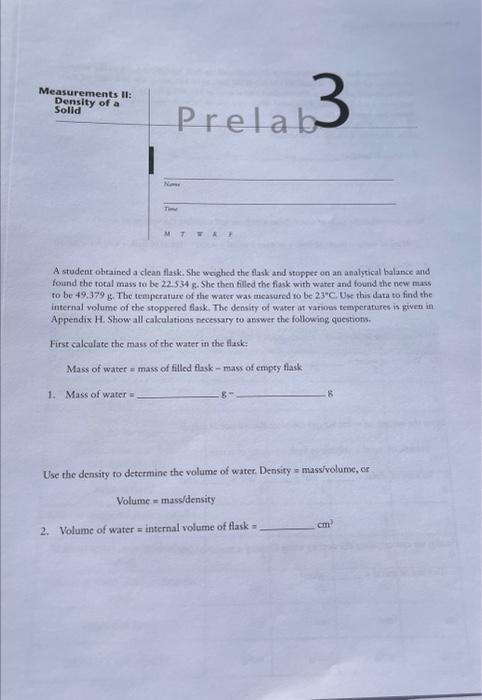
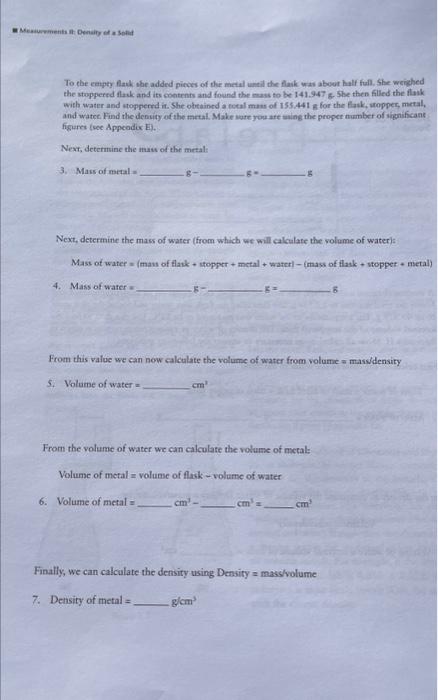
A studear obtained a clean flask. She weighed the tlask and stoppet on an anahtical halance and found the tocal mass to be 22.534 e. She then filled the flask with water and found the new mass to be 49.379 g. The temperature of the water was meavared to be 23. C. Use this data to find the internal volume of the stoppered flask. The density of water at vatious temperatures is given in Appendix H. Show all calculations necesury to answer the following questions. First calculate the mass of the water in the flask: Mass of water = mass of filled flask - mass of empty flask 1. Mass of water = 5= 8 Use the density to determine the volume of water. Density a mass/volume, or Volume = mass/density 2. Volume of water = internal volume of flask = cm3 To ehe eapty fask the added pieses of the metal until the flaik was about half full. she weighed the stoppered flak and iss contrnts and found the mass to be 141.9.47 g. She then flled the flask with water and stoppered it. She otretined a coeal mas of 155.441 e for the flakk, stopper, metal, and watec. Find the density of the metal. Make anote you are aing the proper number of significant figures (see Appeadis E\}. Near, determine the mas of the mrtal. 3. Mass of matal = 8 8= 5 Next, determine the mass of water (from which we will calcalate the volume of water) : Mass of water = (mans of tlask + ttopper + metal + water) (mass of ilask + stopper + msetal) 4. Mass of water = E= From this value we can now aalculate the volume of water from volume = massdensity 5. Voluene of water = cm2 From the volume of water we can calculate the volume of metale Volume of metal = volume of flakk-volurne of water 6. Volume of matal = cm3 cm3
Step by Step Solution
There are 3 Steps involved in it

Get step-by-step solutions from verified subject matter experts
 Study Help