







Question: A student doing an engineering internship tries to determine the gauge pressure in a large tank that will contain two types of fluids, not soluble
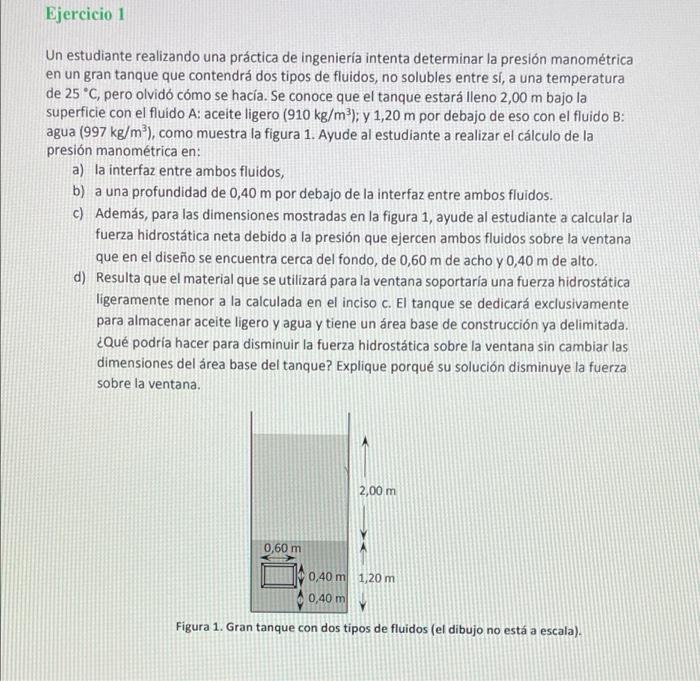
Ejercicio 1 Un estudiante realizando una prctica de ingeniera intenta determinar la presin manomtrica en un gran tanque que contendr dos tipos de fluidos, no solubles entre s, a una temperatura de 25 C, pero olvid cmo se haca. Se conoce que el tanque estar lleno 2,00 m bajo la superficie con el fludo A: aceite ligero (910 kg/m?); y 1,20 m por debajo de eso con el fluido B: agua (997 kg/m), como muestra la figura 1. Ayude al estudiante a realizar el clculo de la presin manomtrica en: a) la interfaz entre ambos fluidos, b) a una profundidad de 0,40 m por debajo de la interfaz entre ambos fluidos. c) Adems, para las dimensiones mostradas en la figura 1, ayude al estudiante a calcular la fuerza hidrosttica neta debido a la presin que ejercen ambos fluidos sobre la ventana que en el diseo se encuentra cerca del fondo, de 0,60 m de acho y 0,40 m de alto. d) Resulta que el material que se utilizar para la ventana soportara una fuerza hidrosttica ligeramente menor a la calculada en el inciso c. El tanque se dedicar exclusivamente para almacenar aceite ligero y agua y tiene un rea base de construccin ya delimitada. Qu podra hacer para disminuir la fuerza hidrosttica sobre la ventana sin cambiar las dimensiones del rea base del tanque? Explique porqu su solucin disminuye la fuerza sobre la ventana. 2,00 m 0,60 m 0,40 m 1,20 m 0 0,40 m Figura 1. Gran tanque con dos tipos de fluidos (el dibujo no est a escala)
Step by Step Solution
There are 3 Steps involved in it

Get step-by-step solutions from verified subject matter experts
 Study Help