







Question: A student in a life science class examines a small lizard for a genetic trait. Previous research suggests that this trait is found in 'I
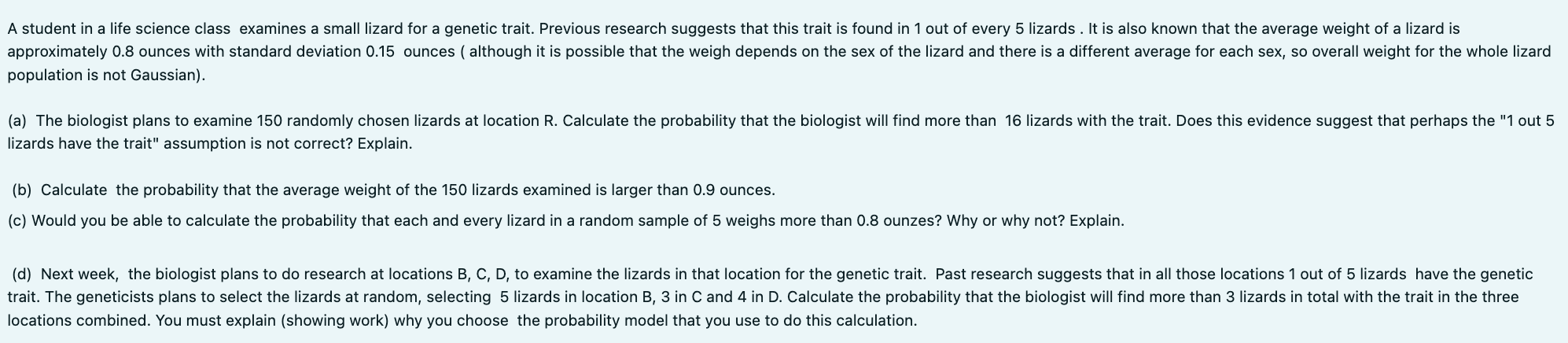
A student in a life science class examines a small lizard for a genetic trait. Previous research suggests that this trait is found in 'I out of every 5 lizards . It is also known that the average weight of a lizard is approximately 0.8 ounces with standard deviation 0,15 ounces (although it is possible that the weigh depends on the sex of the lizard and there is a different average for each sex, so overall weight for the whole lizard population is not Gaussian). (a) The biologist plans to examine 150 randomly chosen lizards at location R. Calculate the probability that the biologist will find more than 16 lizards with the trait. Does this evidence suggest that perhaps the "1 out 5 lizards have the trait" assumption is not correct? Explain. (b) Calculate the probability that the average weight of the 150 lizards examined is larger than 0.9 ounces. (c) Would you be able to calculate the probability that each and every lizard in a random sample of 5 weighs more than 0.8 ounzes? Why or why not? Explain. (d) Next week, the biologist plans to do research at locations B, C, D, to examine the lizards in that location for the genetic trait. Past research suggests that in all those locations 1 out of 5 lizards have the genetic trait. The geneticists plans to select the lizards at random, selecting 5 lizards in location B, 3 in C and 4 in D. Calculate the probability that the biologist will find more than 3 lizards in total with the trait in the three locations combined. You must explain (showing work) why you choose the probability model that you use to do this calculation
Step by Step Solution
There are 3 Steps involved in it

Get step-by-step solutions from verified subject matter experts
 Study Help