Question: A student in the class asked that we all have a discussion about Strategy Highlight 10.2 - Walmart's failed attempt to enter the German marketplace.
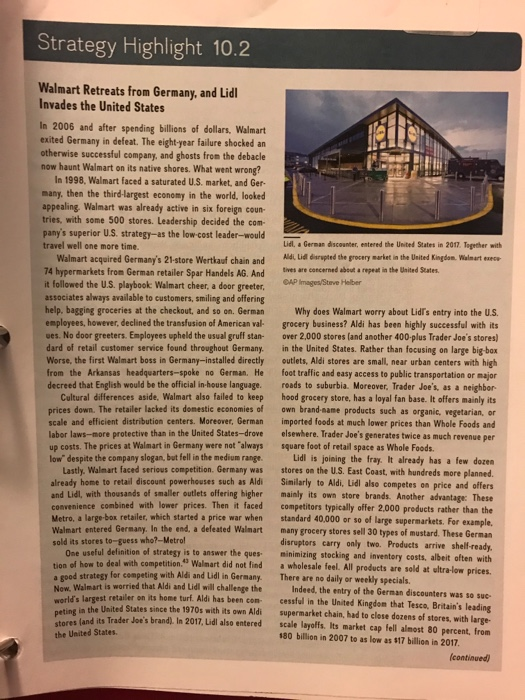
A student in the class asked that we all have a discussion about Strategy Highlight 10.2 - Walmart's failed attempt to enter the German marketplace. Please read the case and answer the following questions: 1. In what ways did Walmart underestimate the impact that cultural elements would have on its success when entering the German market? 2. Are there other components of the CAGE model that Walmart got wrong? Explain your answer even if you say it did everything right. 3. What business level strategy did Walmart think it was pursuing? What strategy did customers see Walmart as pursuing? What led to this disconnect between the two perceptions? Strategy Highlight 10.2 Lidl, a German discounter, entered the United States in 2017. Together with Aldi Lid disrupted the grocery market in the United Kingdom Walmart see tives are concerned about a repeat in the United States. CAP Images/Steve Helber Walmart Retreats from Germany, and Lidl Invades the United States In 2006 and after spending billions of dollars, Walmart exited Germany in defeat. The eight-year failure shocked an otherwise successful company, and ghosts from the debacle now haunt Walmart on its native shores. What went wrong? In 1998, Walmart faced a saturated U.S. market, and Ger- many, then the third-largest economy in the world, looked appealing Walmart was already active in six foreign coun tries, with some 500 stores. Leadership decided the com pany's superior U.S. strategy-as the low-cost leader-would travel well one more time. Walmart acquired Germany's 21-store Wert auf chain and 74 hypermarkets from German retailer Spar Handels AG. And it followed the U.S. playbook Walmart cheer, a door greeter, associates always available to customers, smiling and offering help. bagging groceries at the checkout, and so on. German employees, however, declined the transfusion of American val- wes. No door greeters. Employees upheld the usual gruff stan- dard of retail customer service found throughout Germany. Worse, the first Walmart boss in Germany-installed directly from the Arkansas headquarters-spoke no German. He decreed that English would be the official in-house language Cultural differences aside, Walmart also failed to keep prices down. The retailer lacked its domestic economies of scale and efficient distribution centers. Moreover, German labor laws-more protective than in the United States--drove up costs. The prices at Walmart in Germany were not always low despite the company slogan, but fell in the medium range, Lastly. Walmart faced serious competition. Germany was already home to retail discount powerhouses such as Aldi and Lidl, with thousands of smaller outlets offering higher convenience combined with lower prices. Then it faced Metro, a large-box retailer, which started a price war when Walmart entered Germany. In the end, a defeated Walmart sold its stores to-guess who?-Metrol One useful delinition of strategy is to answer the ques tion of how to deal with competition." Walmart did not find a good strategy for competing with Aldi and Lidl in Germany. Now, Walmart is worried that Aldi and Lidl will challenge the world's largest retailer on its home turf. Aldi has been con peting in the United States since the 1970s with its own Aldi stores and its Trader Joe's brand). In 2017, Lidl also entered Why does Walmart worry about Lidi's entry into the U.S. grocery business? Aldi has been highly successful with its over 2,000 stores and another 400-plus Trader Joe's stores) in the United States. Rather than focusing on large big-box outlets, Aldi stores are small, near urban centers with high foot traffic and easy access to public transportation or major roads to suburbia. Moreover, Trader Joe's, as a neighbor hood grocery store, has a loyal fan base. It offers mainly its own brand name products such as organic, vegetarian, or imported foods at much lower prices than Whole Foods and elsewhere. Trader Joe's generates twice as much revenue per square foot of retail space as Whole Foods. Lidl is joining the fray. It already has a few dozen stores on the U.S. East Coast, with hundreds more planned Similarly to Aldi, Lidl also competes on price and offers mainly its own store brands. Another advantage: These competitors typically offer 2.000 products rather than the standard 40,000 or so of large supermarkets. For example, many grocery stores sell 30 types of mustard. These German disruptors carry only two Products arrive shelf-ready. minimizing stocking and inventory costs, albeit alten with a wholesale feel. All products are sold at ultra-low prices. There are no daily or weekly specials. Indeed, the entry of the German discounters was so sue cessful in the United Kingdom that Tesco, Britain's leading supermarket chain, had to close dozens of stores, with large- scale layoffs. Its market cap fell almost 80 percent from 180 billion in 2007 to as low as 517 billion in 2017 Icontinued the United States









 Study Help