







Question: A study was conducted to determine whether adults with type 2 diabetes who participated in care coordination have more favorable clinical outcomes such as A1c
A study was conducted to determine whether adults with type 2 diabetes who participated in care coordination have more favorable clinical outcomes such as A1c compared to a group of diabetic patients who did not receive care coordination. A1c measures the average levels of blood glucose, an important health indicator for diabetic patients.
The study sample consisted of 89 diabetic patients of whom 47 were assigned to receive care from non-care coordination clinics, and another 42 diabetic patients who received care at care-coordinated practices. The participants' A1c levels were assessed at month 1 (time 1 or T1 when patients were enrolled in one of the two groups and the study began), then at 3 months (T2) and 6 months (T3). The results are presented in the Table below:
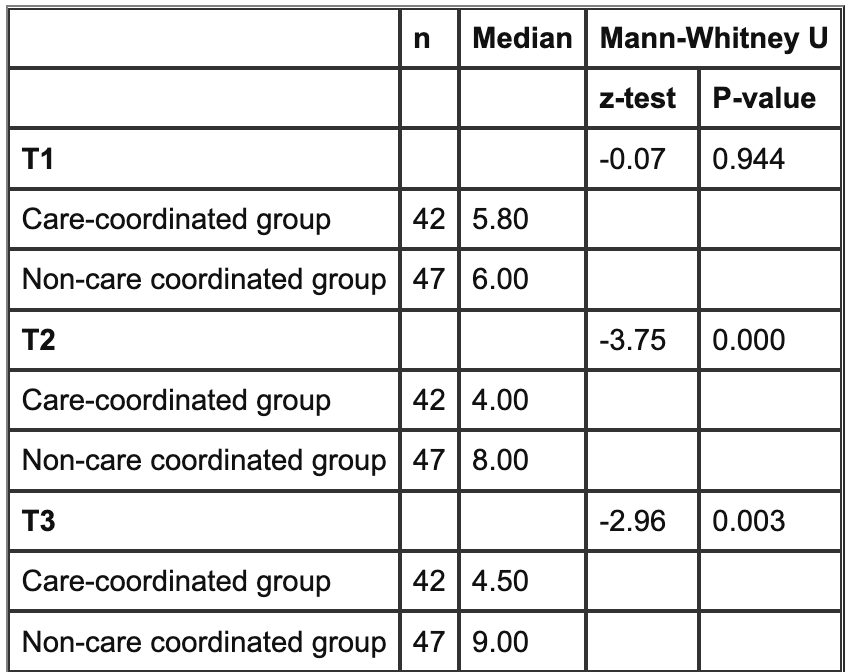
n Median Mann-Whitney U z-test P-value T1 -0.07 0.944 Care-coordinated group 42 5.80 Non-care coordinated group 47 6.00 T2 -3.75 0.000 Care-coordinated group 42 4.00 Non-care coordinated group 47 8.00 T3 -2.96 0.003 Care-coordinated group 42 4.50 Non-care coordinated group 47 9.00
Step by Step Solution
There are 3 Steps involved in it

Get step-by-step solutions from verified subject matter experts
 Study Help