



Question: A study was performed on a method of purifying nuclear fuel waste. The process involves oxidation in molten salt and tends to produce oxygen
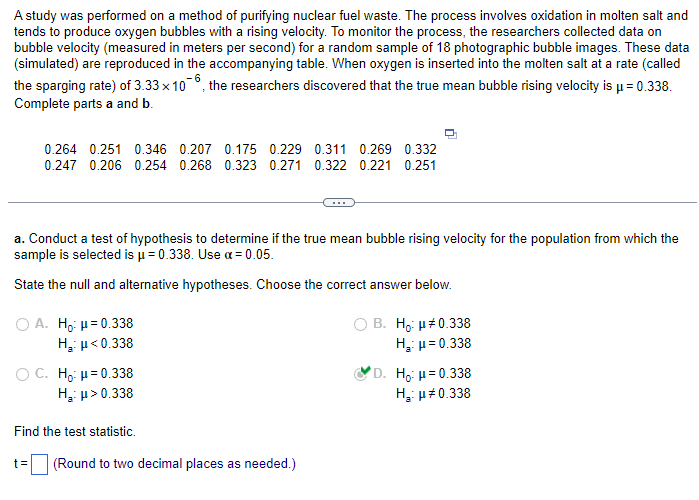
A study was performed on a method of purifying nuclear fuel waste. The process involves oxidation in molten salt and tends to produce oxygen bubbles with a rising velocity. To monitor the process, the researchers collected data on bubble velocity (measured in meters per second) for a random sample of 18 photographic bubble images. These data (simulated) are reproduced in the accompanying table. When oxygen is inserted into the molten salt at a rate (called the sparging rate) of 3.33 x 10⁶, the researchers discovered that the true mean bubble rising velocity is = 0.338. Complete parts a and b. 0.264 0.251 0.346 0.207 0.175 0.229 0.311 0.269 0.332 0.247 0.206 0.254 0.268 0.323 0.271 0.322 0.221 0.251 a. Conduct a test of hypothesis to determine if the true mean bubble rising velocity for the population from which the sample is selected is =0.338. Use = 0.05. State the null and alternative hypotheses. Choose the correct answer below. A. Ho: =0.338 H: 0.338 Find the test statistic. B. Ho U # 0.338 H: =0.338 D. Ho: = 0.338 H: 0.338 t= (Round to two decimal places as needed.)
Step by Step Solution
There are 3 Steps involved in it

Get step-by-step solutions from verified subject matter experts