





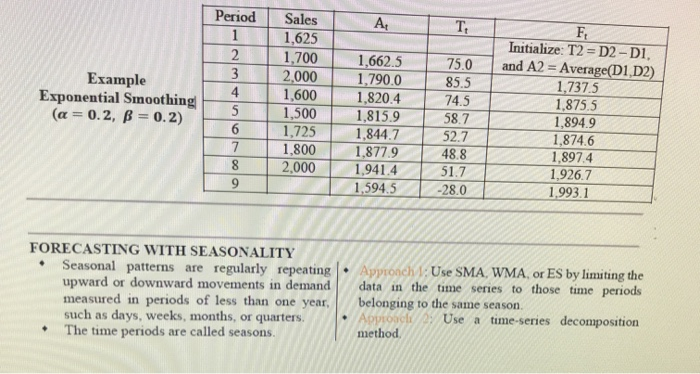
Question: A. T. Example Exponential Smoothing (a=0.2, B = 0.2) Period 1 2 3 4 5 6 7 8 9 Sales 1,625 1,700 2,000 1,600 1,500
A. T. Example Exponential Smoothing (a=0.2, B =
A. T. Example Exponential Smoothing (a=0.2, B = 0.2) Period 1 2 3 4 5 6 7 8 9 Sales 1,625 1,700 2,000 1,600 1,500 1,725 1.800 2.000 1,662.5 1,790.0 1,820.4 1,815.9 1.844.7 1,877.9 1,941.4 1,594.5 75.0 85.5 74.5 58.7 52.7 48.8 51.7 -28.0 F Initialize: T2 =D2 - DI, and A2 = Average(D1,D2) 1,737.5 1,875.5 1,894.9 1,874.6 1,897.4 1.926.7 1.993.1 . FORECASTING WITH SEASONALITY Seasonal patterns are regularly repeating upward or downward movements in demand measured in periods of less than one year, such as days, weeks, months, or quarters. The time periods are called seasons Approch: Use SMA, WMA, or ES by limiting the data in the time series to those time periods belonging to the same season. Approach Use a time-series decomposition method A. T. Example Exponential Smoothing (a=0.2, B = 0.2) Period 1 2 3 4 5 6 7 8 9 Sales 1,625 1,700 2,000 1,600 1,500 1,725 1.800 2.000 1,662.5 1,790.0 1,820.4 1,815.9 1.844.7 1,877.9 1,941.4 1,594.5 75.0 85.5 74.5 58.7 52.7 48.8 51.7 -28.0 F Initialize: T2 =D2 - DI, and A2 = Average(D1,D2) 1,737.5 1,875.5 1,894.9 1,874.6 1,897.4 1.926.7 1.993.1 . FORECASTING WITH SEASONALITY Seasonal patterns are regularly repeating upward or downward movements in demand measured in periods of less than one year, such as days, weeks, months, or quarters. The time periods are called seasons Approch: Use SMA, WMA, or ES by limiting the data in the time series to those time periods belonging to the same season. Approach Use a time-series decomposition method

Step by Step Solution

There are 3 Steps involved in it

1 Expert Approved Answer
Step: 1 Unlock blur-text-image

Question Has Been Solved by an Expert!

Get step-by-step solutions from verified subject matter experts

Step: 2 Unlock
Step: 3 Unlock

Students Have Also Explored These Related General Management Questions!