







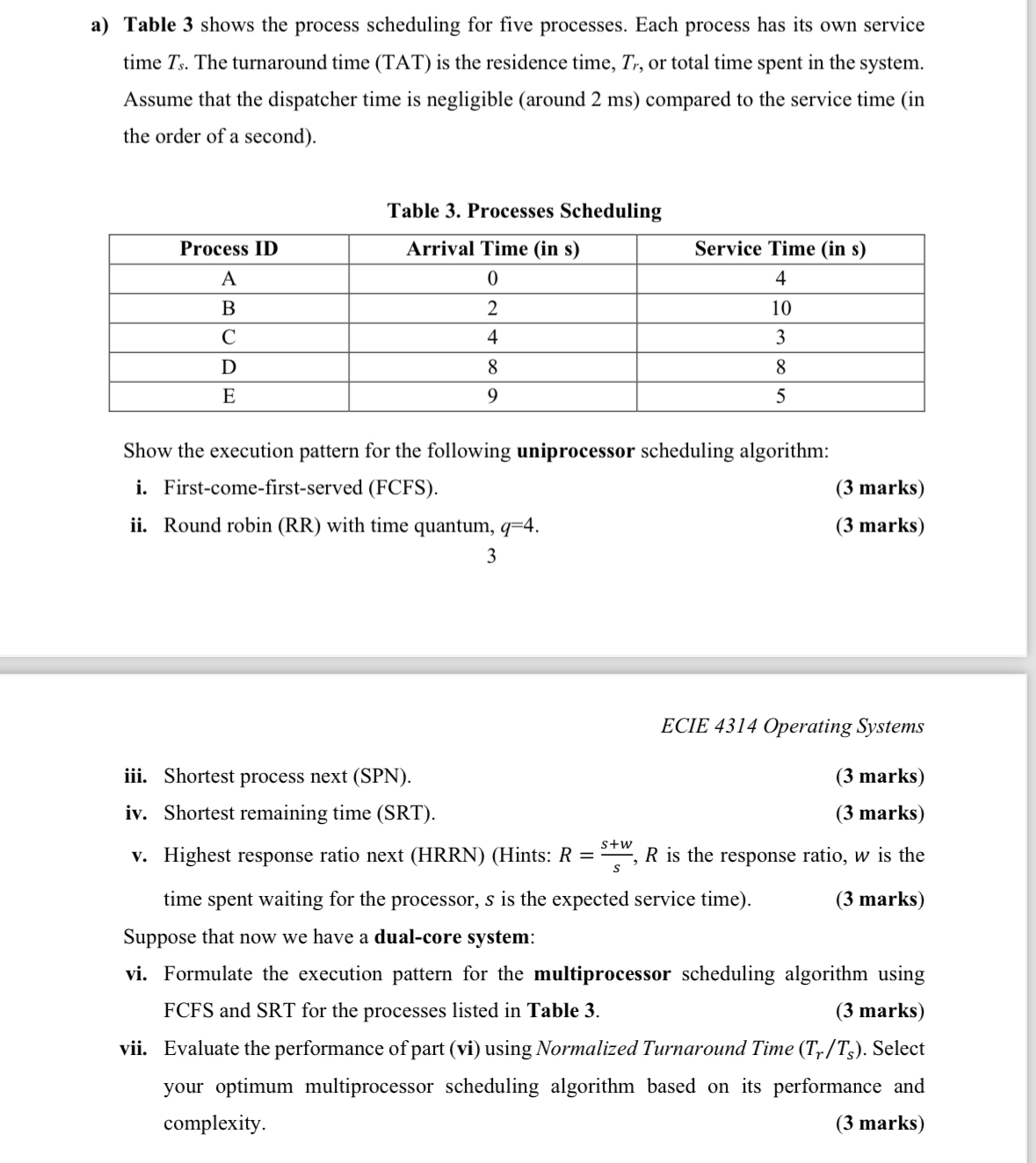
Question: a ) Table 3 shows the process scheduling for five processes. Each process has its own service time T s . The turnaround time (
a Table shows the process scheduling for five processes. Each process has its own service time The turnaround time TAT is the residence time, or total time spent in the system. Assume that the dispatcher time is negligible around ms compared to the service time in the order of a second
Table Processes Scheduling
tableProcess IDArrival Time in sService Time in sABCDE
Show the execution pattern for the following uniprocessor scheduling algorithm:
i Firstcomefirstserved FCFS
marks
ii Round robin with time quantum,
marks
ECIE Operating Systems
iii. Shortest process next SPN
marks
iv Shortest remaining time SRT
marks
v Highest response ratio next HRRNHints: is the response ratio, is the time spent waiting for the processor, is the expected service time
marks
Suppose that now we have a dualcore system:
vi Formulate the execution pattern for the multiprocessor scheduling algorithm using FCFS and SRT for the processes listed in Table
marks
vii. Evaluate the performance of part vi using Normalized Turnaround Time Select your optimum multiprocessor scheduling algorithm based on its performance and complexity.
marks
Step by Step Solution
There are 3 Steps involved in it
1 Expert Approved Answer
Step: 1 Unlock

Question Has Been Solved by an Expert!
Get step-by-step solutions from verified subject matter experts
Step: 2 Unlock
Step: 3 Unlock
 Study Help