



Question: a Testing Hypotheses. In Exercises 13-24, assume that d has been selected and test the given claim. Unless specified by your instructor, use either
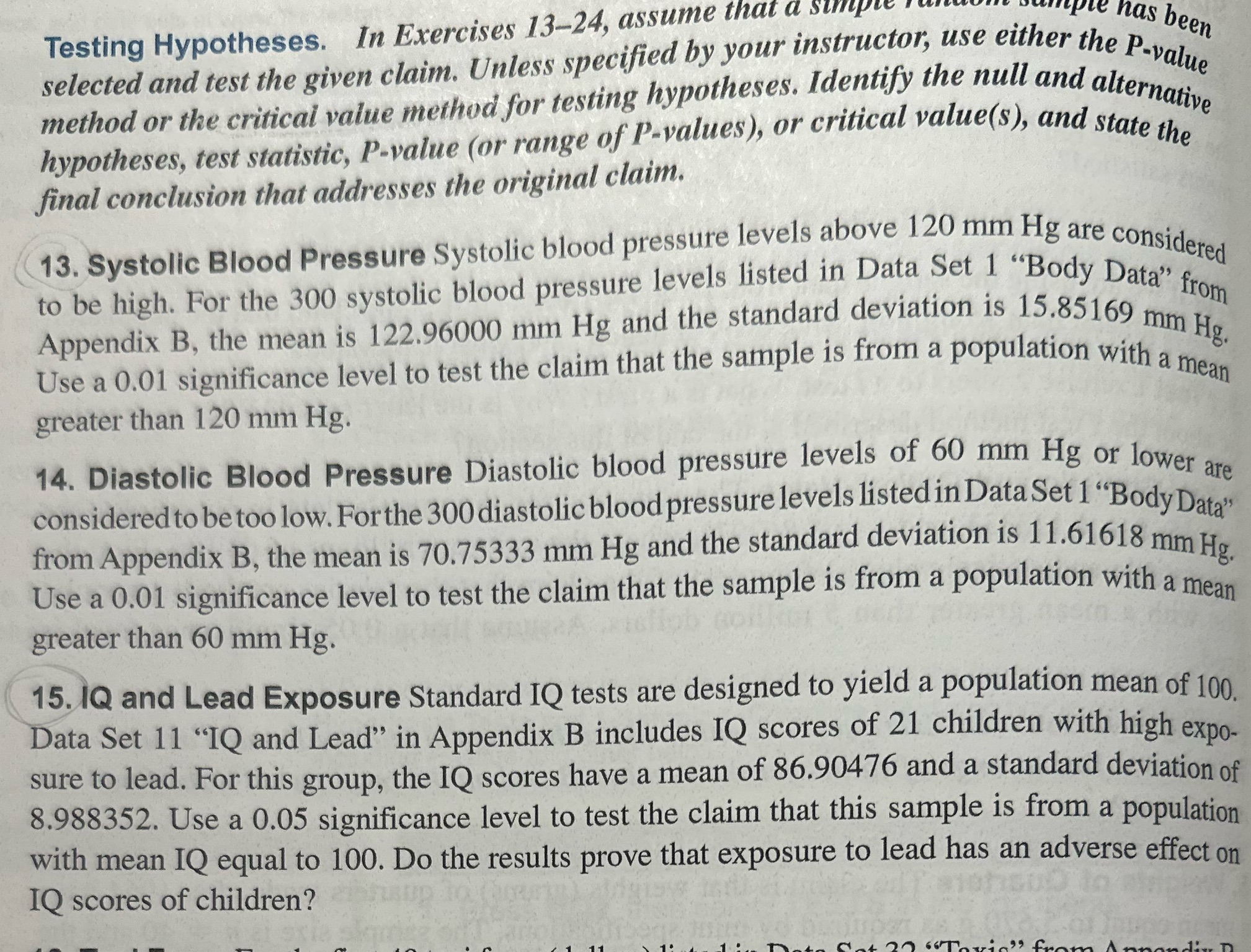
a Testing Hypotheses. In Exercises 13-24, assume that d has been selected and test the given claim. Unless specified by your instructor, use either the P-value method or the critical value method for testing hypotheses. Identify the null and alternative hypotheses, test statistic, P-value (or range of P-values), or critical value(s), and state the final conclusion that addresses the original claim. Hg are considered 13. Systolic Blood Pressure Systolic blood pressure levels above 120 mm Hg are Hg. to be high. For the 300 systolic blood pressure levels listed in Data Set 1 "Body Data" from Appendix B, the mean is 122.96000 mm Hg and the standard deviation is 15.85169 mm Use a 0.01 significance level to test the claim that the sample is from a population with a mean greater than 120 mm Hg. 14. Diastolic Blood Pressure Diastolic blood pressure levels of 60 mm Hg or lower are considered to be too low. For the 300 diastolic blood pressure levels listed in Data Set 1 "Body Data" from Appendix B, the mean is 70.75333 mm Hg and the standard deviation is 11.61618 mm Use a 0.01 significance level to test the claim that the sample is from a population with a mean greater than 60 mm Hg. Hg. 15. IQ and Lead Exposure Standard IQ tests are designed to yield a population mean of 100. Data Set 11 "IQ and Lead" in Appendix B includes IQ scores of 21 children with high expo- sure to lead. For this group, the IQ scores have a mean of 86.90476 and a standard deviation of 8.988352. Use a 0.05 significance level to test the claim that this sample is from a population with mean IQ equal to 100. Do the results prove that exposure to lead has an adverse effect on IQ scores of children?
Step by Step Solution
There are 3 Steps involved in it

Get step-by-step solutions from verified subject matter experts