







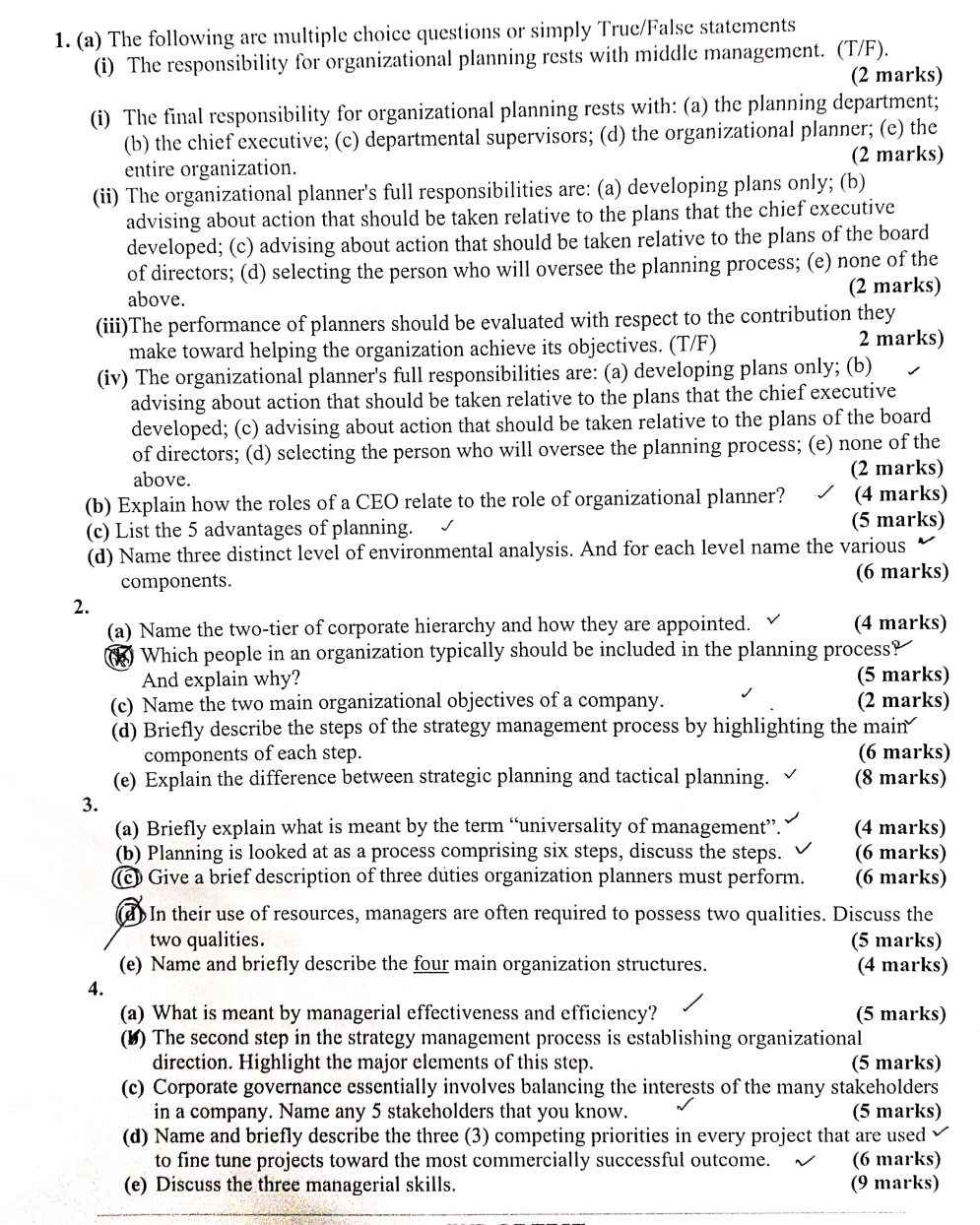
Question: ( a ) The following are multiple choice questions or simply True / False statements ( i ) The responsibility for organizational planning rests with
a The following are multiple choice questions or simply TrueFalse statements
i The responsibility for organizational planning rests with middle management. TF
marks
i The final responsibility for organizational planning rests with: a the planning department; b the chief executive; c departmental supervisors; d the organizational planner; e the entire organization.
marks
ii The organizational planner's full responsibilities are: a developing plans only; b advising about action that should be taken relative to the plans that the chief executive developed; c advising about action that should be taken relative to the plans of the board of directors; d selecting the person who will oversee the planning process; e none of the above.
marks
iiiThe performance of planners should be evaluated with respect to the contribution they make toward helping the organization achieve its objectives. TF
marks
iv The organizational planner's full responsibilities are: a developing plans only; b advising about action that should be taken relative to the plans that the chief executive developed; c advising about action that should be taken relative to the plans of the board of directors; d selecting the person who will oversee the planning process; e none of the above.
marks
b Explain how the roles of a CEO relate to the role of organizational planner? marks
c List the advantages of planning.
marks
d Name three distinct level of environmental analysis. And for each level name the various components.
marks
a Name the twotier of corporate hierarchy and how they are appointed.
marks
Which people in an organization typically should be included in the planning process? And explain why?
marks
c Name the two main organizational objectives of a company.
marks
d Briefly describe the steps of the strategy management process by highlighting the main components of each step.
marks
e Explain the difference between strategic planning and tactical planning. marks
a Briefly explain what is meant by the term "universality of management". marks
b Planning is looked at as a process comprising six steps, discuss the steps. marks
c Give a brief description of three duties organization planners must perform. marks
d In their use of resources, managers are often required to possess two qualities. Discuss the two qualities.
marks
e Name and briefly describe the four main organization structures.
marks
a What is meant by managerial effectiveness and efficiency?
marks
b The second step in the strategy management process is establishing organizational direction. Highlight the major elements of this step.
marks
c Corporate governance essentially involves balancing the interests of the many stakeholders in a company. Name any stakeholders that you know.
marks
d Name and briefly describe the three competing priorities in every project that are used to fine tune projects toward the most commercially successful outcome. marks
e Discuss the three managerial skills.
marks
Step by Step Solution
There are 3 Steps involved in it
1 Expert Approved Answer
Step: 1 Unlock

Question Has Been Solved by an Expert!
Get step-by-step solutions from verified subject matter experts
Step: 2 Unlock
Step: 3 Unlock
 Study Help